
Items related to Building Jerusalem: The Rise And Fall of the Victorian...
Synopsis
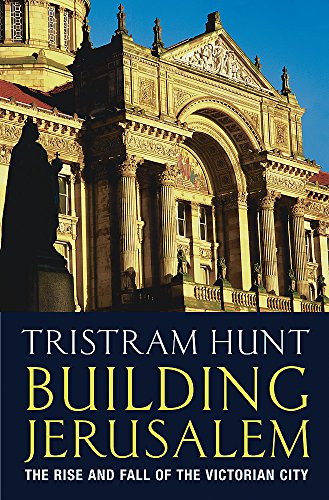
Victorian cities, so long the object of derision as a byword for deprivation, are now celebrated as an urban ideal. They are widely heralded among modern planners and politicians for their active citizenship, local democracy, and civic spirit. This is a history of the ideas that shaped not only London, but Manchester, Glasgow, Liverpool, Leeds, Birmingham, Sheffield and other power-houses of 19th-century Britain. It charts the controversies and visions that fostered Britain s greatest civic renaissance. Tristram Hunt explores the horrors of the Victorian city, as seen by Dickens, Engels and Carlyle; the influence of the medieval Gothic ideal of faith, community and order espoused by Pugin and Ruskin; the reaction led by Macaulay and Mill, who were repelled by the faux medievalism of the early Victorian years and who championed progress and industry; the pride in self-government, identified with the Saxons as opposed to the Normans; the identification with the city republics of the Italian renaissance commerce, trade and patronage; the change from the civic to the municipal, and greater powers over health, education and housing, especially in Joe Chamberlain s Birmingham; and finally at the end of the century, the retreat from the urban to the rural ideal, led by William Morris and the garden-city movement of Ebenezer Howard.
"synopsis" may belong to another edition of this title.
About the Author
Made his name on BBC TV presenting a series about the English Civil War, which led to his first book, THE ENGLISH CIVIL WAR AT FIRST HAND.
Reviews
This fun, if meandering, intellectual history of city-building in Victorian Britain traces the evolution of grim industrialized towns, with their "rat-haunted slums" and "vomiting chimneys," through their heyday as wealthy cultural centers, and beyond. Hunt relates how a newly prosperous middle class, eager to legitimatize its economic power and distance itself from accusations of philistinism, began "manufacturing a new cultural identity," in which architecture and government reflected social and moral values. Using various models—from the buccaneering "municipal gospel" of Joseph Chamberlain to the example of Renaissance Florence, with its traditions of self-government and public design—the Victorians created the Age of Great Cities. No model was wholly successful in combatting the miserable living conditions of the poor, and an "anti-civic" solution—the suburbs—signalled the end of "urbs triumphant." Yet, Hunt argues, aspects of the Victorian framework hold valuable lessons for revivifying contemporary cities.
Copyright © 2006 The New Yorker
"About this title" may belong to another edition of this title.
Search results for Building Jerusalem: The Rise And Fall of the Victorian...

Stock Image
Building Jerusalem : The Rise and Fall of the Victorian City
Published by
Orion Publishing Group, Limited, 2005
ISBN 10: 0297607677
ISBN 13: 9780297607670
Used
Hardcover
Seller: Better World Books, Mishawaka, IN, U.S.A.
Seller rating 5 out of 5 stars

Condition: Good. illustrated edition. Former library copy. Pages intact with minimal writing/highlighting. The binding may be loose and creased. Dust jackets/supplements are not included. Includes library markings. Stock photo provided. Product includes identifying sticker. Better World Books: Buy Books. Do Good. Seller Inventory # GRP16992434
Stock Image
Building Jerusalem: The Rise and Fall of the Victorian City
Seller: AwesomeBooks, Wallingford, United Kingdom
Seller rating 5 out of 5 stars
Hardcover. Condition: Very Good. Building Jerusalem: The Rise and Fall of the Victorian City This book is in very good condition and will be shipped within 24 hours of ordering. The cover may have some limited signs of wear but the pages are clean, intact and the spine remains undamaged. This book has clearly been well maintained and looked after thus far. Money back guarantee if you are not satisfied. See all our books here, order more than 1 book and get discounted shipping. . Seller Inventory # 7719-9780297607670
Buy Used
US$ 5.03
US$ 5.48 shipping
Ships from United Kingdom to U.S.A.
Ships from United Kingdom to U.S.A.
Quantity: 1 available
Seller Image
Building Jerusalem: The Rise And Fall of the Victorian City
Published by
Weidenfeld & Nicolson Ltd, 2005
ISBN 10: 0297607677
ISBN 13: 9780297607670
Used
Hardcover
Seller: MusicMagpie, Stockport, United Kingdom
Seller rating 5 out of 5 stars
Condition: Very Good. 1791382232. 10/7/2026 2:10:32 PM. Seller Inventory # U9780297607670
Buy Used
US$ 5.02
US$ 7.31 shipping
Ships from United Kingdom to U.S.A.
Ships from United Kingdom to U.S.A.
Quantity: 1 available
Stock Image
Building Jerusalem : The Rise and Fall of the Victorian City
Published by
Orion Publishing Group, Limited, 2005
ISBN 10: 0297607677
ISBN 13: 9780297607670
Used
Hardcover
Seller: Better World Books Ltd, Dunfermline, United Kingdom
Seller rating 5 out of 5 stars
Condition: Good. illustrated edition. Former library copy. Pages intact with minimal writing/highlighting. The binding may be loose and creased. Dust jackets/supplements are not included. Includes library markings. Stock photo provided. Product includes identifying sticker. Better World Books: Buy Books. Do Good. Seller Inventory # GRP16992434
Buy Used
US$ 6.22
US$ 6.65 shipping
Ships from United Kingdom to U.S.A.
Ships from United Kingdom to U.S.A.
Quantity: 1 available
Stock Image
Building Jerusalem : The Rise and Fall of the Victorian City
Published by
Orion Publishing Group, Limited, 2005
ISBN 10: 0297607677
ISBN 13: 9780297607670
Used
Hardcover
Seller: Better World Books Ltd, Dunfermline, United Kingdom
Seller rating 5 out of 5 stars
Condition: Very Good. illustrated edition. Former library copy. Pages intact with possible writing/highlighting. Binding strong with minor wear. Dust jackets/supplements may not be included. Includes library markings. Stock photo provided. Product includes identifying sticker. Better World Books: Buy Books. Do Good. Seller Inventory # 7982019-6
Buy Used
US$ 6.22
US$ 6.65 shipping
Ships from United Kingdom to U.S.A.
Ships from United Kingdom to U.S.A.
Quantity: 2 available
Seller Image
Building Jerusalem: The Rise and Fall of the Victorian City
Seller: WeBuyBooks, Rossendale, LANCS, United Kingdom
Seller rating 5 out of 5 stars
hardcover. Condition: Very Good. Most items will be dispatched the same or the next working day. A copy that has been read, but is in excellent condition. Pages are intact and not marred by notes or highlighting. The spine remains undamaged. Seller Inventory # rev8484503542
Buy Used
US$ 2.02
US$ 11.94 shipping
Ships from United Kingdom to U.S.A.
Ships from United Kingdom to U.S.A.
Quantity: 3 available
Seller Image
Building Jerusalem: The Rise and Fall of the Victorian City
Seller: WeBuyBooks, Rossendale, LANCS, United Kingdom
Seller rating 5 out of 5 stars
hardcover. Condition: Like New. Most items will be dispatched the same or the next working day. An apparently unread copy in perfect condition. Dust cover is intact with no nicks or tears. Spine has no signs of creasing. Pages are clean and not marred by notes or folds of any kind. Seller Inventory # rev9690646308
Buy Used
US$ 2.02
US$ 11.94 shipping
Ships from United Kingdom to U.S.A.
Ships from United Kingdom to U.S.A.
Quantity: 1 available
Stock Image
Building Jerusalem: The Rise and Fall of the Victorian City
Seller: Bahamut Media, Reading, United Kingdom
Seller rating 4 out of 5 stars

Hardcover. Condition: Very Good. Shipped within 24 hours from our UK warehouse. Clean, undamaged book with no damage to pages and minimal wear to the cover. Spine still tight, in very good condition. Remember if you are not happy, you are covered by our 100% money back guarantee. Seller Inventory # 6545-9780297607670
Buy Used
US$ 5.03
US$ 9.29 shipping
Ships from United Kingdom to U.S.A.
Ships from United Kingdom to U.S.A.
Quantity: 1 available
Stock Image
Building Jerusalem: The Rise and Fall of the Victorian City
Published by
Weidenfeld & Nicolson Ltd, 2005
ISBN 10: 0297607677
ISBN 13: 9780297607670
Used
Hardcover
Seller: WorldofBooks, Goring-By-Sea, WS, United Kingdom
Seller rating 5 out of 5 stars
Hardback. Condition: Very Good. The book has been read, but is in excellent condition. Pages are intact and not marred by notes or highlighting. The spine remains undamaged. Seller Inventory # GOR001392764
Buy Used
US$ 7.87
US$ 7.45 shipping
Ships from United Kingdom to U.S.A.
Ships from United Kingdom to U.S.A.
Quantity: 4 available
Stock Image
Building Jerusalem: The Rise And Fall of the Victorian City
Published by
Weidenfeld & Nicolson Ltd, United Kingdom, 2004
ISBN 10: 0297607677
ISBN 13: 9780297607670
Used
Hardcover
First Edition
Seller: Price-less Books, Urbana, IL, U.S.A.
Seller rating 4 out of 5 stars
Hb. Condition: VG. Dust Jacket Condition: VG. 1st. 432pp. Extremities book & Dj lightly rubbed. Illus.; notes; biblio.; index. Seller Inventory # 078230