
Items related to The Gladiator: The Secret History of Rome's Warrior...
Synopsis
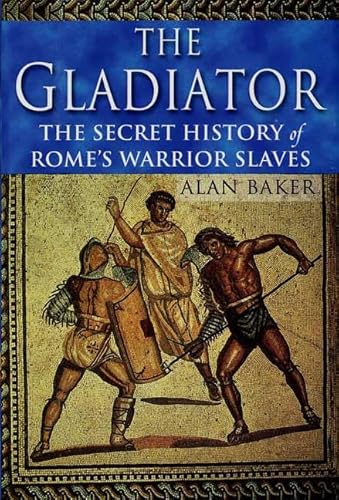
A dramatic, vivid picture of Roman life, Alan Baker's evocative history tells the stories of the extraordinary gladiators, trainers and emperors who participated in history's most violent game.
Condemned and yet feared by Emperors, slaughtered and yet adored by the masses and loved by women, the Gladiator's life was invariably short and violent. His existence was an abyss of bloody darkness illuminated only faintly by the prospect of honor, wealth, public attention and the amorous attentions of adoring women. With fear and danger as his constant companions, his enemy was as likely to be a starved tiger as a fellow battle-hardened human being. Yet men gave up their freedom to become gladiators, noblewomen gave up their positions to elope with them, and Emperors risked death to fight these slaves.
A work of history that reads like fiction, The Gladiator recreates the stories of Spartacus, Commodus, Caligula and others, bringing to life this most extraordinary Empire and the unique players in the gladiatorial arena.
Condemned and yet feared by Emperors, slaughtered and yet adored by the masses and loved by women, the Gladiator's life was invariably short and violent. His existence was an abyss of bloody darkness illuminated only faintly by the prospect of honor, wealth, public attention and the amorous attentions of adoring women. With fear and danger as his constant companions, his enemy was as likely to be a starved tiger as a fellow battle-hardened human being. Yet men gave up their freedom to become gladiators, noblewomen gave up their positions to elope with them, and Emperors risked death to fight these slaves.
A work of history that reads like fiction, The Gladiator recreates the stories of Spartacus, Commodus, Caligula and others, bringing to life this most extraordinary Empire and the unique players in the gladiatorial arena.
"synopsis" may belong to another edition of this title.
About the Author
Alan Baker was born in Birmingham in 1964 and studied English at the University of Reading. This is his fourth book, including Invisible Eagle: The History of Nazi Occultism. He lives in Hove, East Sussex.
Reviews
Adult/High School-Baker states at the very beginning that this book is not intended to be a scholarly study, but rather a history for the layperson. He lives up to this disclaimer. The book begins with a look at the origins of the gladiator games (circa 400 B.C.E.) and ends with why they were abolished 800 years later. In the 150 pages in between, the author covers all aspects of the games: training, equipment, styles of fighting, and types of combat (man versus man, man versus beast, and the grand spectacle of the naval battles). There are chapters on why men became gladiators (some were slaves, others prisoners of wars or common criminals, while others voluntarily participated), the development of the arenas, and even a chapter on the emperors who fought. A culminating chapter called "A Day at the Games" provides readers with a vivid blow-by-blow description-what it was like in the expensive and cheap seats, the opening ceremonies, the scheduling of the events, their staging, and the reactions of the crowds. Baker goes into great detail and the book may not appeal to squeamish readers. It is, however, very well written and the information is thorough enough for student research.
Robert Burnham, R. E. Lee High School, Springfield, VA
Copyright 2002 Cahners Business Information, Inc.
In a lurid, sometimes sensational, tabloid-like account of Roman gladiatorial life, British author Baker (Invisible Eagle: The History of Nazi Occultism) offers an encyclopedic examination. While there were a few famous gladiators, such as Spartacus, the majority of these warriors were unnamed slaves, criminals or prisoners of war whose lives were nasty, brutish and short. Baker points out that there were different groups of gladiators, each with its own style of fighting. The Thracians, for example, used a round shield and sword, while the retiarii (net-men) used a net and trident spear. The games themselves were sponsored by the emperor, whose popularity was often secured by the magnitude of the contests he hosted. Using historical accounts of various games, Baker imaginatively re-creates a day at the Coliseum in Rome, which included a series of fights between criminals one armed, the other defenseless staged in a round robin manner until only one criminal was left standing; the victor was then killed unceremoniously by a Roman guard. The afternoon brought on the great battles between the "trained" gladiators, like the Thracians and the retiarii. The blood and dust from one combat had barely cleared before another began. Although they reflected the virtue of killing and facing death with the courage and dignity that dominated the Roman Empire, gladiatorial contests came to an end in the fifth century, when Christianity became the official state religion and when the empire itself was weakening. Baker builds upon an already established wealth of scholarship e.g., Michael Grant's Gladiators (2000) as he offers a lively, voyeuristic glimpse into the ancient world. Fans of the Ridley Scott movie won't be disappointed.
Copyright 2001 Cahners Business Information, Inc.
Baker doesn't relate much that has been secret about gladiators, but the recent hit movie will surely bring him readers who don't know it, whether secret or not. He pulls together in one compact volume the basic history of Roman gladiatorial combats, from their origins in human sacrifice to their gradual suppression by successive Christian regimes--a period of not much less than 1,000 years--and a good summary of the training and techniques of gladiators. He emphasizes that although gladiators were legally slaves, they had some of the charisma of rock stars, and he discusses the sacrifice of condemned criminals to wild beasts as well as the occasional dabblings of emperors in the arena (Commodus really was a slimy character). Fictionalized portions constitute a minor drawback, while a strong point of the book is the background it furnishes, which makes it useful to readers only minimally acquainted with Roman history. Good choice for popular history collections. Roland Green
Copyright © American Library Association. All rights reserved
Baker (Invisible Eagle: The History of Nazi Occultism) apparently hopes to benefit from the success of Hollywood's blockbuster movie Gladiator with this popular account of Rome's gladiator tradition. His claim that this book is "an attempt to chart the history of the Roman games without succumbing to the anachronism of imposing our own early 21st Century moral attitudes upon them" is, of course, hyperbole, for classical historians are rarely guilty of this historiographical failing. Baker often tells unsubstantiated and irrelevant stories about various emperors in an effort to stimulate the reader. In the chapter titled, "Curio's Swiveling Amphitheater," his muddled theory about the model for the games' venue rests upon a tale of Pliny the Elder that distinguished historian Michael Grant has called spurious. This is a terribly unfocused work, especially the chapter titled "A Day at the Games," which is supposed to give readers an idea of the bloody spectacles by presenting the events in a novelistic manner. Readers who are actually curious about the roots of the games will be far better served by Alison Futrell's Blood in the Arena: The Spectacle of Roman Power (Univ. of Texas, 2001). Not recommended. Clay Williams, Hunter Coll., New York
Copyright 2001 Reed Business Information, Inc.
"About this title" may belong to another edition of this title.
Search results for The Gladiator: The Secret History of Rome's Warrior...

Stock Image
The Gladiator: The Secret History of Rome's Warrior Slaves
Seller: Orion Tech, Kingwood, TX, U.S.A.
Seller rating 5 out of 5 stars

hardcover. Condition: Very Good. Seller Inventory # 0312284039-2-35824453
Stock Image
The Gladiator: The Secret History of Rome's Warrior Slaves
Published by
Thomas Dunne Books (edition First Edition), 2001
ISBN 10: 0312284039
ISBN 13: 9780312284039
Used
Hardcover
First Edition
Seller: BooksRun, Philadelphia, PA, U.S.A.
Seller rating 5 out of 5 stars
Hardcover. Condition: Very Good. First Edition. With dust jacket. It's a well-cared-for item that has seen limited use. The item may show minor signs of wear. All the text is legible, with all pages included. It may have slight markings and/or highlighting. Seller Inventory # 0312284039-11-1-29
Stock Image
The Gladiator : The Secret History of Rome's Warrior Slaves
Published by
St. Martin's Press, 2001
ISBN 10: 0312284039
ISBN 13: 9780312284039
Used
Hardcover
First Edition
Seller: Better World Books, Mishawaka, IN, U.S.A.
Seller rating 5 out of 5 stars
Condition: Good. 1st. Pages intact with minimal writing/highlighting. The binding may be loose and creased. Dust jackets/supplements are not included. Stock photo provided. Product includes identifying sticker. Better World Books: Buy Books. Do Good. Seller Inventory # 4599802-6
Stock Image
The Gladiator : The Secret History of Rome's Warrior Slaves
Published by
St. Martin's Press, 2001
ISBN 10: 0312284039
ISBN 13: 9780312284039
Used
Hardcover
First Edition
Seller: Better World Books, Mishawaka, IN, U.S.A.
Seller rating 5 out of 5 stars
Condition: Very Good. 1st. Former library copy. Pages intact with possible writing/highlighting. Binding strong with minor wear. Dust jackets/supplements may not be included. Includes library markings. Stock photo provided. Product includes identifying sticker. Better World Books: Buy Books. Do Good. Seller Inventory # 11442526-6
Stock Image
The Gladiator : The Secret History of Rome's Warrior Slaves
Published by
St. Martin's Press, 2001
ISBN 10: 0312284039
ISBN 13: 9780312284039
Used
Hardcover
First Edition
Seller: Better World Books, Mishawaka, IN, U.S.A.
Seller rating 5 out of 5 stars
Condition: Good. 1st. Former library copy. Pages intact with minimal writing/highlighting. The binding may be loose and creased. Dust jackets/supplements are not included. Includes library markings. Stock photo provided. Product includes identifying sticker. Better World Books: Buy Books. Do Good. Seller Inventory # 3182184-6
Stock Image
The Gladiator: The Secret History of Rome's Warrior Slaves
Seller: HPB-Red, Dallas, TX, U.S.A.
Seller rating 5 out of 5 stars
hardcover. Condition: Good. Connecting readers with great books since 1972! Used textbooks may not include companion materials such as access codes, etc. May have some wear or writing/highlighting. We ship orders daily and Customer Service is our top priority! Seller Inventory # S_426042768
Stock Image
The Gladiator: The Secret History of Rome's Warrior Slaves
Seller: ThriftBooks-Atlanta, AUSTELL, GA, U.S.A.
Seller rating 5 out of 5 stars
Hardcover. Condition: Very Good. No Jacket. May have limited writing in cover pages. Pages are unmarked. ~ ThriftBooks: Read More, Spend Less. Seller Inventory # G0312284039I4N00
Stock Image
The Gladiator: The Secret History of Rome's Warrior Slaves
Seller: ThriftBooks-Atlanta, AUSTELL, GA, U.S.A.
Seller rating 5 out of 5 stars
Hardcover. Condition: Very Good. No Jacket. Former library book; May have limited writing in cover pages. Pages are unmarked. ~ ThriftBooks: Read More, Spend Less. Seller Inventory # G0312284039I4N10
Stock Image
The Gladiator: The Secret History of Rome's Warrior Slaves.
Seller: Books Revisited, Saint Cloud, MN, U.S.A.
Seller rating 4 out of 5 stars

Hardcover. Condition: Very good. Hardcover in a dust jacket, minor wear, binding tight and pages bright, a very nice copy. Seller Inventory # 293889
Stock Image
The Gladiator: The Secret History of Rome's Warrior Slaves
Seller: HPB-Ruby, Dallas, TX, U.S.A.
Seller rating 5 out of 5 stars
hardcover. Condition: Very Good. Connecting readers with great books since 1972! Used books may not include companion materials, and may have some shelf wear or limited writing. We ship orders daily and Customer Service is our top priority! Seller Inventory # S_485224353