
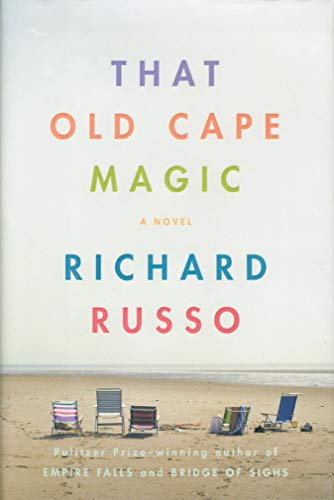
Synopsis
Very near fine in a like dustjacket. SIGNED hardcover first edition - New York:: Alfred A. Knopf,, 2009.. SIGNED hardcover first edition -. Very near fine in a like dustjacket.. First printing. New novel by this Pulitzer prize winning author, the story of one year in a marriage, a year which began and ended with a wedding - the first on Cape Cod, the second in Maine. SIGNED by the author on the title page. 261 pp.
"synopsis" may belong to another edition of this title.
About the Author
Richard Russo lives with his wife in Camden, Maine, and in Boston. In 2002 he was awarded the Pulitzer Prize for Empire Falls.
Reviews
From The Washington Post's Book World/washingtonpost.com Richard Russo has written a novel for people who are terrified of becoming their parents, which is to say for everybody. The misanthropic hero of "That Old Cape Magic" jitters with the anxiety of influence, repelled and attracted to his mom and dad like Woody Allen playing Hamlet. After those sprawling epics of American life "Empire Falls" and "Bridge of Sighs," Russo's new book seems especially intimate, a dyspeptic romantic comedy from a Pulitzer Prize winner who catches the bittersweet humor of our common neuroses. The book's two-part structure is simple and elegant: two weddings, a year apart, the first on Cape Cod, the second in Maine. Russo's focus in both parts is on Jack Griffin, a 57-year-old English professor who's having a "middle-age meltdown." Even while the wedding march plays for members of the younger generation, he's busy fumbling his own 34-year marriage. Griffin loves his wife, but "his dissatisfaction had become palpable." He's bored with teaching, and he hankers after the excitement of his Hollywood writing days. His bigger problem, though, is that he still harbors enough "pathological resentment" toward his parents for a therapists' convention. He's been carting his father's ashes around in the trunk of his car for nine months, waiting for just the right moment to let go of the mortal remains of the man who drove him crazy. And meanwhile, his 85-year-old mother keeps heckling him from her nursing home. It's a sign of Russo's comic genius that these two hilariously acerbic parents -- one on the phone, the other in an urn -- just about steal the show. In their prime, they were frustrated academics who toiled away at second-rate Midwestern colleges, cheated on each other and treated everyone, including their only son, with disdain. Some of the novel's best set pieces describe their disastrous affairs and the shared bitterness that somehow kept them coming back to each other. "They were a single entity," Griffin remarks, "with the same contemptuous mind." American white guys may have no better ally in the world of fiction than Richard Russo. His popular, critically acclaimed novels manage to expose the fragile egos and embarrassing foibles of men while still making them seem essentially lovable. Poor Griffin doesn't want to be a jerk; he just can't help it sometimes -- when the perfect gibe bounces on his tongue like a coin he's got to spend. Although this is a much smaller canvas than Russo has worked on in recent years, what "That Old Cape Magic" lacks in breadth and plot momentum it makes up for with psychological nuance about the ties that bind -- and snap. It's a marvelous portrayal of the strands of affection and irritation that run through a family, entangling in-laws and children's crushes and even old friends. Griffin has concentrated for so long on separating himself from both his wife's parents and his own that he can't see just how thoroughly he's picked up their pet phrases, their pretentious attitudes, even their congenital unhappiness. "You could put a couple thousand miles between yourself and your parents," Griffin says, "and make clear to them that in doing so you mean to reject their values, but how did you distance yourself from your own inheritance?" Like Colson Whitehead's "Sag Harbor" earlier this year, Russo's novel focuses largely on a favorite vacation spot, a place that became hallowed through repeated visits with family. The two novels offer black-and-white versions of a young boy's back-seat excitement as the car passes over the bridge into a special world of freedom. But how reliable are the youthful memories we carry around with us? What monuments of resentment have we built on the shaky foundation of misunderstandings and misimpressions? For Griffin's parents, Cape Cod offered paradise "one glorious month, each summer," but he has the troubling sense that "the perfect spot they were searching for" didn't really exist. And now he's sensing the same restlessness may have infected him, too, leaving him pining for that magical place that will satisfy all his desires. Unfortunately, he realizes, returning to one's youth and escaping one's parents are mutually exclusive fantasies. The shelf of books about middle-aged guys going through midlife crises is long, of course, but Russo threads more comedy through this introspective genre than we get from John Updike, Richard Ford or Chang-rae Lee. He's a master of the comic quip and the ridiculous situation. And as he's shown before, particularly in "Straight Man," one of the funniest college novels ever written, he can be a clown when he wants to. The climactic scene of "That Old Cape Magic" is a no-holds-barred bit of Steve Martin-like wedding slapstick, complete with pratfalls, sucker punches and runaway wheelchairs. "Late middle age," Griffin notes, "was a time of life when everything was predictable and yet somehow you failed to see any of it coming." That's a pretty accurate description of this utterly charming novel. If you always cry at weddings, you'll cry at this -- and laugh, too.
Copyright 2009, The Washington Post. All Rights Reserved.
Set in Cape Cod, California, and Maine rather than upstate New York, That Old Cape Magic is smaller in scope than Russo's previous novels but nonetheless contains Russo's trademark psychological complexity. While reviewers disagreed about the novel's overall success, they concurred that Griffin's quarrelsome, bitter parents—whom Griffin can't seem to shed—steal the show. Another favorite was the story within a story called "The Summer of the Brownings," about Griffin's childhood friendship during a Cape Cod holiday. But critics were generally split on the comic, slapstick set pieces, Griffin's wearying narrative voice, and the story line's predictability. Still, Russo fans will find much to enjoy here—though, hopefully, they will not identify with the familiar souls who blunder their way through life.
Crafting a dense, flashback-filled narrative that stutters across two summer outings to New England (and as many weddings), Russo (Empire Falls) convincingly depicts a life coming apart at the seams, but the effort falls short of the literary magic that earned him a Pulitzer. A professor in his 50s who aches to go back to screenwriting, Jack Griffin struggles to divest himself of his parents. Lugging around, first, his father's, then both his parents' urns in the trunk of his convertible, he hopes to find an appropriate spot to scatter their ashes while juggling family commitments—his daughter's wedding, a separation from his wife. Indeed, his parents—especially his mother, who calls her son incessantly before he starts hearing her from beyond the grave—occupy the narrative like capricious ghosts, and Griffin inherits the worst attributes of both. Though Russo can write gorgeous sentences and some situations are amazingly rendered—Griffin wading into the surf to try to scatter his father's ashes, his wheelchair-bound father-in-law plummeting off a ramp and into a yew—the navel-gazing interior monologues that constitute much of the novel lack the punch of Russo's earlier work. (Aug.)
Copyright © Reed Business Information, a division of Reed Elsevier Inc. All rights reserved.
Excerpt. © Reprinted by permission. All rights reserved.
I
A Finer Place
Though the digital clock on the bedside table in his hotel room read 5:17, Jack Griffin, suddenly wide awake, knew he wouldn’t be able to get back to sleep. He’d allowed himself to drift off too early the night before. On the heels of wakefulness came an unpleasant realization, that what he hadn’t wanted to admit yesterday, even to himself, was now all too clear in the solitary, predawn dark. He should have swallowed his petulance and waited the extra day for Joy.
It had been their long- established habit to flee the campus as soon as Griffin taught his last class. Usually, they hopped on the Freedom Trail (his term for I- 95), drove to New York and treated themselves by checking into a good hotel. During the day he would evaluate his small mountain of student portfolios while Joy shopped or otherwise amused herself, and then, evenings, they’d catch up on movies and go to good restaurants. The whole thing reminded him of the early years of their marriage back in L.A. It cost a small fortune, but there was something about spending money they didn’t really have that made him optimistic about more coming in—which was how it had worked in L.A.—and it got him through the portfolios.
This year Kelsey’s Cape Cod wedding had royally screwed up their plans, making New York impractical, though he’d been willing to substitute Boston. But Joy, assuming that thanks to the wedding all the usual bets were off, had messed things up further by scheduling
meetings on the day after his last class. “Just go,” she said when he expressed his annoyance at the way things were working out. “Have a boys’ night out in Boston and I’ll meet you on the Cape.” He’d squinted at this proposal. Didn’t you need more than one to have a boys’ night out? Or had Joy meant it to be singular, one boy celebrating his boyness? Was that how she’d understood
the phrase all her life, as singular? Joy’s relationship to the English language was not without glitches. She was forever mixing metaphors, claiming that something was “a tough line to hoe.” Row to hoe? Line to walk? Her sisters, Jane and June, were even worse,
and when corrected all three would narrow their eyes dangerously and identically. If they’d had a family motto, it would have been You Know Perfectly Well What I Mean.
In any event his wife’s suggestion that he go on without her had seemed less than sincere, which was why he decided to call her bluff. “All right,” he said, “that’s what I’ll do,” expecting her to say, Fine, if it means that much to you, I’ll reschedule the meetings. But she hadn’t said that, even when she saw him packing his bag, and so he’d discovered a truth that other men probably knew already— that once you’d packed a bag in front of a woman there was no possibility of unpacking, or of not going and taking the damn bag with you.
Worse, Joy, who preferred to watch movies on DVD rather than in a theater, as they were meant to be seen, had given him a list of films he was forbidden to see without her, and of course these were the only ones worth seeing. He’d spent an hour looking through the restaurant guides provided by the hotel, but couldn’t decide on one, or even on what kind of food he wanted. Griffin had no trouble making these sorts of decisions when she was around, but for some reason, when he had only himself to please, he often couldn’t make up his mind. He told himself this was just the result of being married for thirty years, that part of the decision- making process was imagining what his wife would enjoy. Okay, but more and more he found himself stalled, in the middle of whatever room he happened to be standing in, and he realized that this had been, of course, his father’s classic pose. In the end Griffin had ordered room service and watched a crappy made- for- TV movie, the kind he and Tommy, his old partner, had been reduced to writing that last year or two in L.A. before he’d gotten his teaching gig and moved back East with Joy and their daughter, Laura. He’d fallen asleep before the first commercial, confident he could predict not only the movie’s outcome but also half its dialogue.
In order not to dwell on yesterday’s mistakes, he decided to put today in motion by calling down to the bell captain for his car. Twenty minutes later, dressed and showered, he’d checked out of his Back Bay hotel. The whole of Boston fit neatly into the rectangle of his rearview mirror, and by the time the Sagamore Bridge, one of two that spanned the Cape Cod Canal, hove into view, the sky was silver in the east, and he felt the last remnants of yesterday’s prevarications begin to lift like the patchy fog he’d been in and out of since leaving the city. The Sagamore arched dramatically upward in the middle, helping to pull the sun over the horizon, and though the air was far too cool, Griffin pulled off onto the shoulder of the road and put the convertible’s top down, feeling truly off the reservation for the first time since leaving home in Connecticut. There was something vaguely thrilling about not being where his wife thought he was. She liked to know what people were up to, and not just him. She called Laura most mornings, her brain still lazy with sleep, to ask “So . . . what’s on the agenda for you today?” She also phoned both of her sisters several times a week and knew that June was having her hair done tomorrow morning and that Jane had put on five new pounds and was starting a diet. She even knew what new folly her idiot twin brothers, Jared and Jason, were engaged in. To Griffin, an only child, such behavior was well over the line that separated the merely inexplicable from the truly perverse.
Zipping along Route 6, Griffin realized he was humming “That Old Black Magic,” the song his parents had sung ironically—both university English professors, that’s how they did most things— every time they crossed the Sagamore, substituting Cape for black. When he was growing up, they’d spent part of every summer on the Cape. He could always tell what kind of year it had been, moneywise, by when and where they stayed. One particularly prosperous year they’d rented a small house in Chatham for the month of August. Another year, when faculty salaries were frozen, all they could afford was Sandwich in June. His parents had been less wed to each other than to a shared sense of grievance over being exiled eleven months of every year to the “Mid- fucking- west,” a phrase they didn’t say so much as spit. They had good academic careers, though perhaps not the stellar ones that might have been predicted, given their Ivy League pedigree. Both had grown up in the Rust Belt of western New York State, his mother in suburban Rochester, his father in Buffalo, the children of lower- middle- class, white- collar parents. At Cornell, where they’d both gone on scholarship, they’d met not only each other but also the kind of friends who’d invited them home for holidays in Wellesley and Westchester and for summer vacations in the Hamptons or on the Cape. They told their parents they could earn more money there, which was true, but in fact they’d have done anything to avoid returning to their parents’ depressing upstate homes. At Yale, where they did their graduate work, they came to believe they were destined for research positions at one of the other Ivys, at least until the market for academics headed south and they had to take what they could get—the pickings even slimmer for a couple—and that turned out to be a huge state university in Indiana.
Betrayed. That was how they felt. Why go to Cornell, to Yale, if Indiana was your reward? But they’d had little choice but to hunker down and make the best of their wretched timing, so they dove into teaching and research and committee work, hoping to bolster their vitae so that when the academic winds changed they’d be ready. They feared the Princeton and Dartmouth ships had probably sailed for good, but that still left the Swarthmores and Vassars of the world as safe if not terribly exciting havens. This much, at least, was surely their due. And before going up for promotion and tenure (or “promotion and tether,” in their parlance) in the Midfucking-west, they’d each had opportunities—she at Amherst, he at Bowdoin—but never together. So they stayed put in their jobs and their marriage, each terrified, Griffin now suspected, that the other, unshackled, would succeed and escape to the kind of academic post (an endowed chair!) that would complete the misery of the one left behind. To make their unhappy circumstances more tolerable, they had affairs and pretended to be deeply wounded when these came to light. His father had been a genuine serial adulterer, whereas his mother simply refused to lag behind in this or anything else.
Of course all of this was adult understanding. As a boy, the reluctant witness to his parents’ myriad quarrels and recriminations, Griffin had imagined that he must be the one keeping them together. It was his mother who eventually disabused him of this bizarre notion. At his and Joy’s wedding reception, actually. But by then they had finally divorced—even spite, apparently, was not eternal—and she’d narrowly won the race to remarry. In an ecumenical mood, she ventured outside the English department for her second husband, a philosopher named Bart, whom she’d quickly dubbed “Bartleby.” At the reception, half in her cups, she’d assured Griffin, “Good heavens, no, it wasn’t you. What kept us together was ‘That Old Cape Magic.’ Remember how we used to sing it every year on the Sagamore?” She then turned to Bartleby. “One glorious month, each summer...
"About this title" may belong to another edition of this title.
Other Popular Editions of the Same Title

Search results for That Old Cape Magic

Stock Image
That Old Cape Magic
Seller: World of Books (was SecondSale), Montgomery, IL, U.S.A.
Seller rating 5 out of 5 stars

Condition: Good. Item in good condition. Textbooks may not include supplemental items i.e. CDs, access codes etc. Seller Inventory # 00057759629
Seller Image
That Old Cape Magic
Seller: Zoom Books East, Glendale Heights, IL, U.S.A.
Seller rating 5 out of 5 stars
Condition: acceptable. Book is in acceptable condition and shows signs of wear. Book may also include underlining highlighting. The book can also include "From the library of" labels. May not contain miscellaneous items toys, dvds, etc. . We offer 100% money back guarantee and 24 7 customer service. Seller Inventory # ZEV.0375414967.A
Seller Image
That Old Cape Magic
Seller: Used Book Company, Egg Harbor Township, NJ, U.S.A.
Seller rating 3 out of 5 stars

Condition: like_new. Shows very minimal signs of wear and previous use. Can include notes highlighting. A portion of your purchase benefits nonprofits! - Note: Edition & format may differ from what is shown in stock photo & item details. May not include supplementary material such as toys, access code, dvds, etc. Seller Inventory # 584ZST00093D_ns
Seller Image
That Old Cape Magic
Seller: 3Brothers Bookstore, Egg harbor township, NJ, U.S.A.
Seller rating 5 out of 5 stars
Condition: good. Books may contain some notes and highlighting. Supplements such as Access Codes, Cd's Dust Jackets, etc. are not guaranteed with used book purchases. Seller Inventory # EVV.0375414967.G
Seller Image
That Old Cape Magic
Seller: 3Brothers Bookstore, Egg harbor township, NJ, U.S.A.
Seller rating 5 out of 5 stars
Condition: very_good. Cover may have light wear, pages in very good condition and binding is sturdy; may have other light shelf wear or creases. May have notes or highlighting. Seller Inventory # EVV.0375414967.VG
Stock Image
That Old Cape Magic
Seller: More Than Words, Waltham, MA, U.S.A.
Seller rating 5 out of 5 stars
Condition: Good. A sound copy with only light wear. Overall a solid copy at a great price! Seller Inventory # BOS-H-05h-01805
Seller Image
That Old Cape Magic
Seller: MERS Goodwill-Kansas City, Blue Springs, MO, U.S.A.
Seller rating 5 out of 5 stars
Condition: good. The book has been read but is in good condition. It has very minimal damage to the cover, including scuff marks, but no holes or tears. The dust jacket for hard covers may not be included. The binding has minimal wear. The majority of pages are undamaged with minimal creasing or tearing, minimal pencil underlining of text, no highlighting of text, and no writing in the margins. There are no missing pages. See the seller's listing for full details and a description of any imperfections. Seller Inventory # WMEKV.0375414967.G
Stock Image
That Old Cape Magic
Seller: Half Price Books Inc., Dallas, TX, U.S.A.
Seller rating 5 out of 5 stars
Hardcover. Condition: Very Good. Connecting readers with great books since 1972! Used books may not include companion materials, and may have some shelf wear or limited writing. We ship orders daily and Customer Service is our top priority! Seller Inventory # S_457410106
Stock Image
That Old Cape Magic
Seller: HPB-Ruby, Dallas, TX, U.S.A.
Seller rating 5 out of 5 stars
Hardcover. Condition: Very Good. Connecting readers with great books since 1972! Used books may not include companion materials, and may have some shelf wear or limited writing. We ship orders daily and Customer Service is our top priority! Seller Inventory # S_461496065
Stock Image
That Old Cape Magic
Seller: HPB-Emerald, Dallas, TX, U.S.A.
Seller rating 5 out of 5 stars
Hardcover. Condition: Very Good. Connecting readers with great books since 1972! Used books may not include companion materials, and may have some shelf wear or limited writing. We ship orders daily and Customer Service is our top priority! Seller Inventory # S_452354958