
Items related to Trading Twelves: The Selected Letters of Ralph Ellison...
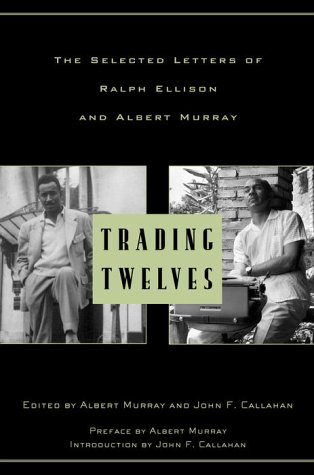
Synopsis
A joyous and important collection of letters between two great American writers and old friends, baring their hearts to each other about life, work, and the American scene.
When two jazz musicians trade twelves with each other in a jam session, one musician begins by riffing off twelve bars of music, the other musician throws the twelve bars back through his instrument, the first answers, and so on, back and forth, in an ecstatic exchange of ideas and emotions. So it is with these letters, joyful music created by the exchanges between two dear friends. Reading these letters, you sense that each man was the other's lifeline, that the emotional and intellectual companionship they found in each other was unique in their lives. They spill it all out here--their struggles, frustrations, ambitions, fears; thoughts on literary gossip, jazz, photography--and the result is literary history, and a book that reminds you what friendship is all about.
"synopsis" may belong to another edition of this title.
About the Author
Ralph Ellison was born in Oklahoma in 1914. He is the author of the novel Invisible Man (1952), as well as numerous essays and short stories. He died in New York City in 1994. Random House published Juneteenth, the book-length excerpt from his unfinished second novel, posthumously in 1999.
Albert Murray was born in Alabama in 1916. A cultural critic, biographer, essayist, and novelist, he has taught at several colleges, including Colgate and Barnard, and his works include The Omni-Americans, South to a Very Old Place, Train Whistle Guitar, The Blue Devils of Nada, and The Seven League Boots. Murray lives in New York City.
John F. Callahan is Morgan S. Odell Professor of Humanities at Lewis and Clark College in Portland, Oregon. He is the editor of Juneteenth and the Modern Library edition of The Collected Essays of Ralph Ellison. Callahan is the literary executor of Ralph Ellison's estate.
From the Inside Flap
important collection of letters between two great American writers and old friends, baring their hearts to each other about life, work, and the American scene.
When two jazz musicians trade twelves with each other in a jam session, one musician begins by riffing off twelve bars of music, the other musician throws the twelve bars back through his instrument, the first answers, and so on, back and forth, in an ecstatic exchange of ideas and emotions. So it is with these letters, joyful music created by the exchanges between two dear friends. Reading these letters, you sense that each man was the other's lifeline, that the emotional and intellectual companionship they found in each other was unique in their lives. They spill it all out here--their struggles, frustrations, ambitions, fears; thoughts on literary gossip, jazz, photography--and the result is literary history, and a book that reminds you what friendship is all about.
Reviews
"I had chosen to re-create the world, but, like a self-doubting god, was uncertain whether I could make the pieces fit smoothly together. Well, its done now and I want to get on to the next one." In this passage from a 1951 letter to his literary colleague and all-around good buddy Albert Murray, Ralph Ellison is referring to his masterpiece Invisible Man; it is both this fly-on-the-wall intimacy, as well as the now-ironic mention of Ellison's "next," never to be completed novel that help to make this book such a pleasure to read. Ellison was an accomplished and dapper upperclassman and Murray a respectful but equally ambitious freshman when they first encountered each other in 1935 at Tuskegee Institute in Alabama. They were not to become close friends until 1947, when Murray was studying for his masters degree in New York City. The letters begin in 1949 and end in 1960, when easy long-distance phone calls brought the need for longhand correspondence (but not their everlasting friendship) to an end. While the 1952 publication of Invisible Man rocketed Ellison to literary stardom, his letters always treat Murray, who taught at Tuskegee and labored on his own unpublished first novel until the 1970s, as his genuine equal, both as a writer and as a cultural thinker. The letters recapitulate their travels around the world (European fellowships for Ellison and cushy postwar Air Force assignments for Murray, who was a colonel in the reserve); their quirky black hipster idiom; Ellison's ambivalence toward Tuskegee and his responses to literary fame, including a brief description of an encounter with William Faulkner at the old Random House offices. There are also funny, thoughtful exchanges on jazz figures, biting comments on literary foes and ample details of the literary and domestic lives of these two gifted and iconoclastic American writers. (June)
Copyright 2000 Reed Business Information, Inc.
In jazz, two musicians are said to be "trading twelves" when they trade feelings and ideas by alternating riffs of 12 bars of music. In much the same manner, Ellison and Murray, in letters written between 1949 and 1960, exchange views on literature and music, among other subjects. The letters shed light on the literary processes of Ellison, whose Invisible Man (1952) remains one of the masterpieces of 20th-century literature, and Murray, the undervalued author of such novels as Train Whistle Guitar (1974), The Spyglass Tree (1991), and The Seven League Boots (1996). However, these letters are important not only for their views on literature and culture but also for their warm and engaging record of a friendship that began when the two men met at Tuskegee in 1935 and endured no matter how vast the geographic distance between them. Brief but insightful prefatory material by Callahan (who edited Ellison's posthumous novel, Juneteenth, LJ 5/1/99) and Murray sets the letters in context. Recommended for all collections of American literature and/or African American culture.DLouis J. Parascandola, Long Island Univ., Brooklyn Campus
Copyright 2000 Reed Business Information, Inc.
Excerpt. © Reprinted by permission. All rights reserved.
PREFACE
by Albert Murray
Ralph Ellison and I became close friends and literary colleagues during the academic year of 1947-1948, while I was in New York earning my master of arts degree in English at New York University, and he was working full-time on the manuscript of the novel that was to become Invisible Man.
I had been aware of him and of his interest in serious fiction since the fall term of 1935-1936, when I was an eager young freshman at Tuskegee Institute in Alabama on a scholarship from the Mobile County Training School, and he was a junior year upperclassman in the School of Music and a leading trumpet player in the famous Tuskegee School Band. I did not meet him during the one term that we overlapped, but I did know that he was there from Oklahoma City on some kind of special scholarship grant; and of all the upperclassmen, he was the one by whom I was most strongly impressed. I liked his very stylish collegiate wardrobe and was struck by the fact that he seemed as serious about supplementing course requirements with further reading as I was. And I also liked the fact that he seemed to do things very much on his own rather than as a member of a group.
The trumpet was his major instrument, but I also came to know that in fact he was enrolled in the School of Music because he wanted to become a composer of concert hall music. I found out later on that he had chosen to come to Tuskegee because its School of Music was directed by William L. Dawson, the conductor of the renowned Tuskegee Institute Choir who had also recently composed a work that received national acclaim as the first Negro folk symphony when it was premiered by Leopold Stokowski conducting the Philadelphia Symphony Orchestra.
What made Ralph an upperclassman of special interest to me, however, was the fact that he seemed more involved with literary matters than any of the upper-class English majors whom I could observe. When you saw him on his way back and forth across the campus he was more likely to be carrying a clutch of library books on history and literature than his trumpet case or a folder of music scores. I remember him doing copy work on sheets of music at a table by himself in the library every now and then, but even so I was more impressed by the fact that his student self-help scholarship supplement job was not in the School of Music but at the circulation counter in the main reading room of the library. Also, in a matter of weeks I became aware of the fact that he was enrolled in a special advanced course in the English novel that included works by Defoe, Richardson, Fielding, Sterne, Jane Austen, the Brontes, and so on to Thomas Hardy, taught by Mr. Morteza Drexel Sprague, head of the English Department, who was also teaching the special section of freshman English 101, 102, and 103 for which my placement test score qualified me.
The only direct face-to-face verbal exchanges I had with Ellison that year consisted of a few polite words we said to each other at the circulation counter when he was on duty and I was checking books out or returning them. There were freshmen that year who lodged in Ralph's memory, mainly because they were musicians, athletes, or irrepressible hotshots of one sort or another, but I was not one of them.
Ralph did not return to complete his senior year and get his degree in music at Tuskegee, but my memory of his sojourn there was kept vivid by the sight of his name on checkout slips of so many of the library books of fiction, poetry, history, and literary criticism that had become the main part of my own personal extracurricular reading program. Some of the books had been checked out by him more than once between 1933 and 1936, and in many instances he was the only previous borrower.
I didn't actually meet Ralph until we were introduced by a mutual friend and Tuskegee graduate and staff member named Louis A. "Mike" Rabb, who was taking a graduate course at Columbia University when I came to New York on my first visit in 1942. I had graduated in 1939 and had returned as a part-time instructor of freshman remedial English in 1940, after taking graduate courses in education at the University of Michigan following a term as principal of a junior high school in southwest Georgia.
I began teaching regular courses in freshman and sophomore English the following year. At the time I did not know that Ellison had given up music as his main interest, but I was aware of the fact that he had published some articles, sketches, and some short fiction, which, given my awareness of his reading interests, did not surprise me. Nor was I really surprised to find that he no longer thought of music as his primary vocation; he now thought of himself as a writer.
But what he and Mike Rabb and I talked about the afternoon that Mike and I went across from the Harlem Y and up the hill to the CCNY area and the apartment on Hamilton Terrace was not books and writing, but mainly about who was doing what at Tuskegee and what Tuskegeans were doing elsewhere. Even so, what I remember most vividly about being there sipping whatever we were sipping as we went on talking was the bookcase on the wall beyond the writing table where Ellison sat. There, along with copies of Andre Malraux's Man's Fate and Man's Hope, I also finally saw copies of Malraux's The Conquerors and The Royal Way, which I had never seen before.
I had read Man's Fate, Man's Hope, and Days of Wrath at Tuskegee and at the time I assumed that he had too. I found later that he hadn't read Man's Fate until he came to New York and was introduced to Langston Hughes, who was carrying a copy which he suggested that Ralph read and return to a friend. Before I left New York I found copies of The Conquerors and The Royal Way at Gotham Book Mart on Forty-seventh Street and began reading The Conquerors on the train back to Tuskegee.
The next time I saw Ralph in New York he was making wartime Atlantic crossings in the Merchant Marine, and I was a second lieutenant in what was then the U.S. Army Air Corps, stationed at the Tuskegee Army Air Field where the "Tuskegee Airmen" were being trained. I hadn't looked him up; I just happened to run into him on Seventh Avenue near 135th Street. I may have mentioned the musette bag of poetry by Auden, Spender, and C. Day Lewis that I had bought in the "We Moderns" section of Gotham Book Mart, but only because I knew he had read a lot of contemporary poetry at Tuskegee. At the time I had no idea that we would become lifelong friends and literary colleagues. For one thing, I thought that he was as involved with Marxism as Richard Wright was and I had spent much of my first year out of college studying and rejecting Marxism. I also assumed that he regarded himself as a refugee from the South, much as Wright did.
As soon as we began to discuss his current project, however, both of these assumptions changed. It was immediately clear that, like me, he had accepted the challenge of William Faulkner's complex literary image of the South, and that he shared other of my enthusiasms as well.
When I happened to run into Ralph again while I was on another trip to New York during the war, I had a very specific literary matter to talk to him about. He had written a short story about a flying cadet at an airfield obviously based on the one where I was stationed. The story was called "Flying Home," as in Lionel Hampton's popular jazz instrumental, and I had read it in Cross Section, a new collection of contemporary writing edited by Edwin Seaver. In this story a student pilot has had to crash-land his plane onto an Alabama plantation after flying into a buzzard. Ellison had made up the incident, but I couldn't wait to tell him that one of our planes actually had flown into an Alabama buzzard not before, but after his story was published. The buzzard that he had concocted at his writing desk in New York had actually come to life! The plane had not crash-landed, because it was a twin-engine medium bomber, rather than a single-engine BT-11 Basic Trainer or AT-6 Advanced Trainer. The impact had caused the vulture to get stuck in the partially split Plexiglas of the pilot/copilot cabin, and when the crew returned to the base the ground level temperature plus that of the plane itself was such that by the time I heard about what had happened and got down to the flight line, the cabin was reeking with barbecued buzzard.
He was delighted by the coincidence of the buzzard in "Flying Home," but he was certainly not amazed, because he then reminded me playfully that "stories endure not only from generation to generation but also from age to age because literary truth amounts to prophecy. Telling is not only a matter of retelling but also of foretelling." So the incident of the buzzard in "Flying Home" was entirely consistent with Ralph's conception of literature. (Incidentally, Ralph was also amused by my account of one of our cadets who could not resist temptation and zonked his AT-6 down to deck level and buzzed an Alabama cotton field at the peak of harvest time, leaving a stalk-brown right-of-way down the middle of all that infinity of post-Confederate whiteness. Some cotton picking black eagle, man!)
It was that Seventh Avenue exchange that turned out to be the prologue to what became our lifelong dialogue about life, literary craft, and American identity, a part of which is collected here. As for the most basic and most comprehensive assumptions underlying that dialogue, given the oversubscription to social science surveys and platitudes that now characterizes so many discussions about American culture in our time, perhaps the source of our orientation may not be as obvious as one might have once hoped. Ellison and I regarded ourselves as being the heirs and continuators of the most indigenous mythic prefiguration of the most fundamental existential assumption underlying the human proposition ...
"About this title" may belong to another edition of this title.
Search results for Trading Twelves: The Selected Letters of Ralph Ellison...

Stock Image
Trading Twelves: The Selected Letters of Ralph Ellison and Albert Murray (Modern Library)
Seller: Wonder Book, Frederick, MD, U.S.A.
Seller rating 5 out of 5 stars

Condition: Very Good. Very Good condition. Acceptable dust jacket. A copy that may have a few cosmetic defects. May also contain light spine creasing or a few markings such as an owner's name, short gifter's inscription or light stamp. Seller Inventory # K16L-01218
Stock Image
Trading Twelves: The Selected Letters of Ralph Ellison and Albert Murray (Modern Library)
Seller: St Vincent de Paul of Lane County, Eugene, OR, U.S.A.
Seller rating 5 out of 5 stars
Condition: Good. FORMER LIBRARY COPY. Former Library book. Hardcover This item shows wear from consistent use but remains in good readable condition. It may have marks on or in it, and may show other signs of previous use or shelf wear. May have minor creases or signs of wear on dust jacket. Packed with care, shipped promptly. Seller Inventory # G-02-4332
Stock Image
Trading Twelves : The Selected Letters of Ralph Ellison and Albert Murray
Published by
Random House, Incorporated, 2000
ISBN 10: 0375503676
ISBN 13: 9780375503672
Used
Hardcover
First Edition
Seller: Better World Books: West, Reno, NV, U.S.A.
Seller rating 5 out of 5 stars
Condition: Very Good. First Edition. Pages intact with possible writing/highlighting. Binding strong with minor wear. Dust jackets/supplements may not be included. Stock photo provided. Product includes identifying sticker. Better World Books: Buy Books. Do Good. Seller Inventory # 3224076-6
Stock Image
Trading Twelves : The Selected Letters of Ralph Ellison and Albert Murray
Published by
Random House, Incorporated, 2000
ISBN 10: 0375503676
ISBN 13: 9780375503672
Used
Hardcover
First Edition
Seller: Better World Books, Mishawaka, IN, U.S.A.
Seller rating 5 out of 5 stars
Condition: Very Good. First Edition. Former library copy. Pages intact with possible writing/highlighting. Binding strong with minor wear. Dust jackets/supplements may not be included. Includes library markings. Stock photo provided. Product includes identifying sticker. Better World Books: Buy Books. Do Good. Seller Inventory # 4866360-75
Stock Image
Trading Twelves: The Selected Letters of Ralph Ellison and Albert Murray (Modern Library)
Seller: Open Books, Chicago, IL, U.S.A.
Seller rating 5 out of 5 stars
Hardcover. Condition: Very Good. Open Books is a nonprofit social venture that provides literacy experiences for thousands of readers each year through inspiring programs and creative capitalization of books. Seller Inventory # mon0000484179
Stock Image
Trading Twelves: The Selected Letters of Ralph Ellison and Albert Murray (Modern Library)
Published by
Modern Library June 2000, 2000
ISBN 10: 0375503676
ISBN 13: 9780375503672
Used
Hardcover
Seller: A Cappella Books, Inc., Atlanta, GA, U.S.A.
Seller rating 5 out of 5 stars
Hardcover. Condition: Very Good. Dust Jacket Condition: Very Good. Seller Inventory # 349266
Stock Image
Trading Twelves; The Selected Letters of Ralph Ellison and Albert Murray
Seller: Daedalus Books, Portland, OR, U.S.A.
Seller rating 4 out of 5 stars

Hardcover. Condition: Near Fine. Dust Jacket Condition: Near Fine. A nice, solid copy.; 5.75 X 1 X 8.5 inches; 237 pages. Seller Inventory # 349574
Stock Image
Trading Twelves: The Selected Letters of Ralph Ellison and Albert Murray
Seller: GoldBooks, Denver, CO, U.S.A.
Seller rating 5 out of 5 stars
Hardcover. Condition: new. New Copy. Customer Service Guaranteed. Seller Inventory # 80E33_26_0375503676
Stock Image
Trading Twelves: The Selected Letters of Ralph Ellison and Albert Murray (Modern Library)
Published by
Modern Library, 2000
ISBN 10: 0375503676
ISBN 13: 9780375503672
Used
Hardcover
First Edition
Seller: J. Mercurio Books, Maps, & Prints IOBA, Garrison, NY, U.S.A.
Seller rating 5 out of 5 stars
Hardcover. Condition: Fine. Dust Jacket Condition: Fine. 1st Edition. DJ in archival cover. with a full number line starting with 1. Seller Inventory # 003262