
Items related to Classical Loop-in-Loop Chains: And Their Derivatives
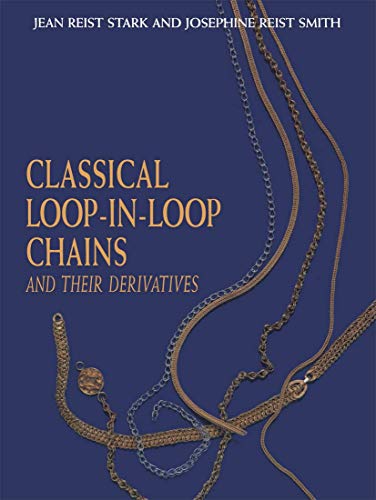
Synopsis
ThiS is not only a book of instruction in chainmaking but it is also a work celebrating man's continuous creativity over thousands of years. At times something that man creates has far-reach ing effects; an example that quickly comes to mind is the wheel, which has enabled many devel opments, from pottery to computers. At this point it is important to note that these same wheels could not have been made without metal tools. From early Neolithic times on gold was a favorite choice in the making of jewelry. During the Neolithic period these "shining stones," probably alluvial, were prized. Actually gold was cold worked as if it were a stone. There is a surviving example of cold-worked gold from Catahuyuk (present day Turkey) estimated to have been made in 6500 B. C. There were only four metals on the earth's surface that were found in sufficient quantity to be used: gold, copper, silver, and meteoric iron. An understanding of the malleability of gold, and of the annealing effect of fire, changed jewelry making; new forms were found. Gold was no longer a piece of stone but a material that could be flattened and made very thin. Sheet and foil are the oldest forms of worked gold. The smiths' tools were stone, wood, and horn.
"synopsis" may belong to another edition of this title.
About the Author
Jean Reist Stark has been a goldsmith and teacher for over 25 years, She was co-founder of the Kulicke-Stark Academy of Jewlry Art in New York City. Josephine Reist Smith is a retired professor of Biological Sciences at Montgomery County College in Pennsylvania.
"About this title" may belong to another edition of this title.
Search results for Classical Loop-in-Loop Chains: And Their Derivatives

Stock Image
Classical Loop-in-Loop Chains: And Their Derivatives
Seller: thebookforest.com, San Rafael, CA, U.S.A.
Seller rating 4 out of 5 stars

Condition: New. Seller Inventory # BAY24-00385
Stock Image
Classical Loop-in-Loop Chains: And Their Derivatives
Published by
Kluwer Academic Publishers, 1997
ISBN 10: 0412078813
ISBN 13: 9780412078811
New
paperback
Seller: BennettBooksLtd, Los Angeles, CA, U.S.A.
Seller rating 5 out of 5 stars

paperback. Condition: New. In shrink wrap. Looks like an interesting title! Seller Inventory # Q-0412078813
Stock Image
Classical Loop-in-Loop Chains: And Their Derivatives
Seller: Chiron Media, Wallingford, United Kingdom
Seller rating 5 out of 5 stars
Paperback. Condition: New. Brand new book, sourced directly from publisher. Dispatch time is 6-7 days from our warehouse. Book will be sent in robust, secure packaging to ensure it reaches you securely. Seller Inventory # 6666-IUK-9780412078811
Buy New
US$ 129.28
US$ 6.60 shipping
Ships from United Kingdom to U.S.A.
Ships from United Kingdom to U.S.A.
Quantity: Over 20 available
Stock Image
Classical Loop-in-Loop Chains: And Their Derivatives
Seller: Ria Christie Collections, Uxbridge, United Kingdom
Seller rating 5 out of 5 stars
Condition: New. In English. Seller Inventory # ria9780412078811_new
Buy New
US$ 145.41
US$ 14.94 shipping
Ships from United Kingdom to U.S.A.
Ships from United Kingdom to U.S.A.
Quantity: Over 20 available
Seller Image
Classical Loop-In-Loop Chains : And Their Derivatives
Seller: GreatBookPrices, Columbia, MD, U.S.A.
Seller rating 5 out of 5 stars
Condition: New. Seller Inventory # 20179171-n
Seller Image
Classical Loop-in-Loop Chains
Published by
Springer, Humana Jan 1997, 1997
ISBN 10: 0412078813
ISBN 13: 9780412078811
New
Taschenbuch
Seller: BuchWeltWeit Ludwig Meier e.K., Bergisch Gladbach, Germany
Seller rating 5 out of 5 stars
Taschenbuch. Condition: Neu. This item is printed on demand - it takes 3-4 days longer - Neuware -ThiS is not only a book of instruction in chainmaking but it is also a work celebrating man's continuous creativity over thousands of years. At times something that man creates has far-reach ing effects; an example that quickly comes to mind is the wheel, which has enabled many devel opments, from pottery to computers. At this point it is important to note that these same wheels could not have been made without metal tools. From early Neolithic times on gold was a favorite choice in the making of jewelry. During the Neolithic period these 'shining stones,' probably alluvial, were prized. Actually gold was cold worked as if it were a stone. There is a surviving example of cold-worked gold from Catahuyuk (present day Turkey) estimated to have been made in 6500 B. C. There were only four metals on the earth's surface that were found in sufficient quantity to be used: gold, copper, silver, and meteoric iron. An understanding of the malleability of gold, and of the annealing effect of fire, changed jewelry making; new forms were found. Gold was no longer a piece of stone but a material that could be flattened and made very thin. Sheet and foil are the oldest forms of worked gold. The smiths' tools were stone, wood, and horn. 212 pp. Englisch. Seller Inventory # 9780412078811
Buy New
US$ 148.04
US$ 25.75 shipping
Ships from Germany to U.S.A.
Ships from Germany to U.S.A.
Quantity: 1 available
Seller Image
Classical Loop-In-Loop Chains : And Their Derivatives
Seller: GreatBookPrices, Columbia, MD, U.S.A.
Seller rating 5 out of 5 stars
Condition: As New. Unread book in perfect condition. Seller Inventory # 20179171
Stock Image
Classical Loop-in-Loop Chains: And Their Derivatives
Published by
Chapman and Hall, 1997
ISBN 10: 0412078813
ISBN 13: 9780412078811
New
Paperback / softback
Seller: THE SAINT BOOKSTORE, Southport, United Kingdom
Seller rating 5 out of 5 stars
Paperback / softback. Condition: New. This item is printed on demand. New copy - Usually dispatched within 5-9 working days. Seller Inventory # C9780412078811
Buy New
US$ 156.67
US$ 21.23 shipping
Ships from United Kingdom to U.S.A.
Ships from United Kingdom to U.S.A.
Quantity: Over 20 available
Seller Image
Classical Loop-in-Loop Chains
Seller: moluna, Greven, Germany
Seller rating 5 out of 5 stars
Condition: New. Seller Inventory # 5914097
Buy New
US$ 126.64
US$ 54.84 shipping
Ships from Germany to U.S.A.
Ships from Germany to U.S.A.
Quantity: Over 20 available
Stock Image
Classical Loop-in-Loop Chains
Seller: Kennys Bookshop and Art Galleries Ltd., Galway, GY, Ireland
Seller rating 5 out of 5 stars
Condition: New. This manual describes and illustrates procedures for making a variety of chains based on ancient loop-in-loop techniques. The illustrations by the author guide the reader, with previous knowledge of the basics of goldsmithing, thorugh the procedures of making these chains without assistance. Num Pages: 208 pages, 438 black & white illustrations. BIC Classification: AFKG. Category: (P) Professional & Scholarly; (XV) Technical / vocational (manuals etc). Dimension: 279 x 210 x 11. Weight in Grams: 533. . 1997. Paperback. . . . . Seller Inventory # V9780412078811
Buy New
US$ 187.27
US$ 10.64 shipping
Ships from Ireland to U.S.A.
Ships from Ireland to U.S.A.
Quantity: 15 available