
Items related to Dear Mr. Darwin: Letters on the Evolution of Life and...
Synopsis
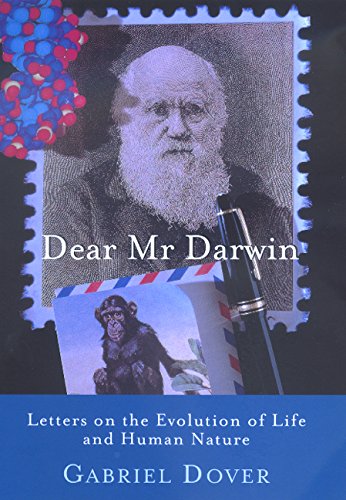
Anyone who has ever wondered what it would be like to talk to Charles Darwin about changes that have taken place in evolutionary biology since his death will be fascinated by this witty and literate blend of science, history, and biography. Stimulated by Darwin's relatively uninformed but obviously intelligent questions, Gabriel Dover takes the father of evolution on an exhilarating roller-coaster ride through the new genetics. The imagined two-way correspondence between Dover and Darwin about the surprising findings of modern genetics and the evolution of biological novelties, from genes to organisms, is both erudite and entertaining. In the process, Dover presents a startlingly original view of development and evolution that puts the individual organism on center stage.
Creating a cultural backdrop that ranges from the poetry of Ted Hughes to the music of Captain Beefheart to the current crisis in the Balkans, Dover debunks the naively deterministic view of selfish genes and their supposed lonely pursuits of self-replication and self-immortalization. He reveals a world of evolution far more intricate and subtle than can be expected from the notion of natural selection acting alone--a world in which genes are born to cooperate.
Creating a cultural backdrop that ranges from the poetry of Ted Hughes to the music of Captain Beefheart to the current crisis in the Balkans, Dover debunks the naively deterministic view of selfish genes and their supposed lonely pursuits of self-replication and self-immortalization. He reveals a world of evolution far more intricate and subtle than can be expected from the notion of natural selection acting alone--a world in which genes are born to cooperate.
"synopsis" may belong to another edition of this title.
About the Author
Gabriel Dover is an internationally recognized authority on the evolution of genes and genomes and is the originator of the molecular drive theory of evolution. He has written more than 150 research papers and edited several books on modern aspects of molecular and developmental evolution. He is currently Professor of Genetics at the University of Leicester.
Reviews
What would happen if a modern biologist could get in touch with Charles Darwin and enter into a lively and stimulating discussion about recent developments in evolutionary theory? Here, we have the answer. Molecular biologist Gabriel Dover uses imaginary correspondence as a literary device for explaining how our ideas about evolution have evolved since Darwin's day.
Dover argues that evolution involves more than just natural selection and cites such phenomena of sampling error as genetic drift. The basic idea behind sampling error is easily recalled. Gene frequencies inevitably fluctuate at random. Some alleles within a population may happen not to be present in any of the zygotes that ultimately become the next generation of adult organisms. This is more apt to happen when the alleles are rare and in small populations. So pure accident may result in the elimination or fixation of an allele. The result is change in gene frequencies, but not adaptation.
According to Darwin's theory of natural selection, adaptation results when one organism has properties that allow it to out-reproduce another of the same species. Dover does not mention another of Darwin's mechanisms -- correlated variability, or pleiotropy. Variation sometimes involves traits that always go together, so that they both increase in frequency even if only one of them is selectively advantageous. Dover's additional mechanisms are something different. Because of the way in which chromosomes behave in the course of reproduction, the genome is constantly being reorganized. Sexual reproduction generates change, and Dover sees in it a cause of evolution (a "molecular drive") that interacts with selection and sampling error.
Although Dover explains all this very well, his real goal is to rebut the metaphysics of Richard Dawkins, an Oxford behaviorist who studied chickens before branching out and writing popular books. Dover laments the influence of Dawkins's reasoning on persons who are not equipped to see through it, especially textbook writers and social scientists. Let me clarify what Dover is complaining about. Dawkins decided to call genes, and other things of which copies are made, "replicators." The problem with that term is that in ordinary English, the suffix "-or" refers to the doer of the action. Thus, a replicator should be that which does the replication, not that which is replicated. (Likewise, a photocopier is not the copy that is produced by the machine.) Dawkins's term is apt to dupe the unwary into thinking that a passive participant is an active agent. This is what Dover has to grapple with: the metaphysics of agency. He makes it abundantly clear that genes are not replicators, in the sense of things that carry out replication. Rather, they are replicated by the cells that contain them. More important, he argues that organisms are active agents in evolution by virtue of their roles in restructuring the genome in producing compatibility among genes, chromosomes, and other components of organisms and species.
This suggests an important role for sex. Dover maintains that molecular drive produces compatibility within reproductive populations. The compatibility within species, together with the lack of it between them, is fundamental to the modern "biological species concept." The point that species are not just abstractions but, rather, higher-level units that play an important part in evolution is very much in line with Dover's antireductionist metaphysics. However true it may be that species and other populations are not likely to have adaptations over and above those of their component organisms, there is no legitimate reason to extrapolate and treat species and organisms as mere epiphenomena of molecules.
Species are important because they are historical units -- things that evolve and give rise to the branches of the phylogenetic tree. Dover is off the mark when he suggests that biology is history, pure and simple, and that we seek in vain for its laws of nature. Rather, biologists have been seeking laws of nature in the wrong place. Although it is true that there are no laws of nature for organisms and species, this is because organisms and species are concrete, particular things, or "individuals" in the broad, metaphysical sense. All laws of nature are about kinds, or things in general, and not about instances of such kinds. In evolutionary biology, laws apply to kinds of populations, such as large populations and small populations. For example, as the effective population size goes down, the frequency with which alleles are fixed by sampling error goes up. This is a perfectly legitimate law of nature: it is necessarily true of everything to which it applies, irrespective of time and place. However, it is a statistical law, since it does not predict which particular version of a gene will be eliminated from the population. The fact that so much of the lawfulness (such as it is) of biology must be conceptualized in such statistical terms gives scant comfort to those who would have us treat human behavior in Laplacian, deterministic style.
One might wonder whether debunking the metaphysical pretensions of one's colleagues is perhaps beneath the dignity of a good scientist like Dover. Isn't it enough to joke about selfish chromosomal deletions and then get on with one's research? The trouble is that selfish genes are becoming part of popular culture. The medical community should brace itself for an onslaught of belief systems, alternative therapies, and nostrums -- all justified on the basis of what purports to be legitimate science.
Michael T. Ghiselin, Ph.D.
Copyright © 2001 Massachusetts Medical Society. All rights reserved. The New England Journal of Medicine is a registered trademark of the MMS.
Excerpt. © Reprinted by permission. All rights reserved.
From the book:
Dear Mr. Darwin,
You might find it presumptuous of me, if not a little macabre, that I should take up my pen and write to you more than a hundred years after your death. But I'm encouraged to do this because it is on record that you yourself wrote almost 14,000 letters on scientific issues, many of which I expect were answers to unsolicited correspondence. . . . I cannot know whether or not, deep in your tomb in Westminster Abbey, you've been keeping abreast since your demise with the ups and downs of your theory of evolution which you called, quite cleverly (and if a little misleadingly as it turned out), natural selection. . . . Despite the gulf that separates us in time and means, I know that this letter will arouse your scientific interests, for it touches on some of the central issues with which you wrestled all your life.
"About this title" may belong to another edition of this title.
Search results for Dear Mr. Darwin: Letters on the Evolution of Life and...

Stock Image
Dear Mr. Darwin: Letters on the Evolution of Life
Published by
University of California Press, 2000
ISBN 10: 0520227905
ISBN 13: 9780520227903
Used
Hardcover
Seller: N. Fagin Books, Chicago, IL, U.S.A.
Seller rating 5 out of 5 stars

2000, Natural History, Evolutionary Theory, University of California Press, 268 p., fine boards and dust jacket. Seller Inventory # -1986402310
Stock Image
Dear Mr. Darwin: Letters on the Evolution of Life and Human Nature
Published by
University of California Press, 2000
ISBN 10: 0520227905
ISBN 13: 9780520227903
Used
Hardcover
Seller: HPB-Red, Dallas, TX, U.S.A.
Seller rating 5 out of 5 stars
hardcover. Condition: Good. Connecting readers with great books since 1972! Used textbooks may not include companion materials such as access codes, etc. May have some wear or writing/highlighting. We ship orders daily and Customer Service is our top priority! Seller Inventory # S_456594458
Stock Image
Dear Mr. Darwin : Letters on the Evolution of Life and Human Nature
Published by
University of California Press, 2000
ISBN 10: 0520227905
ISBN 13: 9780520227903
Used
Hardcover
First Edition
Seller: Better World Books, Mishawaka, IN, U.S.A.
Seller rating 5 out of 5 stars
Condition: Good. First Edition. Former library copy. Pages intact with minimal writing/highlighting. The binding may be loose and creased. Dust jackets/supplements are not included. Includes library markings. Stock photo provided. Product includes identifying sticker. Better World Books: Buy Books. Do Good. Seller Inventory # 9125158-6
Stock Image
Dear Mr. Darwin : Letters on the Evolution of Life and Human Nature
Published by
University of California Press, 2000
ISBN 10: 0520227905
ISBN 13: 9780520227903
Used
Hardcover
First Edition
Seller: Better World Books, Mishawaka, IN, U.S.A.
Seller rating 5 out of 5 stars
Condition: Good. First Edition. Pages intact with minimal writing/highlighting. The binding may be loose and creased. Dust jackets/supplements are not included. Stock photo provided. Product includes identifying sticker. Better World Books: Buy Books. Do Good. Seller Inventory # 8774098-75
Stock Image
Dear Mr. Darwin: Letters on the Evolution of Life and Human Nature
Published by
University of California Press, 2000
ISBN 10: 0520227905
ISBN 13: 9780520227903
Used
Hardcover
Seller: Midtown Scholar Bookstore, Harrisburg, PA, U.S.A.
Seller rating 5 out of 5 stars
Hardcover. Condition: Very Good. With very good dust jacket. Very Good hardcover with light shelfwear - NICE! Standard-sized. Seller Inventory # mon0000082152
Stock Image
Dear Mr. Darwin; Letters on the Evolution of Life and Human Nature
Published by
University of California Press, Berkeley & Los Angeles, 2000
ISBN 10: 0520227905
ISBN 13: 9780520227903
Used
Hardcover
Seller: Jeff Stark, Barstow, CA, U.S.A.
Seller rating 5 out of 5 stars
Hardcover. Condition: Fine. 1st. 1st printing with 1 in copyright line on copyright page. Fine and bright with no wear or markings in a near fine or better dj that is protected in an archival plastic sleeve. Seller Inventory # 045754
Stock Image
Dear Mr Darwin
Published by
University Of California Press, 2000
ISBN 10: 0520227905
ISBN 13: 9780520227903
Used
Hardcover
First Edition
Seller: Terrace Horticultural Books, St. Paul, MN, U.S.A.
Seller rating 4 out of 5 stars

Hardcover. Condition: As New. First Edition. Copyright Date: 2000 Sm Quarto, , PP.268, Letters On The Evolution Of Life And Human Nature. Seller Inventory # 39215D16b
Stock Image
Dear Mr. Darwin Letters on the evolution of Live and Human Nature
Published by
University of California Press, Berkeley, 2000
ISBN 10: 0520227905
ISBN 13: 9780520227903
Used
Hardcover
Seller: Chequamegon Books, Washburn, WI, U.S.A.
Seller rating 5 out of 5 stars
Hardcover. Condition: As New in As New dust jacket. "The imagined two-way correspondence between Dover and Darwin about the surprising findings of modern genetics and the evolution of biological novelties, from genes to organisms, is both erudite and entertaining." 268 pages; 6 1/2 x 9 1/2 ". Seller Inventory # 17099
Seller Image
Dear Mr. Darwin: letters on the evolution of life and human nature.
Published by
Berkeley: University of California Press, 2000., 2000
ISBN 10: 0520227905
ISBN 13: 9780520227903
Used
Hardcover
Seller: Andrew Isles Natural History Books, Prahran, VIC, Australia
Seller rating 5 out of 5 stars
Octavo,268 pp.,text illustrations, dustwrapper. The imagined two-way correspondence between the author, Dover, and Darwin about the surprising findings of modern genetics and the evolution of biological novelties, from genes to organisms, is both erudite and entertaining. In the process, Dover presents a startingly original view of development and evolution that puts the individual organism on center stage. Seller Inventory # 24592
Buy Used
US$ 14.36
US$ 31.00 shipping
Ships from Australia to U.S.A.
Ships from Australia to U.S.A.
Quantity: 1 available