
Items related to The Arcades Project
Synopsis
"To great writers," Walter Benjamin once wrote, "finished works weigh lighter than those fragments on which they labor their entire lives." Conceived in Paris in 1927 and still in progress when Benjamin fled the Occupation in 1940, The Arcades Project (in German, Das Passagen-Werk) is a monumental ruin, meticulously constructed over the course of thirteen years―"the theater," as Benjamin called it, "of all my struggles and all my ideas."
Focusing on the arcades of nineteenth-century Paris-glass-roofed rows of shops that were early centers of consumerism―Benjamin presents a montage of quotations from, and reflections on, hundreds of published sources, arranging them in thirty-six categories with descriptive rubrics such as "Fashion," "Boredom," "Dream City," "Photography," "Catacombs," "Advertising," "Prostitution," "Baudelaire," and "Theory of Progress." His central preoccupation is what he calls the commodification of things―a process in which he locates the decisive shift to the modern age.
The Arcades Project is Benjamin's effort to represent and to critique the bourgeois experience of nineteenth-century history, and, in so doing, to liberate the suppressed "true history" that underlay the ideological mask. In the bustling, cluttered arcades, street and interior merge and historical time is broken up into kaleidoscopic distractions and displays of ephemera. Here, at a distance from what is normally meant by "progress," Benjamin finds the lost time(s) embedded in the spaces of things.
"synopsis" may belong to another edition of this title.
About the Authors
Walter Benjamin (1892–1940) was the author of many works of literary and cultural analysis.
Howard Eiland is an editor and translator of Benjamin’s writings.
Kevin McLaughlin is Assistant Professor of English at Brown University and the author of Writing in Parts: Imitation and Exchange in Nineteenth-Century Literature.
From the Back Cover
Quite simply, the Passagen-Werk is one of the twentieth century's great efforts at historical comprehension-some would say the greatest.-T. J. Clark
Reviews
Because he was Jewish and a Marxist in Nazi Germany, history was against the great literary and cultural critic Walter Benjamin (1892-1940). His writings were left scattered in ephemeral publications, went unpublished or were simply left unfinished when, in 1940, the critic committed suicide because he believed that the Gestapo was about to seize him. In Germany, his works have been compiled and scrupulously edited, and now, at last, American readers too have access to his final, great unfinished work in an edition that is both well translated and helpfully annotated by the editor of the German edition, Rolf Tiedemann. In 1927, Benjamin began taking notes for a book that would critique the cultural, public, artistic and commercial life of Paris, a city Benjamin thought of as the "capital of the nineteenth century." The arcades of the title are the city's glass-covered shopping malls dating from that era. This edition is comprised of the fastidious notes he made for this never-completed study. Essentially, Benjamin was planning to write a prehistory of the 20th century. The lively arcades--colorful scenes of public mixing, modern shopping and quotidian activities of all sorts--figure as a focusing device. His ambition was to integrate a picture including advertising, architecture, department store shopping, fashion, prostitution, city planning, literature, bourgeois luxuries, slums, public transit, photography and much more. His perspective is largely Marxist, but not in any conventional or dogmatic sense. Benjamin's chief virtue is an uncanny originality of vision and insight that transcends the constraints of ideology. (Dec.)
Copyright 1999 Reed Business Information, Inc.
A heavy book, to say the least, from one of the exiting centurys greatest thinkers, Walter Benjamin (Selected Writings, Vol. I: 1913-1926, 1996, etc.). Heavy because of its 960 pages, and heavy because of its standing as Benjamins final, and unfinished, work, this tome will prove a curious blessing for those wearing the right equipment. Begun in 1927 as a planned collaboration for a newspaper article on the arcades of nineteenth-century Paris, the project soon bloomed in Benjamins mind (appearing in different incarnations in his essays and articles), and would continue to bloom until his suicide in 1940. The arcade came to represent, for Benjamin, the architectural idiom for the liberation of 19th-century bourgeois history. This kaleidoscopic work is arranged in 36 categories with such loosely descriptive headings as Prostitution, Boredom, Catacombs, Dream City, and Theory of Progress. It makes sense why Benjamin would refer to this work as the theater of all of my struggles and ideas. Everything seems to be in there, making it at once awe-inspiring and inscrutable in its present form. Had the war not kept it from its final flower, this theater might have been one of the greatest intellectual works of the century. As it stands, it is merely brilliant. -- Copyright ©1999, Kirkus Associates, LP. All rights reserved.
The Arcades Project, which Benjamin worked on for 13 years before his death, was an attempt to capture the reality that he believed underlay the political, economic, and technological world of the 19th and early 20th centuries. In the phenomenon of the Paris arcades, Benjamin saw a turning away from a communal society based on mutual concern to one based on material well-being and economic gain. To fortify his argument, Benjamin used quotations from a variety of published literary, philosophical, and artistic sources and added his own reflections and commentary. Because of Benjamin's untimely and tragic death, this is not a finished work, but, nonetheless, the architectonic of the whole is impressive in its breadth and as an attempt at historical comprehension. Also included is a poignant, beautifully written eyewitness account of Benjamin's last days and hours. The Complete Correspondence 1928-1940 is an excellent accompaniment to The Arcades Project since a considerable portion of the correspondence between Adorno and Benjamin included here concerns the work that Benjamin called "the theater of all my struggles and all my ideas." Originally published in Germany in 1994, the 121 letters included begin in 1928 and allow an intimate look at the two men's personalities, their philosophical thinking, and their attitudes toward the events, persons, and ideologies of the contemporary world. The last letter is from Benjamin, shortly after he was denied entry into Spain in a futile attempt to flee the Nazis and, thus, shortly before his suicide. Recommended for academic collections.
-Leon H. Brody, U.S. Office of Personnel Mgt. Lib., Washington, DC
Copyright 2000 Reed Business Information, Inc.
"About this title" may belong to another edition of this title.
Search results for The Arcades Project

Stock Image
The Arcades Project
Published by
Harvard University Press, 1999
ISBN 10: 067404326X
ISBN 13: 9780674043268
Used
Hardcover
Seller: World of Books (was SecondSale), Montgomery, IL, U.S.A.
Seller rating 5 out of 5 stars

Hardback. Condition: Fair. Focusing on the arcades of 19th-century Paris, the glass-roofed rows of shops, Benjamin presents a montage of quotations from, and reflections on, hundreds of published sources, arranging them in 36 categories with descriptive rubrics such as "Fashion", "Boredom" or "Prostitution". Seller Inventory # 00102108583
Stock Image
The Arcades Project
Published by
The Belknapp Press of Harvard University Press, Cambridge (MA) & London (UK), 1999
ISBN 10: 067404326X
ISBN 13: 9780674043268
Used
Hardcover
First Edition
Seller: Mnemosyne, New Haven, CT, U.S.A.
Seller rating 5 out of 5 stars
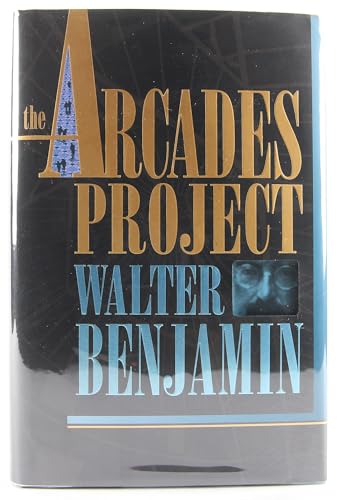
Hardcover. Condition: Fine. Dust Jacket Condition: Very Good. 1st Edition. META-CLASSIC: MONUMENTAL: FINE First Edition hardcover (Orig. 1999) Unstated First Printing, VERY GOOD handsomely-designed unpriced mylar-protected jacket BUT w/ significant (repaired) creasing at top-left front & 1.0" sq. chip missing at top-left front corner, NEW cover w/ library-durable navy-blue fabric wrapping spine & extending 2.36" onto front & back panels covered in slate-blue paper w/ a portrait of Walter Benjamin printed blue-on-blue on front panel, STRIKING "electric-blue" card-stock end-papers, EXCELLENT unblemished smooth-cut text-block exterior, NEW sewn binding w/ tight signatures, PRISTINE interior handsomely printed in Adobe Bethold Baskerville Book & Bodoni on 45-pound Glatfelter Offset Hi-Opaque paper * 6.86" x 10.18" x 2.12", 1.86 kg, xiv+1074 (1098) pp * ABOUT THE BOOK: "To great writers," Walter Benjamin once wrote, "finished works weigh lighter than those fragments on which they labor their entire lives." Conceived in Paris in 1927 & still in progress when Benjamin fled the Occupation in 1940, "The Arcades Project" (in German "Das Passagen-Werk") is a monumental ruin, meticulously constructed over the course of 13 years: "the theater," as Benjamin called it, "of all my struggles & all my ideas." Focusing on the arcades of 19th-century Paris--glass-roofed rows of shops that were early centers of consumerism--Benjamin presents a montage of quotations from, & reflections on, 100s of published sources, arranging them in 36 categories w/ descriptive rubrics such as "Fashion," "Boredom," "Dream City," "Photography," "Catacombs," "Advertising," "Prostitution," "Baudelaire," & "Theory of Progress." His central preoccupation is what he calls the commodification of things--a process in which he locates the decisive shift to the modern age. "The Arcades Project" is Benjamin's effort to represent & to critique the bourgeois experience of 19th-century history, &, in so doing, to liberate the suppressed "true history" that underlay the ideological mask. In the bustling, cluttered arcades, street & interior merge & historical time is broken up into kaleidoscopic distractions & displays of ephemera. Here, at a distance from what is normally meant by "progress," Benjamin finds the lost time(s) embedded in the spaces of things. * HIGHEST PRAISE: "Quite simply, 'The Arcades Project' is one of the 20th-century's greatest efforts of historical comprehension, even in its fragmentary form. And the fragmentary form is in any case not untrue to Benjamin's over-all intentions. The book would surely have remained a palimpsest of quotations, for reasons Benjamin several times explains in his writings: the palimpsest is Benjamin's form, his own eccentric effort at totalization." -T.J. Clark, author of "Farewell to an Idea" * "More than half a century after it was composed, Walter Benjamin's fragmentary 'Arcades Project' still surpasses all other historiographic projects on the 19th-century & its capital, Paris. 'The Arcades Project' remains unequaled in the wealth of perspectives it offers, & no other study has come close to its methodological inventiveness or so exemplarily met its demand that history writing be reinvented for every topic & on every occasion. Benjamin's work is the most advanced, most complex, & most comprehensive study of the dominant motifs of the 19th century--motifs that continue to be critically important for us today." -Werner Hamacher, author of 'Premises' * SHIPPING: MNEMOSYNE carefully wraps, labels & custom-packages this fine book for FREE domestic shipment via USPS MEDIA MAIL or USPS PRIORITY MAIL for a below-cost additional fee & due to its weight to international destinations via postal-regulation-mandated USPS INTERNATIONAL PRIORITY AIRMAIL at nation-by-nation rates available on request. Seller Inventory # 011578
Stock Image
The Arcades Project
Published by
Harvard University Press, 1999
ISBN 10: 067404326X
ISBN 13: 9780674043268
Used
Hardcover
Seller: World of Books Inc, Montgomery, IL, U.S.A.
Seller rating 4 out of 5 stars

Hardback. Condition: Fair. Focusing on the arcades of 19th-century Paris, the glass-roofed rows of shops, Benjamin presents a montage of quotations from, and reflections on, hundreds of published sources, arranging them in 36 categories with descriptive rubrics such as "Fashion", "Boredom" or "Prostitution". Seller Inventory # CIN067404326XA
Stock Image
The Arcades Project
Published by
Harvard University Press, 1999
ISBN 10: 067404326X
ISBN 13: 9780674043268
Used
Hardcover
Seller: Better World Books: West, Reno, NV, U.S.A.
Seller rating 5 out of 5 stars
Condition: Very Good. Pages intact with possible writing/highlighting. Binding strong with minor wear. Dust jackets/supplements may not be included. Stock photo provided. Product includes identifying sticker. Better World Books: Buy Books. Do Good. Seller Inventory # 5760742-75
Stock Image
The Arcades Project
Published by
Harvard University Press, 1999
ISBN 10: 067404326X
ISBN 13: 9780674043268
Used
Hardcover
Seller: Better World Books, Mishawaka, IN, U.S.A.
Seller rating 5 out of 5 stars
Condition: Good. Pages intact with minimal writing/highlighting. The binding may be loose and creased. Dust jackets/supplements are not included. Stock photo provided. Product includes identifying sticker. Better World Books: Buy Books. Do Good. Seller Inventory # GRP95692084
Stock Image
The Arcades Project
Published by
Harvard University Press, 1999
ISBN 10: 067404326X
ISBN 13: 9780674043268
Used
Hardcover
Seller: Better World Books, Mishawaka, IN, U.S.A.
Seller rating 5 out of 5 stars
Condition: Good. Former library copy. Pages intact with minimal writing/highlighting. The binding may be loose and creased. Dust jackets/supplements are not included. Includes library markings. Stock photo provided. Product includes identifying sticker. Better World Books: Buy Books. Do Good. Seller Inventory # GRP15293834
Stock Image
The Arcades Project
Published by
Harvard University Press, 1999
ISBN 10: 067404326X
ISBN 13: 9780674043268
Used
Hardcover
Seller: Black Gull Books (P.B.F.A.), St Leonard's on Sea, United Kingdom
Seller rating 5 out of 5 stars
hardcover. Condition: Very Good. Dust Jacket Condition: very good. Seller Inventory # 18641
Buy Used
US$ 61.27
US$ 17.18 shipping
Ships from United Kingdom to U.S.A.
Ships from United Kingdom to U.S.A.
Quantity: 1 available
Stock Image
The Arcades Project.
Published by
Harvard University Press, 1999
ISBN 10: 067404326X
ISBN 13: 9780674043268
Used
Hardcover
Seller: Anybook.com, Lincoln, United Kingdom
Seller rating 5 out of 5 stars
Condition: Fair. This is an ex-library book and may have the usual library/used-book markings inside.This book has hardback covers. Book contains pencil markings. In fair condition, suitable as a study copy. No dust jacket. Library sticker on front cover. Please note the Image in this listing is a stock photo and may not match the covers of the actual item,1850grams, ISBN:067404326X. Seller Inventory # 4940336
Buy Used
US$ 72.22
US$ 20.12 shipping
Ships from United Kingdom to U.S.A.
Ships from United Kingdom to U.S.A.
Quantity: 1 available
Stock Image
The Arcades Project.
Published by
Harvard University Press, 1999
ISBN 10: 067404326X
ISBN 13: 9780674043268
Used
Hardcover
Seller: Anybook.com, Lincoln, United Kingdom
Seller rating 5 out of 5 stars
Condition: Fair. This is an ex-library book and may have the usual library/used-book markings inside.This book has hardback covers. Book contains pencil markings. In fair condition, suitable as a study copy. No dust jacket. Library sticker on front cover. Please note the Image in this listing is a stock photo and may not match the covers of the actual item,1850grams, ISBN:067404326X. Seller Inventory # 4940338
Buy Used
US$ 72.22
US$ 20.12 shipping
Ships from United Kingdom to U.S.A.
Ships from United Kingdom to U.S.A.
Quantity: 1 available
Stock Image
The Arcades Project
Published by
Belknap - Harvard University Press, Cambridge, Mass., 1999
ISBN 10: 067404326X
ISBN 13: 9780674043268
Used
Hardcover
Seller: The People's Co-op Bookstore, Vancouver, BC, Canada
Seller rating 5 out of 5 stars
Hardcover. Condition: Near Fine. Dust Jacket Condition: Near Fine. 6-11/16"" x 10-1/8", xiv + 1073pp. Printed on alkaline paper and bound in sewn signatures in blue paper covered boards with black cloth backing. Blue end papers. Light edge wear, shelf wear to cover. Binding is square and tight. Pages are clean and bright and unmarked. Seller Inventory # 006304
Buy Used
US$ 108.31
US$ 18.00 shipping
Ships from Canada to U.S.A.
Ships from Canada to U.S.A.
Quantity: 1 available