
Items related to Practices and Principles
Synopsis
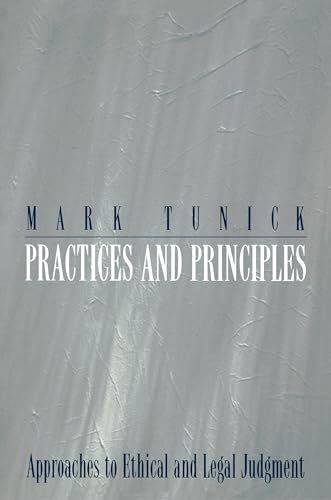
A Japanese woman living in California attempts parent-child suicide, an ancient Japanese custom called "oyako-shinju," in order to rid herself of shame upon learning that her husband has a mistress. She survives, but her two children are drowned in the attempt. Since her attempt was made in accordance with the standards of Japanese culture, should she be tried by the standards and laws of the United States? Are there universally valid moral principles that dictate what is right? Or are moral judgments culturally relative, ultimately dictated by conventions and practices that vary among societies? In Practices and Principles, Mark Tunick takes up the debate between universalists and relativists, and, in political philosophy, between communitarians and liberals, each of which has roots in an earlier debate between Kant and Hegel.
Tunick focuses on three case studies: promises, contract law, and the Fourth Amendment issue of privacy. In his analysis, he rejects both uncritical deference to social practice and draconian adherence to principles when making legal and ethical judgments. He argues that we do not always need to choose between abstract principles and social practices. Sometimes we appeal to both; sometimes we need to appeal to shared social norms; and sometimes, where there is no ethical community, we can appeal only to principles. Ultimately, Tunick rejects simplified arguments that force us to choose between either practices or principles, universalism or relativism, and liberalism or communitarianism.
"synopsis" may belong to another edition of this title.
About the Author
Mark Tunick is Associate Professor of Political Science, The Honors College, at Florida Atlantic University. He is the author of Punishment: Theory and Practice and Hegel's Political Philosophy: Interpreting the Practice of Legal Punishment (Princeton).
"About this title" may belong to another edition of this title.
Search results for Practices and Principles

Stock Image
Practices and Principles
Published by
Princeton University Press, 2001
ISBN 10: 0691070792
ISBN 13: 9780691070797
Used
Paperback
Seller: Powell's Bookstores Chicago, ABAA, Chicago, IL, U.S.A.
Seller rating 5 out of 5 stars

Paperback. Condition: Used-Very Good. Some shelf-wear. Else clean copy. Seller Inventory # 1758606
Seller Image
Practices and Principles
Published by
Princeton University Press, 2001
ISBN 10: 0691070792
ISBN 13: 9780691070797
Used
Softcover
Seller: -OnTimeBooks-, Phoenix, AZ, U.S.A.
Seller rating 5 out of 5 stars
Condition: good. A copy that has been read, remains in good condition. All pages are intact, and the cover is intact. The spine and cover show signs of wear. Pages can include notes and highlighting and show signs of wear, and the copy can include "From the library of" labels or previous owner inscriptions. 100% GUARANTEE! Shipped with delivery confirmation, if you're not satisfied with purchase please return item! Ships via media mail. Seller Inventory # OTV.0691070792.G
Stock Image
Practices and Principles
Published by
Princeton University Press, 2001
ISBN 10: 0691070792
ISBN 13: 9780691070797
New
Paperback
Seller: Academybookshop, Long Island City, NY, U.S.A.
Seller rating 4 out of 5 stars

Paperback. Condition: New. Seller Inventory # A-13177
Seller Image
Practices and Principles : Approaches to Ethical and Legal Judgement
Published by
Princeton University Press, 2001
ISBN 10: 0691070792
ISBN 13: 9780691070797
New
Softcover
Seller: GreatBookPrices, Columbia, MD, U.S.A.
Seller rating 5 out of 5 stars
Condition: New. Seller Inventory # 400572-n
Stock Image
Practices and Principles
Seller: PBShop.store US, Wood Dale, IL, U.S.A.
Seller rating 5 out of 5 stars
PAP. Condition: New. New Book. Shipped from UK. Established seller since 2000. Seller Inventory # WP-9780691070797
Seller Image
Practices and Principles : Approaches to Ethical and Legal Judgement
Published by
Princeton University Press, 2001
ISBN 10: 0691070792
ISBN 13: 9780691070797
Used
Softcover
Seller: GreatBookPrices, Columbia, MD, U.S.A.
Seller rating 5 out of 5 stars
Condition: As New. Unread book in perfect condition. Seller Inventory # 400572
Stock Image
Practices and Principles
Seller: PBShop.store UK, Fairford, GLOS, United Kingdom
Seller rating 5 out of 5 stars
PAP. Condition: New. New Book. Shipped from UK. Established seller since 2000. Seller Inventory # WP-9780691070797
Buy New
US$ 56.89
US$ 5.52 shipping
Ships from United Kingdom to U.S.A.
Ships from United Kingdom to U.S.A.
Quantity: 1 available
Stock Image
Practices and Principles: Approaches to Ethical and Legal Judgment
Published by
Princeton University Press, 2001
ISBN 10: 0691070792
ISBN 13: 9780691070797
New
Softcover
Seller: Kennys Bookshop and Art Galleries Ltd., Galway, GY, Ireland
Seller rating 5 out of 5 stars
Condition: New. 2001. Paperback. . . . . . Seller Inventory # V9780691070797
Buy New
US$ 57.64
US$ 10.65 shipping
Ships from Ireland to U.S.A.
Ships from Ireland to U.S.A.
Quantity: 1 available
Seller Image
Practices and Principles
Published by
Princeton University Press, US, 2000
ISBN 10: 0691070792
ISBN 13: 9780691070797
New
Paperback
Seller: Rarewaves USA, HEBRON, KY, U.S.A.
Seller rating 5 out of 5 stars
Paperback. Condition: New. A Japanese woman living in California attempts parent-child suicide, an ancient Japanese custom called "oyako-shinju," in order to rid herself of shame upon learning that her husband has a mistress. She survives, but her two children are drowned in the attempt. Since her attempt was made in accordance with the standards of Japanese culture, should she be tried by the standards and laws of the United States? Are there universally valid moral principles that dictate what is right? Or are moral judgments culturally relative, ultimately dictated by conventions and practices that vary among societies? In Practices and Principles, Mark Tunick takes up the debate between universalists and relativists, and, in political philosophy, between communitarians and liberals, each of which has roots in an earlier debate between Kant and Hegel. Tunick focuses on three case studies: promises, contract law, and the Fourth Amendment issue of privacy. In his analysis, he rejects both uncritical deference to social practice and draconian adherence to principles when making legal and ethical judgments. He argues that we do not always need to choose between abstract principles and social practices.Sometimes we appeal to both; sometimes we need to appeal to shared social norms; and sometimes, where there is no ethical community, we can appeal only to principles. Ultimately, Tunick rejects simplified arguments that force us to choose between either practices or principles, universalism or relativism, and liberalism or communitarianism. Seller Inventory # LU-9780691070797
Stock Image
Practices and Principles: Approaches to Ethical and Legal Judgment
Published by
Princeton University Press 2000-12-10, 2000
ISBN 10: 0691070792
ISBN 13: 9780691070797
New
Paperback
Seller: Chiron Media, Wallingford, United Kingdom
Seller rating 5 out of 5 stars
Paperback. Condition: New. Brand new book, sourced directly from publisher. Dispatch time is 3-4 days from our warehouse. Book will be sent in robust, secure packaging to ensure it reaches you securely. Seller Inventory # 6666-WLY-9780691070797
Buy New
US$ 63.53
US$ 6.62 shipping
Ships from United Kingdom to U.S.A.
Ships from United Kingdom to U.S.A.
Quantity: 1 available