
Items related to Bringing Back The Dodo: Lessons In Natural And Unnatural...
Synopsis
A penetrating book on the very roots of our relationship with nature.
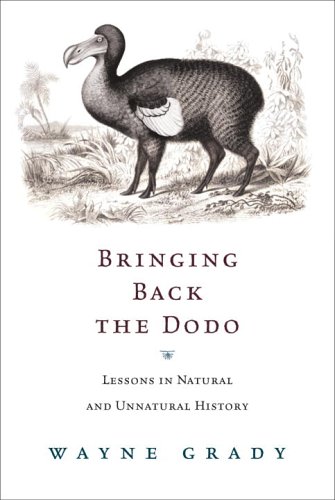
Bringing Back the Dodo is about how the forces of evolution and extinction have shaped the living world, and the part that humans play therein. This strikingly thought-provoking book, in the tradition of John McPhee and David Quammen, explores the very roots of our relationship with nature and challenges us to look at ourselves and the natural world around us in new light.
Wayne Grady searches our history and prehistory to explain why humans love nature and fear it at the same time. He explores the repercussions of our manipulations of nature through science, as exemplified by the Harvard Mouse, and suggests which extinct species we could clone (sadly, probably not the dodo), and whether we ought to try. He looks into the ramifications of getting up on our hind legs to walk, and what it meant to humankind when we lost our nocturnal vision. A visit to the supermarket leads him to uncover our vestigial longing for subtropical foods, and elsewhere he ponders how our instinct for “home” compares to that of other animals.
These elegant and penetrating essays, based on pieces originally published in Explore magazine, linger long in the imagination. They speak to some of our most fundamental questions about the human and animal worlds, and confirm Wayne Grady’s standing as one of our foremost literary science writers.
"synopsis" may belong to another edition of this title.
About the Author
Wayne Grady’s eight books of non-fiction include The Dinosaur Project, The Quiet Limit of the World, Chasing the Chinook, and The Bone Museum. He is also a prolific magazine writer, an equally prolific editor of Canadian travel, fiction, and nature writing, and the translator of many French authors into English, including Antonine Maillet and Herménégilde Chiasson. His most recent book, the bestselling Tree: A Life Story, was written in collaboration with David Suzuki. Wayne Grady lives near Kingston, Ontario.
Excerpt. © Reprinted by permission. All rights reserved.
Generally speaking, in these essays I seem to be constantly alarmed at our tendency to ignore or deny the degree to which we are part of the natural world. I believe it is true that, as J.F. Blumenbach, the nineteenth-century founder of anthropology, first observed, we are “the most perfect of all domesticated species.” Many of these essays are ruminations about what that means. But we have not taken nature out of ourselves — even the most domesticated cat eats, drinks, breathes, hunts, hosts fleas, and reproduces — rather, we have taken ourselves out of nature. To our cost. In many of the essays I try to remind us of the fact that when we destroy a segment of nature — by cutting down a forest to make a road, or killing wild animals for sport, or even ridding ourselves of pests and parasites — we destroy an essential part of ourselves. When we tamper with nature, by altering an organism’s genetic makeup to produce a new plant or animal, or bypass sexual reproduction through cloning or gene splicing, when we remove a species from or add a species to an ecosystem, we are interfering with a process that has evolved on its own, and which has taken us into account, for millions of years, and about which we know next to nothing. It ought to be a sobering thought that, when most of us encounter a bear in the forest, the bear knows more about us than we know about it.
I am not, however, a polemicist by nature. My inclination is simply to point out what we’re doing as a species, place that action in some kind of natural context, and occasionally ask why we persist in doing it. If the voice sometimes sounds plaintive, or incredulous, or impatient, well, that is often the voice of the essayist. An essay is a pearl that began with an irritating grain of sand.
"About this title" may belong to another edition of this title.
Search results for Bringing Back The Dodo: Lessons In Natural And Unnatural...

Stock Image
Bringing Back The Dodo: Lessons In Natural And Unnatural History
Seller: World of Books (was SecondSale), Montgomery, IL, U.S.A.
Seller rating 5 out of 5 stars

Hardback. Condition: Very Good. This is a strikingly thought-provoking book about how the forces of evolution and extinction have shaped the living world, and the part that humans play therein. These elegant and penetrating essays speak to some of our most fundamental questions about the human and animal worlds, and confirm Grady's standing as one of our foremost literary science writers. Seller Inventory # 00101412703
Seller Image
Bringing Back The Dodo: Lessons In Natural And Unnatural History
Seller: Zoom Books Company, Lynden, WA, U.S.A.
Seller rating 5 out of 5 stars
Condition: very_good. Book is in very good condition and may include minimal underlining highlighting. The book can also include "From the library of" labels. May not contain miscellaneous items toys, dvds, etc. . We offer 100% money back guarantee and 24 7 customer service. Seller Inventory # ZBV.0771035047.VG
Seller Image
Bringing Back The Dodo: Lessons In Natural And Unnatural History
Seller: Greenworld Books, Arlington, TX, U.S.A.
Seller rating 5 out of 5 stars
Condition: very_good. Fast Free Shipping â" Very Good condition book with a firm cover and clean pages. Shows normal use and some light wear or limited notes markings. A solid, nice copy to enjoy. Seller Inventory # GWV.0771035047.VG
Stock Image
Bringing Back The Dodo: Lessons In Natural And Unnatural History
Seller: World of Books Inc, Montgomery, IL, U.S.A.
Seller rating 4 out of 5 stars

Hardback. Condition: Very Good. This is a strikingly thought-provoking book about how the forces of evolution and extinction have shaped the living world, and the part that humans play therein. These elegant and penetrating essays speak to some of our most fundamental questions about the human and animal worlds, and confirm Grady's standing as one of our foremost literary science writers. Seller Inventory # CIN0771035047VG
Stock Image
Bringing Back the Dodo : Lessons in Natural and Unnatural History
Seller: Better World Books: West, Reno, NV, U.S.A.
Seller rating 5 out of 5 stars
Condition: Very Good. Pages intact with possible writing/highlighting. Binding strong with minor wear. Dust jackets/supplements may not be included. Stock photo provided. Product includes identifying sticker. Better World Books: Buy Books. Do Good. Seller Inventory # 56062992-6
Stock Image
Bringing Back the Dodo : Lessons in Natural and Unnatural History
Seller: Better World Books, Mishawaka, IN, U.S.A.
Seller rating 5 out of 5 stars
Condition: Very Good. Former library copy. Pages intact with possible writing/highlighting. Binding strong with minor wear. Dust jackets/supplements may not be included. Includes library markings. Stock photo provided. Product includes identifying sticker. Better World Books: Buy Books. Do Good. Seller Inventory # GRP87482914
Stock Image
Bringing Back The Dodo; Lessons In Natural And Unnatural History
Seller: A Good Read, Toronto, ON, Canada
Seller rating 4 out of 5 stars
Hardcover. Condition: Good. Dust Jacket Condition: No Dust Jacket. A Good Read ships from Toronto and Niagara Falls, NY - customers outside of North America please allow two to three weeks for delivery. No dustjacket.; 8.40 X 6 X 0.80 inches; 240 pages. Seller Inventory # 90202
Buy Used
US$ 6.99
US$ 11.00 shipping
Ships from Canada to U.S.A.
Ships from Canada to U.S.A.
Quantity: 1 available
Stock Image
Bringing Back the Dodo: ; Lessons In Natural And Unnatural History
Published by
McClelland & Stewart, 2006
ISBN 10: 0771035047
ISBN 13: 9780771035043
Used
Hardcover
First Edition
Seller: B-Line Books, Amherst, NS, Canada
Seller rating 5 out of 5 stars
Hardcover. Condition: Fine. Dust Jacket Condition: Near Fine. First Edition. Stiff unmarked book in barely rubbed dust jacket.; 8.40 X 6 X 0.80 inches; 240 pages. Seller Inventory # 47908
Buy Used
US$ 13.00
US$ 12.50 shipping
Ships from Canada to U.S.A.
Ships from Canada to U.S.A.
Quantity: 1 available
Stock Image
Bringing Back the Dodo: Lessons in Natural And Unnatural History
Published by
McClelland & Stewart Ltd, Westminster, Maryland, U.S.A., 2006
ISBN 10: 0771035047
ISBN 13: 9780771035043
Used
Hardcover
First Edition
Seller: Quickhatch Books, Ottawa, ON, Canada
Seller rating 5 out of 5 stars
Cloth. Condition: Very Good. Dust Jacket Condition: Very Good. First. 234pp., very light wear. Size: 8vo - over 7¾" - 9¾" tall. Book. Seller Inventory # 007153
Buy Used
US$ 15.00
US$ 14.00 shipping
Ships from Canada to U.S.A.
Ships from Canada to U.S.A.
Quantity: 1 available
Stock Image
Bringing Back the Dodo
Seller: The Next Page, Calgary, AB, Canada
Seller rating 3 out of 5 stars

Hardcover. Condition: Very Good. Seller Inventory # 978077103504C
Buy Used
US$ 18.38
US$ 18.00 shipping
Ships from Canada to U.S.A.
Ships from Canada to U.S.A.
Quantity: 1 available