
Items related to Too Safe for Their Own Good: How Risk and Responsibility...
Synopsis
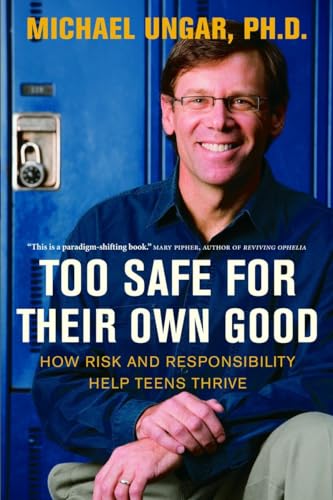
Canadian children are safer now than at any other time in history. So why are we so fearful for them? When they’re young, we drive them to playdates, fill up their time with organized activity, and cocoon them from every imaginable peril. We think we are doing what’s best for them. But as they grow into young adults and we continue to manage their lives, running interference with teachers and coaches, we are, in fact, unwittingly stunting them.
Internationally respected social worker and family therapist Michael Ungar tells us why our mania to keep our kids safe is causing us to do the opposite: put them in harm’s way. By continuing to protect them from failure and disappointment, many of our kids are missing out on the “risk-taker’s advantage,” the benefits that come from experiencing manageable amounts of danger. In Too Safe for Their Own Good, Ungar inspires parents to recall their own childhoods and the lessons they learned from being risk-takers and responsibility-seekers, much to the annoyance of their own parents. He offers the support parents need in setting appropriate limits and provides concrete suggestions for allowing children the opportunity to experience the rites of passage that will help them become competent, happy, thriving adults.
In many communities, we are failing miserably doing much more than keeping our children vacuum-safe. They are not getting the experiences they need to grow up well. An entire generation of children from middle class homes, in downtown row houses, apartment blocks, and copycat suburbs, whose good fortune it is to have sidewalks and neighbourhood watch programs, crossing guards, and playground monitors, are not being provided with the opportunities they need to learn how to navigate their way through life’s challenges. We don’t intend any harm. Quite the contrary. In our mania to provide emotional life jackets around our kids, helmets and seatbelts, approved playground equipment, after-school supervision, an endless stream of evening programming, and no place to hang out but the tiled flooring of our local mall, we parents are accidentally creating a generation of youth who are not ready for life. Our children are too safe for their own good.
—From Too Safe for Their Own Good
"synopsis" may belong to another edition of this title.
About the Author
Michael Ungar is an internationally recognized expert on resilience in at-risk youth and leads the International Resilience Project that includes researchers in eleven countries. He teaches at the School of Social Work at Dalhousie University and runs a private practice specializing in working with children and adults in mental health and correctional settings. He has lectured extensively on the subject of resilience and is the author of four books and dozens of professional and scholarly articles. Michael Ungar lives in Halifax with his wife and two children.
Excerpt. © Reprinted by permission. All rights reserved.
I’m a social worker, family therapist, and teacher. My work has given me the opportunity to visit with troubled children all over the world: children who throw stones in Palestinian refugee camps and unsupervised teens on Israeli kibbutzim, children who dodge gunfire to go to school in Colombia’s poorest mountainside communities, and those who live as student paramilitaries in remote parts of India, teenaged mothers living in the cinderblock slums of rural Tanzania, glue-sniffing children on native reserves in Canada’s Far North, and bored disenfranchised youth existing in monochrome suburbs across the United States, Canada, and Europe. In many ways, these children are not all that different from one another. They are all at risk of being harmed or harming others, living desperate lives that force them to find creative ways to survive. And survive they do. The world over, young people tell me the same thing: they will do whatever they need to do to convince themselves they are competent, capable contributors to their communities. They are all, in one way or another, steadfastly committed to making their lives better.
For these children growing up amid real danger, our task is simple. We need to give them safer homes, safer streets, immunizations, connections with adults who won’t abuse them, and most of all, hope.
However, for many other more fortunate children, I’ve become concerned that we are offering them too much safety. Odd as that may sound, there is a connection between all the security we offer children and why our kids behave violently, do drugs, and take risks with their bodies, minds, and spirits.
What’s going on? Why would a child with everything choose the life of the delinquent, the bully, the runaway, the street kid, or the drug addict? Why would a child with everything insist on taking on responsibility that parents know is beyond her years? Why would a young person insist on being sexually active, or demand the right to work after school, threatening the grades he might get if he focused more on his studies? This book presents some unconventional wisdom to answer these questions, wisdom that comes from the kids themselves. They tell me that, whether growing up with lots of advantages or few, they crave adventure and responsibility. Both necessarily come with a sizable amount of risk. And both are often in short supply in families and communities dead set on keeping their children too safe for their own good.
Don’t get me wrong. I am as concerned as anyone about our young people growing up and drifting into problem behaviours. But I’m worried that we may, out of our deep and committed love for our children, be overdoing it. It’s not that our commitment to raising healthy children is the problem. It is simply that we are going about keeping our children safe in a way that is inadvertently putting them at much greater risk of serious harm.
SO WHAT’S SO GOOD ABOUT RISK-TAKING?
But how much of a good thing is too much? While we are keeping kids safe, have we also paid enough attention to some of the good things that risk-taking brings us while growing up? Can you remember a time when putting yourself in harm’s way was a rite of passage you craved? I remember those large steel playground wheels I used to love to jump on and spin around on at high speeds when I was a kid. Emboldened by the adrenalin rush of centrifugal force, my friends and I wouldn’t stop until our stomachs heaved. My city council recently voted to remove them from my children’s playground.
I’m becoming anxious that we’ve gone too far in removing “risky” activities from our children’s lives.
After all, once we’ve taken away all the dangerous things for our kids to do under our watchful gaze, where will they turn to find their thrills? We mustn’t forget to offer them other opportunities to experience moments of growth and exhilaration.
This book explores how to find a balance between keeping our children out of harm’s way while still offering them what they need to experience the thrills that are part of growing up.
"About this title" may belong to another edition of this title.
Search results for Too Safe for Their Own Good: How Risk and Responsibility...

Stock Image
Too Safe for Their Own Good: How Risk and Responsibility Help Teens Thrive
Published by
McClelland & Stewart Inc., 2007
ISBN 10: 077108708X
ISBN 13: 9780771087080
Used
Paperback
Seller: World of Books (was SecondSale), Montgomery, IL, U.S.A.
Seller rating 5 out of 5 stars

Paperback. Condition: Good. Canadian children are safer now than at any other time in history. So why are we so fearful for them? When they're young, we drive them to playdates, fill up their time with organized activity, and cocoon them from every imaginable peril. We think we are doing what's best for them. But as they grow into young adults and we continue to manage their lives, running interference with teachers and coaches, we are, in fact, unwittingly stunting them. Internationally respected social worker and family therapist Michael Ungar tells us why our mania to keep our kids safe is causing us to do the opposite: put them in harm's way. By continuing to protect them from failure and disappointment, many of our kids are missing out on the risk-taker's advantage, the benefits that come from experiencing manageable amounts of danger. In Too Safe for Their Own Good, Ungar inspires parents to recall their own childhoods and the lessons they learned from being risk-takers and responsibility-seekers, much to the annoyance of their own parents. He offers the support parents need in setting appropriate limits and provides concrete suggestions for allowing children the opportunity to experience the rites of passage that will help them become competent, happy, thriving adults. In many communities, we are failing miserably doing much more than keeping our children vacuum-safe. They are not getting the experiences they need to grow up well. An entire generation of children from middle class homes, in downtown row houses, apartment blocks, and copycat suburbs, whose good fortune it is to have sidewalks and neighbourhood watch programs, crossing guards, and playground monitors, are not being provided with the opportunities they need to learn how to navigate their way through life's challenges. We don't intend any harm. Quite the contrary. In our mania to provide emotional life jackets around our kids, helmets and seatbelts, approved playground equipment, after-school supervision, an endless stream of evening programming, and no place to hang out but the tiled flooring of our local mall, we parents are accidentally creating a generation of youth who are not ready for life. Our children are too safe for their own good.--From Too Safe for Their Own Good. Seller Inventory # 00095175664
Stock Image
Too Safe for Their Own Good: How Risk and Responsibility Help Teens Thrive
Seller: ThriftBooks-Dallas, Dallas, TX, U.S.A.
Seller rating 5 out of 5 stars
Paperback. Condition: Very Good. No Jacket. May have limited writing in cover pages. Pages are unmarked. ~ ThriftBooks: Read More, Spend Less. Seller Inventory # G077108708XI4N00
Stock Image
Too Safe for Their Own Good : How Risk and Responsibility Help Teens Thrive
Seller: Better World Books, Mishawaka, IN, U.S.A.
Seller rating 5 out of 5 stars
Condition: Very Good. Former library copy. Pages intact with possible writing/highlighting. Binding strong with minor wear. Dust jackets/supplements may not be included. Includes library markings. Stock photo provided. Product includes identifying sticker. Better World Books: Buy Books. Do Good. Seller Inventory # 12307757-6
Stock Image
Too Safe for Their Own Good : How Risk and Responsibility Help Teens Thrive
Seller: Better World Books, Mishawaka, IN, U.S.A.
Seller rating 5 out of 5 stars
Condition: Good. Pages intact with minimal writing/highlighting. The binding may be loose and creased. Dust jackets/supplements are not included. Stock photo provided. Product includes identifying sticker. Better World Books: Buy Books. Do Good. Seller Inventory # 869088-6
Stock Image
Too Safe for Their Own Good: How Risk and Responsibility Help Teens Thrive
Published by
McClelland & Stewart Inc., 2007
ISBN 10: 077108708X
ISBN 13: 9780771087080
Used
Paperback
Seller: World of Books Inc, Montgomery, IL, U.S.A.
Seller rating 4 out of 5 stars

Paperback. Condition: Good. Canadian children are safer now than at any other time in history. So why are we so fearful for them? When they're young, we drive them to playdates, fill up their time with organized activity, and cocoon them from every imaginable peril. We think we are doing what's best for them. But as they grow into young adults and we continue to manage their lives, running interference with teachers and coaches, we are, in fact, unwittingly stunting them. Internationally respected social worker and family therapist Michael Ungar tells us why our mania to keep our kids safe is causing us to do the opposite: put them in harm's way. By continuing to protect them from failure and disappointment, many of our kids are missing out on the risk-taker's advantage, the benefits that come from experiencing manageable amounts of danger. In Too Safe for Their Own Good, Ungar inspires parents to recall their own childhoods and the lessons they learned from being risk-takers and responsibility-seekers, much to the annoyance of their own parents. He offers the support parents need in setting appropriate limits and provides concrete suggestions for allowing children the opportunity to experience the rites of passage that will help them become competent, happy, thriving adults. In many communities, we are failing miserably doing much more than keeping our children vacuum-safe. They are not getting the experiences they need to grow up well. An entire generation of children from middle class homes, in downtown row houses, apartment blocks, and copycat suburbs, whose good fortune it is to have sidewalks and neighbourhood watch programs, crossing guards, and playground monitors, are not being provided with the opportunities they need to learn how to navigate their way through life's challenges. We don't intend any harm. Quite the contrary. In our mania to provide emotional life jackets around our kids, helmets and seatbelts, approved playground equipment, after-school supervision, an endless stream of evening programming, and no place to hang out but the tiled flooring of our local mall, we parents are accidentally creating a generation of youth who are not ready for life. Our children are too safe for their own good.--From Too Safe for Their Own Good. Seller Inventory # CIN077108708XG
Seller Image
Too Safe for Their Own Good
Published by
McClelland & Stewart, Toronto, 2007
ISBN 10: 077108708X
ISBN 13: 9780771087080
Used
Trade Paperback
Seller: Gene The Book Peddler, Winchester, NH, U.S.A.
Seller rating 5 out of 5 stars
Trade Paperback. Condition: Very Good. No Jacket. First Edition/First Printing. first edition/first printing book is tight with no markings, page edges have some soiling, corners have some curling and creasing, wraps have minor rubbing. Seller Inventory # 016254
Stock Image
Too Safe for Their Own Good How Risk and Responsibility Help Teens Thrive
Published by
McClelland & Stewart Ltd, 2007
ISBN 10: 077108708X
ISBN 13: 9780771087080
Used
Soft cover
First Edition
Seller: Samuel S Lin, Etobicoke, ON, Canada
Seller rating 5 out of 5 stars
Soft cover. Condition: Fine. 1st Edition. 222 pages. A like new fine copy. Seller Inventory # BH26
Buy Used
US$ 12.00
US$ 5.90 shipping
Ships from Canada to U.S.A.
Ships from Canada to U.S.A.
Quantity: 1 available
Stock Image
Too Safe for Their Own Good: How Risk and Responsibility Help Teens Thrive
Published by
McClelland & Stewart Inc., Canada, Toronto, 2007
ISBN 10: 077108708X
ISBN 13: 9780771087080
Used
Paperback
Seller: WorldofBooks, Goring-By-Sea, WS, United Kingdom
Seller rating 5 out of 5 stars
Paperback. Condition: Very Good. The book has been read, but is in excellent condition. Pages are intact and not marred by notes or highlighting. The spine remains undamaged. Seller Inventory # GOR008390457
Buy Used
US$ 15.26
US$ 7.49 shipping
Ships from United Kingdom to U.S.A.
Ships from United Kingdom to U.S.A.
Quantity: 1 available
Stock Image
Too Safe for Their Own Good
Published by
mcClelland & Stewart, Toronto, 2007
ISBN 10: 077108708X
ISBN 13: 9780771087080
Used
Softcover
Seller: Ghost River Rare and Used Books, Cremona, AB, Canada
Seller rating 5 out of 5 stars
Condition: Very Good. Toronto: mcClelland & Stewart, 2007. 222 pages. A nice, clean, unmarked copy. How risk and responsibility help teen thrive. Very Good. Seller Inventory # 402428
Buy Used
US$ 14.00
US$ 15.50 shipping
Ships from Canada to U.S.A.
Ships from Canada to U.S.A.
Quantity: 1 available
Stock Image
Too Safe for Their Own Good: How Risk and Responsibility Help Teens Thrive
Seller: GoldBooks, Denver, CO, U.S.A.
Seller rating 5 out of 5 stars
Paperback. Condition: new. New Copy. Customer Service Guaranteed. Seller Inventory # 34Q57_44_077108708X