
Items related to Issues in the Structure of Arabic Clauses and Words...
Issues in the Structure of Arabic Clauses and Words (Studies in Natural Language and Linguistic Theory, 29) - Hardcover
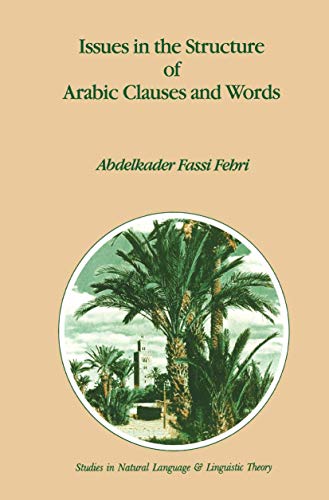
Synopsis
This study has a twofold goal. First, it investigates the internal structure of words and clauses in Standard Arabic (SA), in the light of recent developments of Government and Binding Theory (GB). Second, it argues for a specific theory of typology, and proposes a particular view of how parametrization can be construed and executed. SA is a language used throughout the Arab world, in contrast to specific local dialects which are limited to a particular area. The language has a number of features which make it particularly suitable for cross-linguistic comparative morpho-syntax, as well as research in different modules of the theory of grammar. SA morphology is essentially non-concatenative, though a rich analytic affixation system makes word formation hierarchical. Word order in SA is basically VSO, but the language has alternative SVO structures as well. Sentences can be 'nominal' (i.e. with no verb or copula realized at surface structure), or verbal. Arguments can be left syntacti cally unexpressed (i.e. SA is a null argument language). SA is an agreement language, with a rich and complex agreement system interacting with word order, pronominal incorporation, and expletive structures. It also has a productive morphological case system. Tense, Aspect, Modal, and Negation properties interact in intriguing ways. Finally, SA's DP system exhibits interesting complementary distributions between overt determiners, genitive complements, and possessive markers. It also uses different licensing strategies for Genitive Case marking.
"synopsis" may belong to another edition of this title.
Search results for Issues in the Structure of Arabic Clauses and Words...

Seller Image
Issues in the Structure of Arabic Clauses and Words
Published by
Springer Netherlands Mai 1993, 1993
ISBN 10: 0792320824
ISBN 13: 9780792320821
New
Hardcover
Seller: BuchWeltWeit Ludwig Meier e.K., Bergisch Gladbach, Germany
Seller rating 5 out of 5 stars

Buch. Condition: Neu. This item is printed on demand - it takes 3-4 days longer - Neuware -This study has a twofold goal. First, it investigates the internal structure of words and clauses in Standard Arabic (SA), in the light of recent developments of Government and Binding Theory (GB). Second, it argues for a specific theory of typology, and proposes a particular view of how parametrization can be construed and executed. SA is a language used throughout the Arab world, in contrast to specific local dialects which are limited to a particular area. The language has a number of features which make it particularly suitable for cross-linguistic comparative morpho-syntax, as well as research in different modules of the theory of grammar. SA morphology is essentially non-concatenative, though a rich analytic affixation system makes word formation hierarchical. Word order in SA is basically VSO, but the language has alternative SVO structures as well. Sentences can be 'nominal' (i.e. with no verb or copula realized at surface structure), or verbal. Arguments can be left syntacti cally unexpressed (i.e. SA is a null argument language). SA is an agreement language, with a rich and complex agreement system interacting with word order, pronominal incorporation, and expletive structures. It also has a productive morphological case system. Tense, Aspect, Modal, and Negation properties interact in intriguing ways. Finally, SA's DP system exhibits interesting complementary distributions between overt determiners, genitive complements, and possessive markers. It also uses different licensing strategies for Genitive Case marking. 334 pp. Englisch. Seller Inventory # 9780792320821
Buy New
US$ 185.19
US$ 25.77 shipping
Ships from Germany to U.S.A.
Ships from Germany to U.S.A.
Quantity: 2 available
Seller Image
Issues in the Structure of Arabic Clauses and Words
Print on DemandSeller: moluna, Greven, Germany
Seller rating 5 out of 5 stars
Gebunden. Condition: New. Dieser Artikel ist ein Print on Demand Artikel und wird nach Ihrer Bestellung fuer Sie gedruckt. This study has a twofold goal. First, it investigates the internal structure of words and clauses in Standard Arabic (SA), in the light of recent developments of Government and Binding Theory (GB). Second, it argues for a specific theory of typology, and pr. Seller Inventory # 5966697
Buy New
US$ 157.11
US$ 54.88 shipping
Ships from Germany to U.S.A.
Ships from Germany to U.S.A.
Quantity: Over 20 available
Stock Image
Issues in the Structure of Arabic Clauses and Words (Studies in Natural Language and Linguistic Theory, 29)
Seller: Ria Christie Collections, Uxbridge, United Kingdom
Seller rating 5 out of 5 stars
Condition: New. In English. Seller Inventory # ria9780792320821_new
Buy New
US$ 209.12
US$ 15.10 shipping
Ships from United Kingdom to U.S.A.
Ships from United Kingdom to U.S.A.
Quantity: Over 20 available
Seller Image
Issues in the Structure of Arabic Clauses and Words
Print on DemandSeller: preigu, Osnabrück, Germany
Seller rating 5 out of 5 stars
Buch. Condition: Neu. Issues in the Structure of Arabic Clauses and Words | A. Fassi Fehri | Buch | Einband - fest (Hardcover) | Englisch | 1993 | Springer Netherlands | EAN 9780792320821 | Verantwortliche Person für die EU: Springer Nature Customer Service Center GmbH, Europaplatz 3, 69115 Heidelberg, productsafety[at]springernature[dot]com | Anbieter: preigu Print on Demand. Seller Inventory # 102478140
Buy New
US$ 162.94
US$ 78.42 shipping
Ships from Germany to U.S.A.
Ships from Germany to U.S.A.
Quantity: 5 available
Stock Image
Issues in the Structure of Arabic Clauses and Words
Published by
Kluwer Academic Publishers, 1993
ISBN 10: 0792320824
ISBN 13: 9780792320821
New
Hardcover
Seller: Kennys Bookshop and Art Galleries Ltd., Galway, GY, Ireland
Seller rating 5 out of 5 stars
Condition: New. Investigates the internal structure of words and clauses in Standard Arabic (SA), in the light of developments of Government and Binding Theory (GB). This study argues for a specific theory of typological variation. Series: Studies in Natural Language and Linguistic Theory. Num Pages: 316 pages, biography. BIC Classification: 2CSR; CFK. Category: (P) Professional & Vocational; (UP) Postgraduate, Research & Scholarly. Dimension: 234 x 156 x 19. Weight in Grams: 647. . 1993. Hardback. . . . . Seller Inventory # V9780792320821
Buy New
US$ 233.18
US$ 10.64 shipping
Ships from Ireland to U.S.A.
Ships from Ireland to U.S.A.
Quantity: 15 available
Seller Image
Issues in the Structure of Arabic Clauses and Words
Seller: AHA-BUCH GmbH, Einbeck, Germany
Seller rating 5 out of 5 stars
Buch. Condition: Neu. Druck auf Anfrage Neuware - Printed after ordering - This study has a twofold goal. First, it investigates the internal structure of words and clauses in Standard Arabic (SA), in the light of recent developments of Government and Binding Theory (GB). Second, it argues for a specific theory of typology, and proposes a particular view of how parametrization can be construed and executed. SA is a language used throughout the Arab world, in contrast to specific local dialects which are limited to a particular area. The language has a number of features which make it particularly suitable for cross-linguistic comparative morpho-syntax, as well as research in different modules of the theory of grammar. SA morphology is essentially non-concatenative, though a rich analytic affixation system makes word formation hierarchical. Word order in SA is basically VSO, but the language has alternative SVO structures as well. Sentences can be 'nominal' (i.e. with no verb or copula realized at surface structure), or verbal. Arguments can be left syntactically unexpressed (i.e. SA is a null argument language). SA is an agreement language, with a rich and complex agreement system interacting with word order, pronominal incorporation, and expletive structures. It also has a productive morphological case system. Tense, Aspect, Modal, and Negation properties interact in intriguing ways. Finally, SA's DP system exhibits interesting complementary distributions between overt determiners, genitive complements, and possessive markers. It also uses different licensing strategies for Genitive Case marking. Seller Inventory # 9780792320821
Buy New
US$ 211.52
US$ 39.21 shipping
Ships from Germany to U.S.A.
Ships from Germany to U.S.A.
Quantity: 1 available
Seller Image
Issues in the Structure of Arabic Clauses and Words
Published by
Springer Netherlands, Springer Netherlands Mai 1993, 1993
ISBN 10: 0792320824
ISBN 13: 9780792320821
New
Hardcover
Seller: buchversandmimpf2000, Emtmannsberg, BAYE, Germany
Seller rating 5 out of 5 stars
Buch. Condition: Neu. This item is printed on demand - Print on Demand Titel. Neuware -This study has a twofold goal. First, it investigates the internal structure of words and clauses in Standard Arabic (SA), in the light of recent developments of Government and Binding Theory (GB). Second, it argues for a specific theory of typology, and proposes a particular view of how parametrization can be construed and executed. SA is a language used throughout the Arab world, in contrast to specific local dialects which are limited to a particular area. The language has a number of features which make it particularly suitable for cross-linguistic comparative morpho-syntax, as well as research in different modules of the theory of grammar. SA morphology is essentially non-concatenative, though a rich analytic affixation system makes word formation hierarchical. Word order in SA is basically VSO, but the language has alternative SVO structures as well. Sentences can be 'nominal' (i.e. with no verb or copula realized at surface structure), or verbal. Arguments can be left syntactically unexpressed (i.e. SA is a null argument language). SA is an agreement language, with a rich and complex agreement system interacting with word order, pronominal incorporation, and expletive structures. It also has a productive morphological case system. Tense, Aspect, Modal, and Negation properties interact in intriguing ways. Finally, SA's DP system exhibits interesting complementary distributions between overt determiners, genitive complements, and possessive markers. It also uses different licensing strategies for Genitive Case marking.Springer-Verlag GmbH, Tiergartenstr. 17, 69121 Heidelberg 334 pp. Englisch. Seller Inventory # 9780792320821
Buy New
US$ 185.19
US$ 67.22 shipping
Ships from Germany to U.S.A.
Ships from Germany to U.S.A.
Quantity: 1 available
Stock Image
Issues in the Structure of Arabic Clauses and Words
Seller: Books Puddle, Woodside, NY, U.S.A.
Seller rating 4 out of 5 stars

Condition: New. pp. 336. Seller Inventory # 26319250
Stock Image
Issues in the Structure of Arabic Clauses and Words
Print on DemandSeller: Majestic Books, Hounslow, United Kingdom
Seller rating 4 out of 5 stars
Condition: New. Print on Demand pp. 336 52:B&W 6.14 x 9.21in or 234 x 156mm (Royal 8vo) Case Laminate on White w/Gloss Lam. Seller Inventory # 7561421
Buy New
US$ 284.09
US$ 8.69 shipping
Ships from United Kingdom to U.S.A.
Ships from United Kingdom to U.S.A.
Quantity: 4 available
Stock Image
Issues in the Structure of Arabic Clauses and Words
Published by
Kluwer Academic Publishers, 1993
ISBN 10: 0792320824
ISBN 13: 9780792320821
New
Hardcover
Seller: Kennys Bookstore, Olney, MD, U.S.A.
Seller rating 5 out of 5 stars
Condition: New. Investigates the internal structure of words and clauses in Standard Arabic (SA), in the light of developments of Government and Binding Theory (GB). This study argues for a specific theory of typological variation. Series: Studies in Natural Language and Linguistic Theory. Num Pages: 316 pages, biography. BIC Classification: 2CSR; CFK. Category: (P) Professional & Vocational; (UP) Postgraduate, Research & Scholarly. Dimension: 234 x 156 x 19. Weight in Grams: 647. . 1993. Hardback. . . . . Books ship from the US and Ireland. Seller Inventory # V9780792320821