
Items related to Restructuring Regulation and Financial Institutions...
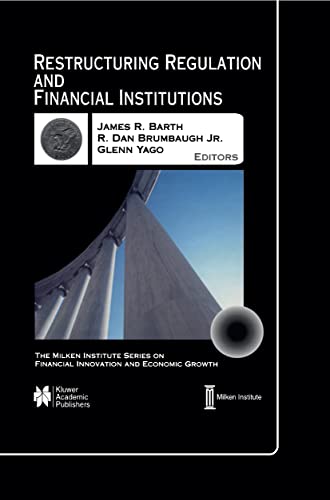
Restructuring Regulation and Financial Institutions (The Milken Institute Series on Financial Innovation and Economic Growth, 1) - Hardcover
Synopsis
Policy makers around the globe will find that Restructuring Regulation and Financial Institutions offers a cogent assessment of the contemporary regulatory environment in the U.S. financial markets, and a blueprint for action in evolving global financial markets.
Financial markets are among the most highly-regulated markets in the world. Nevertheless, financial crises still occur, witness the U.S. savings-and-loan fiasco of the late 1980s and early 1990s, and the Mexican and East Asian Financial implosions of 1994 and 1997. What role does regulation play in stabilizing-or-destabilizing financial markets? Restructuring Regulation and Financial Institutions answers this question with incisive analysis of financial market regulation in the United States.
Each paper considers how regulation enhances or impedes the efficiency of a particular financial sector, and is followed by comments by two or three noted experts. The result of this approach is a wealth of useful information that may be applied by policy makers contemplating the restructuring of regulations and financial institutions.
The contributors to this volume are distinguished economists, many of whom have careers not just in business, government, or academia, but have held influential positions in all three. Such varied backgrounds enable the contributors to offer remarkable insights based on the best of theory and practice.
Never before has understanding the workings of U.S. financial market regulation been so important to the development of world financial markets. The ramifications of financial regulation in the United States extend far beyond the nation's borders. World financial markets are undergoing dramatic change, driven by the rapid development and deployment of new technology that enables information-and money-to travel farther, faster. However, a Byzantine array of regulatory structures in the international arena hinders the development of efficient global financial markets. Policy makers around the world are attempting to address the issues by emulating the financial markets of the United States.
"synopsis" may belong to another edition of this title.
About the Author
James R. Barth is Lowder Eminent Scholar in Finance at Auburn University and Senior Finance Fellow at the Milken Institute. He has held positions as chief economist of the Office of Thrift Supervision and of the Federal Home Loan Bank Board. Barth has testified before congressional committees on financial-institution and deposit-insurance issues, and has been a visiting consultant at the World Bank. He is the author of "The Great Savings and Loan Debacle," and has published more than 100 articles in professional journals and books. Dr. Barth received his Ph.D. in economics from Ohio State University.
R. Dan Brumbaugh Jr. is a Senior Fellow at the Milken Institute. He has testified before congressional committees on financial-institution matters, consulted for financial-service companies, and served as president and chief executive officer of Independence Savings and Loan from 1986 to 1987. Brumbaugh is the author of "The Collapse of Federally Insured Depositories: The Savings and Loans as Precursor" and of "Thrifts Under Seige: Restoring Order to American Banking." He is coauthor of the forthcoming book, "The Role of Banks in Global Financial Markets" (with James R. Barth and Glenn Yago). Dr. Brumbaugh received his Ph.D. in economics from George Washington University.
Glenn Yago is Director of Capital Studies for the Milken Institute. Formerly, he was Director of the Center for Capital Studies at the City University of New York, which he founded. He has served as consultant to the New York State Governor's Office, as well as to the governments of Bolivia, Hungary, and Israel. Yago also served as adviser and consultant to the White House Conference on Small Business, Small Business Administration, Competitiveness Policy Council, and Department of Commerce. In addition, he has consulted widely in the private sector. He is the author of three books, numerous academic articles, and articles for the financial press. Dr. Yago earned his Ph.D. at the University of Wisconsin.
"About this title" may belong to another edition of this title.
Search results for Restructuring Regulation and Financial Institutions...

Stock Image
Restructuring Regulation and Financial Institutions (The Milken Institute Series on Financial Innovation and Economic Growth, 1)
Seller: Ria Christie Collections, Uxbridge, United Kingdom
Seller rating 5 out of 5 stars

Condition: New. In English. Seller Inventory # ria9780792373643_new
Buy New
US$ 286.14
US$ 15.07 shipping
Ships from United Kingdom to U.S.A.
Ships from United Kingdom to U.S.A.
Quantity: Over 20 available
Seller Image
Restructuring Regulation and Financial Institutions
Seller: moluna, Greven, Germany
Seller rating 5 out of 5 stars
Gebunden. Condition: New. Policy makers around the globe will find that Restructuring Regulation and Financial Institutions offers a cogent assessment of the contemporary regulatory environment in the U.S. financial markets, and a blueprint for action in evolvin. Seller Inventory # 458441896
Buy New
US$ 284.17
US$ 54.74 shipping
Ships from Germany to U.S.A.
Ships from Germany to U.S.A.
Quantity: Over 20 available
Stock Image
Restructuring Regulation and Financial Institutions
Seller: Books Puddle, Woodside, NY, U.S.A.
Seller rating 4 out of 5 stars

Condition: New. pp. 496. Seller Inventory # 26464230
Stock Image
Restructuring Regulation and Financial Institutions
Print on DemandSeller: Majestic Books, Hounslow, United Kingdom
Seller rating 4 out of 5 stars
Condition: New. Print on Demand pp. 496 52:B&W 6.14 x 9.21in or 234 x 156mm (Royal 8vo) Case Laminate on White w/Gloss Lam. Seller Inventory # 7383737
Buy New
US$ 361.04
US$ 8.67 shipping
Ships from United Kingdom to U.S.A.
Ships from United Kingdom to U.S.A.
Quantity: 4 available
Stock Image
Restructuring Regulation and Financial Institutions
Print on DemandSeller: Biblios, Frankfurt am main, HESSE, Germany
Seller rating 4 out of 5 stars
Condition: New. PRINT ON DEMAND pp. 496. Seller Inventory # 18464236
Buy New
US$ 381.07
US$ 11.12 shipping
Ships from Germany to U.S.A.
Ships from Germany to U.S.A.
Quantity: 4 available
Seller Image
Restructuring Regulation and Financial Institutions
Seller: AHA-BUCH GmbH, Einbeck, Germany
Seller rating 5 out of 5 stars
Buch. Condition: Neu. Neuware - Policy makers around the globe will find that Restructuring Regulation and Financial Institutions offers a cogent assessment of the contemporary regulatory environment in the U.S. financial markets, and a blueprint for action in evolving global financial markets. Financial markets are among the most highly-regulated markets in the world. Nevertheless, financial crises still occur, witness the U.S. savings-and-loan fiasco of the late 1980s and early 1990s, and the Mexican and East Asian Financial implosions of 1994 and 1997. What role does regulation play in stabilizing-or-destabilizing financial markets Restructuring Regulation and Financial Institutions answers this question with incisive analysis of financial market regulation in the United States. Each paper considers how regulation enhances or impedes the efficiency of a particular financial sector, and is followed by comments by two or three noted experts. The result of this approach is a wealth of useful information that may be applied by policy makers contemplating the restructuring of regulations and financial institutions. The contributors to this volume are distinguished economists, many of whom have careers not just in business, government, or academia, but have held influential positions in all three. Such varied backgrounds enable the contributors to offer remarkable insights based on the best of theory and practice. Never before has understanding the workings of U.S. financial market regulation been so important to the development of world financial markets. The ramifications of financial regulation in the United States extend far beyond the nation's borders. World financial markets are undergoing dramatic change, driven by the rapid development and deployment of new technology that enables information-and money-to travel farther, faster. However, a Byzantine array of regulatory structures in the international arena hinders the development of efficient global financial markets. Policy makers around the world are attempting to address the issues by emulating the financial markets of the United States. Seller Inventory # 9780792373643
Buy New
US$ 378.93
US$ 39.11 shipping
Ships from Germany to U.S.A.
Ships from Germany to U.S.A.
Quantity: 2 available
Stock Image
Restructuring Regulation and Financial Institutions (The Milken Institute Series on Financial Innovation and Economic Growth)
Seller: Mispah books, Redhill, SURRE, United Kingdom
Seller rating 4 out of 5 stars
Hardcover. Condition: Like New. LIKE NEW. SHIPS FROM MULTIPLE LOCATIONS. book. Seller Inventory # ERICA75807923736425
Buy Used
US$ 474.19
US$ 33.36 shipping
Ships from United Kingdom to U.S.A.
Ships from United Kingdom to U.S.A.
Quantity: 1 available
Stock Image
Restructuring Regulation and Financial Institutions
Published by
Kluwer Academic Publishers, 2001
ISBN 10: 0792373642
ISBN 13: 9780792373643
New
Hardcover
Seller: Kennys Bookstore, Olney, MD, U.S.A.
Seller rating 5 out of 5 stars
Condition: New. Financial markets are among the most highly-regulated markets in the world. Nevertheless, financial crises still occur. What role does regulation play in stabilizing-or-destabilizing financial markets? This title answers this question with an analysis of financial market regulation in the United States. Editor(s): Barth, James R.; Brumbaugh, R.Dan; Yago, Glenn. Series: The Milken Institute Series on Financial Innovation and Economic Growth. Num Pages: 489 pages, biography. BIC Classification: 1KBB; KFFK. Category: (P) Professional & Vocational; (UP) Postgraduate, Research & Scholarly; (UU) Undergraduate. Dimension: 234 x 156 x 26. Weight in Grams: 1910. . 2001. Hardback. . . . . Books ship from the US and Ireland. Seller Inventory # V9780792373643
Stock Image
Restructuring Regulation and Financial Institutions
Published by
Kluwer Academic Publishers, 2001
ISBN 10: 0792373642
ISBN 13: 9780792373643
New
Hardcover
Seller: Kennys Bookshop and Art Galleries Ltd., Galway, GY, Ireland
Seller rating 5 out of 5 stars
Condition: New. Financial markets are among the most highly-regulated markets in the world. Nevertheless, financial crises still occur. What role does regulation play in stabilizing-or-destabilizing financial markets? This title answers this question with an analysis of financial market regulation in the United States. Editor(s): Barth, James R.; Brumbaugh, R.Dan; Yago, Glenn. Series: The Milken Institute Series on Financial Innovation and Economic Growth. Num Pages: 489 pages, biography. BIC Classification: 1KBB; KFFK. Category: (P) Professional & Vocational; (UP) Postgraduate, Research & Scholarly; (UU) Undergraduate. Dimension: 234 x 156 x 26. Weight in Grams: 1910. . 2001. Hardback. . . . . Seller Inventory # V9780792373643
Buy New
US$ 612.09
US$ 10.61 shipping
Ships from Ireland to U.S.A.
Ships from Ireland to U.S.A.
Quantity: 15 available