
Items related to The Basque History of the World
Synopsis
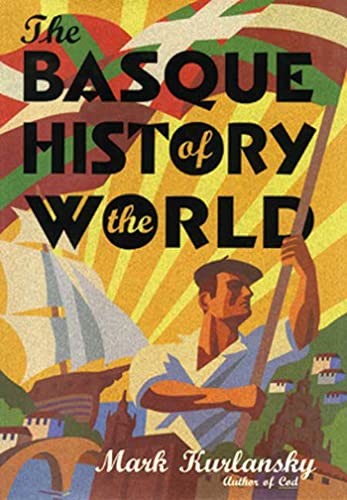
The Basque History of the World is the illuminating story of an ancient and enigmatic people. Signs of their civilization existed well before the arrival of the Romans in 218 B.C., and though theories abound, no one has ever been able to determine their origins. Their ancient tongue, Euskera, is equally mysterious: It is the oldest living European language, and is related to no other language on Earth.
Yet despite their obscure origins and small numbers (2.4 million people today), the Basques have had a profound impact on Europe and the world for more than 2,000 years. Never seeking more land, they have nonetheless fiercely defended their own against invaders ranging from the Celts and Visigoths to Napoleon and Franco. They have always been a paradoxical blend of inbred tradition and worldly ambition, preserving their indigenous legal code, cuisine, literature―even their own hat and shoe―while at the same time striving immodestly to be leaders in the world. They were pioneers of commercial whaling and cod fishing, were among the first Europeans in the Americas, Africa, and Asia during the age of exploration, and were prosperous capitalists when capitalism was a new idea, later leading the Industrial Revolution in southern Europe. Their influence has been felt in every realm, from religion (the charismatic Ignatius Loyola founded the Jesuits in 1534) to sports and commerce. Today, even while clinging to their ancient tribal identity, they are ready for a borderless world: The unique Basque concept of nationhood has never been more relevant, at a time when Basques are enjoying what may be the most important cultural renaissance in their long existence.
Mark Kurlansky's passion for the Basque people– their heroes and commoners alike-and his exuberant eye for detail shine throughout The Basque History of the World. Like his celebrated book Cod, it blends human stories with economic, political, literary, and culinary history into a rich and heroic tale.
"synopsis" may belong to another edition of this title.
About the Author
Mark Kurlansky began his career as a foreign correspondent writing about the last years of Francoism in Spain, especially in the Basque provinces, and he has returned there annually for the past twenty-five years. He is the author of Cod: A Biography of the Fish That Changed the World, which won the James Beard Award for Excellence in Food Writing, and also of A Continent of Islands: Searching for the Caribbean Destiny, and A Chosen Few: The Resurrection of European Jewry. He lives in New York City.
Reviews
Straddling the border of southern France and northern Spain, the land of the Basques has long been home to a people who had no country of their own but have always viewed themselves as a nation. In this marvelous work of cultural history and appreciation, Kurlansky traces Basque history from pre-Roman times, when Basques worked as the mercenaries of Carthage, to the region's recent renaissance in language and arts. Along the way, he explains how the Basques came to be among Europe's first whalers, capitalists, explorers, industrialists and international traders. As he did in Cod, Kurlansky fuses political and economic history with delightful digressions into cultural and culinary traditions (several delicious recipes are included). The book is as politically loaded with opinion as it is culturally informative: Kurlansky expresses sympathy for the cause of Basque independence, arguing that many of Spain's current policies toward its Basque minority are holdovers from the repressive Franco regime. He also tends to accept the claim that the Basques "are the original Europeans," largely on the ground that Euskera, the Basque language, appears to have no linguistic relative and is likely the oldest European language still spoken. For all the ground it covers, this wildly informative work is a marvel of clarity, glittering with unusual facts and marked by penetrating insights into a people always "making complex choices about the degree of independence that was needed to preserve their way of life, while looking to the rest of the world for commercial opportunities to ensure their prosperity." 56 illustrations, 6 maps, 10 recipes. Agent, Charlotte Sheedy Agency. 5-city author tour. (Oct.) FYI: Cod received the James Beard Award for Excellence in Food Writing and was a New York Public Library Best Book of 1997.
Copyright 1999 Reed Business Information, Inc.
A comprehensive view of all things Basque, from the author of Cod: A Biography of the Fish That Changed the World (1997). The Basque History of the World is an honorable title, alerting readers to its singularly Basque-centric mix of cultural studies, history, and politics. The writing is direct and accessible, although limited by the occasional descriptive clich (jagged mountains and crisp fall days). Its most interesting when describing the periods when Basque history intersects with the history of the larger world. For example, in a section on the Spanish Civil War, Kurlansky utilizes quotes from survivors of the 1937 bombing of Guernica by Francos forces, the first large-scale use of air power against a civilian population, to create a sense of suspense, dread, and terror. The bravery of members of the Basque underground, who helped over 700 downed Allied fliers escape from Nazi-occupied territory to England during WWII, is also depicted through compelling first-person recollections. The last third of the book, covering the post-WWII period and the radicalization of a faction of the Basque independence movement, is most problematic. While Kurlansky adeptly explains the logic for Basque autonomy and presents the most radical wings justification for its historical use of terrorism, his analysis too often accepts the Basque view at face value and offers no independent perspective. Perhaps this is because Kurlansky is enamored of his subject, especially the Basque language, Euskera. Euskera warrants attention, as its a unique non-Indo-European language with no known linguistic relatives. Kurlansky knows the Basques well and includes many entertaining anecdotes, myths, and facts about them, all of which reflect a quaint Basque chauvinism. According to the author, the Basque are: probably the original Europeans, the first Europeans to cultivate tobacco, the first bankers in Spain, the most devout Catholics in the world, and among the inventors of beach resorts. In its entirety, this is an informative but ethnocentric history that readers should approach with their critical faculties intact. (Author tour) -- Copyright ©1999, Kirkus Associates, LP. All rights reserved.
The author of Cod, one of last year's quirkiest and most enjoyable entries, returns with a slightly less meandering but equally entertaining history of the Basques. Kurlansky brings a novelist's storytelling talents, a journalist's eye for the salient fact, and an unapologetic admiration of his subject to an episodic narrative of Europe's oldest surviving culture. (LJ 10/1/99)
Copyright 2000 Reed Business Information, Inc.
"About this title" may belong to another edition of this title.
Search results for The Basque History of the World

Stock Image
The Basque History of the World
Published by
Walker Books (edition ), 1999
ISBN 10: 0802713491
ISBN 13: 9780802713490
Used
Hardcover
Seller: BooksRun, Philadelphia, PA, U.S.A.
Seller rating 5 out of 5 stars

Hardcover. Condition: Fair. With dust jacket. The item might be beaten up but readable. May contain markings or highlighting, as well as stains, bent corners, or any other major defect, but the text is not obscured in any way. Seller Inventory # 0802713491-7-1-13_29
Stock Image
The Basque History of the World
Seller: Better World Books, Mishawaka, IN, U.S.A.
Seller rating 5 out of 5 stars
Condition: Good. Former library copy. Pages intact with minimal writing/highlighting. The binding may be loose and creased. Dust jackets/supplements are not included. Includes library markings. Stock photo provided. Product includes identifying sticker. Better World Books: Buy Books. Do Good. Seller Inventory # 4481094-75
Stock Image
The Basque History of the World
Seller: Better World Books: West, Reno, NV, U.S.A.
Seller rating 5 out of 5 stars
Condition: Good. Former library copy. Pages intact with minimal writing/highlighting. The binding may be loose and creased. Dust jackets/supplements are not included. Includes library markings. Stock photo provided. Product includes identifying sticker. Better World Books: Buy Books. Do Good. Seller Inventory # 4481094-75
Stock Image
The Basque History of the World
Seller: Better World Books: West, Reno, NV, U.S.A.
Seller rating 5 out of 5 stars
Condition: Very Good. Former library copy. Pages intact with possible writing/highlighting. Binding strong with minor wear. Dust jackets/supplements may not be included. Includes library markings. Stock photo provided. Product includes identifying sticker. Better World Books: Buy Books. Do Good. Seller Inventory # 7573324-6
Seller Image
The Basque History of the World
Seller: -OnTimeBooks-, Phoenix, AZ, U.S.A.
Seller rating 5 out of 5 stars
Condition: very_good. Gently read. May have name of previous ownership, or ex-library edition. Binding tight; spine straight and smooth, with no creasing; covers clean and crisp. Minimal signs of handling or shelving. 100% GUARANTEE! Shipped with delivery confirmation, if you're not satisfied with purchase please return item! Ships USPS Media Mail. Seller Inventory # OTV.0802713491.VG
Stock Image
The Basque History of the World
Seller: HPB Inc., Dallas, TX, U.S.A.
Seller rating 5 out of 5 stars
Hardcover. Condition: Very Good. Connecting readers with great books since 1972! Used books may not include companion materials, and may have some shelf wear or limited writing. We ship orders daily and Customer Service is our top priority! Seller Inventory # S_480226740
Stock Image
The Basque History of the World
Seller: HPB-Diamond, Dallas, TX, U.S.A.
Seller rating 5 out of 5 stars
Hardcover. Condition: Very Good. Connecting readers with great books since 1972! Used books may not include companion materials, and may have some shelf wear or limited writing. We ship orders daily and Customer Service is our top priority! Seller Inventory # S_481813745
Seller Image
The Basque History of the World
Seller: Austin Goodwill 1101, Austin, TX, U.S.A.
Seller rating 5 out of 5 stars
Condition: good. Book shows general signs of use and handling. May have light wear on the cover or edges and minimal writing or highlighting. Binding remains tight, and pages are clean and readable. Seller Inventory # CTXV.0802713491.G
Stock Image
Basque History of the World
Seller: World of Books (was SecondSale), Montgomery, IL, U.S.A.
Seller rating 5 out of 5 stars
Hardback. Condition: Fair. From Mark Kurlansky, the bestselling author of Cod, Salt, Birdseye, and Paper--the illuminating story of an ancient and enigmatic people Straddling a small corner of Spain and France in a land that is marked on no maps except their own, the Basques are a puzzling contradiction--they are Europe's oldest nation without ever having been a country. No one has ever been able to determine their origins, and even the Basques' language, Euskera--the most ancient in Europe--is related to none other on earth. For centuries, their influence has been felt in nearly every realm, from religion to sports to commerce. Even today, the Basques are enjoying what may be the most important cultural renaissance in their long existence, as displayed by new cookbooks like chefs Alexandra Raij and Eder Montero's The Basque Book and restaurateur Jose Pizarro's Basque.Mark Kurlansky's passion for the Basque people and his exuberant eye for detail shine throughout this fascinating book. Like Cod, The Basque History of the World, blends human stories with economic, political, literary, and culinary history into a rich and heroic tale.Among the Basques' greatest accomplishments: - Exploration--the first man to circumnavigate the globe, Juan Sebastian de Elcano, was a Basque and the Basques were the second Europeans, after the Vikings, in North America - Gastronomy and agriculture--they were the first Europeans to eat corn and chili peppers and cultivate tobacco, and were among the first to use chocolate - Religion--Ignatius Loyola, a Basque, founded the Jesuit religious order - Business and politics--they introduced capitalism and modern commercial banking to southern Europe - Recreation--they invented beach resorts, jai alai, and racing regattas, and were the first Europeans to play sports with balls A delectable portrait of an uncanny, indomitable nation. -NewsdayExciting, Illuminating, and thought provoking. -The Boston GlobeEntertaining and instructive. Kurlansky's] approach is unorthodox, mixing history with anecdotes, poems with recipes. -The New York Times Book Review. Seller Inventory # 00109137672
Seller Image
The Basque History of the World
Seller: Solr Books, Lincolnwood, IL, U.S.A.
Seller rating 5 out of 5 stars
Condition: acceptable. This book is in Acceptable condition. All pages are intact, but may have lots of notes, water damage or other issues and be ex library. Seller Inventory # BCV.0802713491.A