
Items related to The Civil Rights Movement (Eyewitness History)
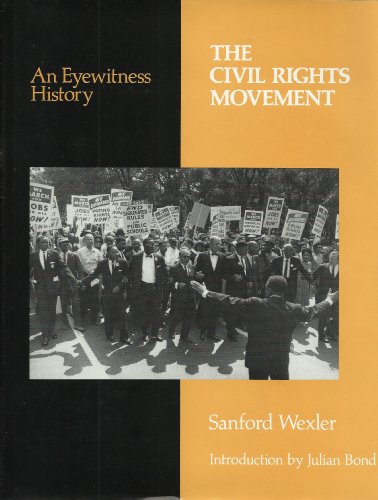
Synopsis
The civil rights movement that spanned the years following the Brown v. Board of Education decision of 1954 through the passage of the Voting Rights Act of 1965 marked a watershed period for human rights in America. Julian Bond, former communications director of SNCC (Student Nonviolent Coordinating Committee), notes in his introduction that "the words 'civil rights' summon up memories and images in modern minds of grainy television footage of packed mass meetings, firehoses and police dogs, of early-1960s peaceful protestors replaced over time by violent rioters, of soul-stirring oratory and bold actions, of assassination and death." The civil rights movement was also a movement of courage, of perseverance, of strength and of triumph. Its eyewitnesses and its many participants saw the Montgomery Bus Boycott, school integration, the freedom rides, the march on Washington, Martin Luther King Jr.'s "I Have a Dream" speech and the passage of the Civil Rights Act of 1964. The Civil Rights Movement covers the key years 1954-1965 in detail. It also traces the roots of the civil rights movement to the 19th century in the years following the Emancipation Proclamation through the Reconstruction period, with the rise of the Ku Klux Klan and the denial of basic rights to blacks.
The Civil Rights Movement, the latest volume in Facts On File's acclaimed Eyewitness History series, provides hundreds of firsthand accounts of the movement - from letters, speeches, newspaper editorials and press statements, which illustrate how historical events appeared to those who lived through them. Among the eyewitness testimonies included are those from Martin Luther King Jr., Thurgood Marshall, Malcolm X, President Lyndon Johnson, Stokely Carmichael, Rosa Parks and Ralph Abernathy.
In addition to the firsthand accounts, each chapter provides an introductory essay and a chronology of events. The book also includes such critical documents as the Formation of the NAACP, the Brown v. Board of Education decision, The Southern Manifesto, The Civil Rights Act of 1964 and The Civil Rights Act of 1991 as well as capsule biographies of more than 100 key figures, a bibliography, an index and 80 black-and-white photographs.
"synopsis" may belong to another edition of this title.
From the Back Cover
The civil rights movement that spanned the years following the Brown v. Board of Education decision of 1954 through the passage of the Voting Rights Act of 1965 marked a watershed period for human rights in America. Julian Bond, former communications director of SNCC (Student Nonviolent Coordinating Committee), notes in his introduction that "the words 'civil rights' summon up memories and images in modern minds of grainy television footage of packed mass meetings, firehoses and police dogs, of early-1960s peaceful protestors replaced over time by violent rioters, of soul-stirring oratory and bold actions, of assassination and death." The civil rights movement was also a movement of courage, of perseverance, of strength and of triumph. Its eyewitnesses and its many participants saw the Montgomery Bus Boycott, school integration, the freedom rides, the march on Washington, Martin Luther King Jr.'s "I Have a Dream" speech and the passage of the Civil Rights Act of 1964. The Civil Rights Movement covers the key years 1954-1965 in detail. It also traces the roots of the civil rights movement to the 19th century in the years following the Emancipation Proclamation through the Reconstruction period, with the rise of the Ku Klux Klan and the denial of basic rights to blacks. The Civil Rights Movement, the latest volume in Facts On File's acclaimed Eyewitness History series, provides hundreds of firsthand accounts of the movement - from letters, speeches, newspaper editorials and press statements, which illustrate how historical events appeared to those who lived through them. Among the eyewitness testimonies included are those from Martin Luther King Jr., Thurgood Marshall, Malcolm X, President Lyndon Johnson, Stokely Carmichael, Rosa Parks and Ralph Abernathy. In addition to the firsthand accounts, each chapter provides an introductory essay and a chronology of events. The book also includes such critical documents as the Formation of the NAACP, the Brown v. Board of Education decision, The Southern Manifesto, The Civil Rights Act of 1964 and The Civil Rights Act of 1991 as well as capsule biographies of more than 100 key figures, a bibliography, an index and 80 black-and-white photographs.
Reviews
YA-Letters, speeches, newspaper articles, and other primary sources are used to chronicle the civil rights movement in the U.S. from 1954-1965. In addition to the chronologically arranged text, more information is packaged concisely in the appendixes: pertinent documents, biographical sketches, acronyms for movement organizations, and maps of sites and events.
Copyright 1994 Reed Business Information, Inc.
This work, as with others in the Eyewitness History series for young adults, aims to assist readers in the development of their historical imagination by providing direct quotations from selected documents of a period. Thus, one can read Rosa Parks' description of her weariness and resistance on that momentous bus ride or learn what it was like for Melba Patillo to be escorted into Central High School as one of nine black students accompanied by 22 soldiers. The excerpts are drawn from such primary sources as memoirs, diaries, letters, and news articles. An eloquent foreword by Julian Bond, a participant in the civil rights movement, reminds readers of the countless "ordinary women and men" who laid the groundwork for a national consensus for reform.
The chapters are arranged chronologically beginning with the origins of the movement after the Civil War. Each chapter opens with a brief summary of the period followed by a "Chronicle of Events." The bulk of each chapter consists of a large number of quotations from eyewitness accounts, accompanied by black-and-white photographs. Extensive appendixes contain documents, such as the Thirteenth Amendment and the Report of the National Advisory Commission on Civil Rights; brief biographies of major persons referred to in the text; acronyms; maps of sites; and an extensive bibliography of the sources quoted.
There is sometimes oversimplification in the "Chronicle of Events" section in chapters. For example, it is misleading to give a single date and place for the founding of the Klan when this organization had three separate foundings.
This timely source complements The Encyclopedia of African-American Civil Rights: From Emancipation to the Present [RBB Ag 92] and The Negro Almanac: A Reference Work on the African American (5th ed., Gale, 1991), both of which are better organized for checking specific facts. A similar book in the words of activists themselves is Freedom's Children: Young Civil Rights Activists Tell Their Own Stories by Ellen Levine (Putnam, 1993).
This very readable source deserves a place in every public and middle and high school library, though it may fit better in the circulating collection. The honest, angry, thoughtful, and sad words can be read by individuals of any age. The intention of the author to bring the reader into the historical moment is admirably realized.
"About this title" may belong to another edition of this title.
Search results for The Civil Rights Movement (Eyewitness History)

Stock Image
Civil Rights
Seller: World of Books (was SecondSale), Montgomery, IL, U.S.A.
Seller rating 5 out of 5 stars

Hardback. Condition: Very Good. Uses speeches, articles, and other writings of those involved to trace the history of the civil rights movement in the United States, primarily from 1954 to 1965. Seller Inventory # CIN081602748XVG
Stock Image
Civil Rights
Seller: World of Books Inc, Montgomery, IL, U.S.A.
Seller rating 4 out of 5 stars

Hardback. Condition: Very Good. Uses speeches, articles, and other writings of those involved to trace the history of the civil rights movement in the United States, primarily from 1954 to 1965. Seller Inventory # CIN081602748XVG
Stock Image
The Civil Rights Movement (Eyewitness History (Hardcover))
Published by
Facts on File (edition First Edition), 1993
ISBN 10: 081602748X
ISBN 13: 9780816027484
Used
Hardcover
First Edition
Seller: BooksRun, Philadelphia, PA, U.S.A.
Seller rating 5 out of 5 stars
Hardcover. Condition: Fair. First Edition. The item might be beaten up but readable. May contain markings or highlighting, as well as stains, bent corners, or any other major defect, but the text is not obscured in any way. Seller Inventory # 081602748X-7-1
Stock Image
Civil Rights
Published by
Infobase Holdings, Inc., 1993
ISBN 10: 081602748X
ISBN 13: 9780816027484
Used
Hardcover
Seller: Better World Books, Mishawaka, IN, U.S.A.
Seller rating 5 out of 5 stars
Condition: Good. Former library copy. Pages intact with minimal writing/highlighting. The binding may be loose and creased. Dust jackets/supplements are not included. Includes library markings. Stock photo provided. Product includes identifying sticker. Better World Books: Buy Books. Do Good. Seller Inventory # 15874974-6
Stock Image
Civil Rights
Published by
Infobase Holdings, Inc., 1993
ISBN 10: 081602748X
ISBN 13: 9780816027484
Used
Hardcover
Seller: Better World Books, Mishawaka, IN, U.S.A.
Seller rating 5 out of 5 stars
Condition: Good. Pages intact with minimal writing/highlighting. The binding may be loose and creased. Dust jackets/supplements are not included. Stock photo provided. Product includes identifying sticker. Better World Books: Buy Books. Do Good. Seller Inventory # 15946751-6
Stock Image
The Civil Rights Movement
Seller: ThriftBooks-Dallas, Dallas, TX, U.S.A.
Seller rating 5 out of 5 stars
Hardcover. Condition: Good. No Jacket. Pages can have notes/highlighting. Spine may show signs of wear. ~ ThriftBooks: Read More, Spend Less. Seller Inventory # G081602748XI3N00
Stock Image
The Civil Rights Movement
Seller: ThriftBooks-Dallas, Dallas, TX, U.S.A.
Seller rating 5 out of 5 stars
Hardcover. Condition: Very Good. No Jacket. May have limited writing in cover pages. Pages are unmarked. ~ ThriftBooks: Read More, Spend Less. Seller Inventory # G081602748XI4N00
Stock Image
The Civil Rights Movement (Eyewitness History)
Seller: HPB Inc., Dallas, TX, U.S.A.
Seller rating 5 out of 5 stars
hardcover. Condition: Very Good. Connecting readers with great books since 1972! Used books may not include companion materials, and may have some shelf wear or limited writing. We ship orders daily and Customer Service is our top priority! Seller Inventory # S_476411651
Stock Image
The Civil Rights Movement (Eyewitness History (Hardcover))
Seller: Midtown Scholar Bookstore, Harrisburg, PA, U.S.A.
Seller rating 5 out of 5 stars
Hardcover. Condition: Very Good. unmarked, light shelfwear-NICE Standard-sized. Seller Inventory # 081602748X-01
Stock Image
The Civil Rights Movement (Eyewitness History (Hardcover))
Published by
Facts on File, 1993
ISBN 10: 081602748X
ISBN 13: 9780816027484
Used
Hardcover
First Edition
Seller: Jeff Stark, Barstow, CA, U.S.A.
Seller rating 5 out of 5 stars
Hardcover. Condition: VG minus or a Little Better. Dust Jacket Condition: Good. 1st Edition. Very good first printing but has ex-library markings in a good plus dj. Seller Inventory # 053369