
Items related to The Theory of Moral Sentiments (Glasgow Edition of...
The Theory of Moral Sentiments (Glasgow Edition of the Works and Correspondence of Adam Smith, vol.1) - Softcover
Book 33 of 77: Cambridge Texts in the History of Philosophy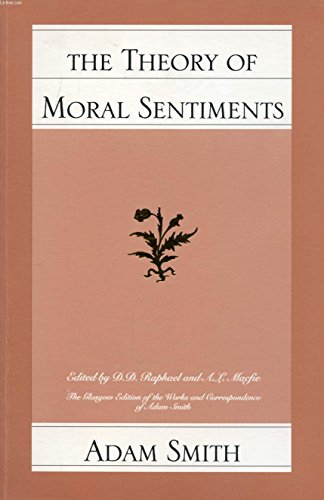
Synopsis
The Theory of Moral Sentiments, Smith’s first and in his own mind most important work, outlines his view of proper conduct and the institutions and sentiments that make men virtuous. Here he develops his doctrine of the impartial spectator, whose hypothetical disinterested judgment we must use to distinguish right from wrong in any given situation. We by nature pursue our self-interest, according to Smith. This makes independence or self-command an instinctive good, and neutral rules as difficult to craft as they are necessary. But society is not held together merely by neutral rules; it is held together by sympathy. Smith argues that we naturally share the emotions and to a certain extent the physical sensations we witness in others. Sharing the sensations of our fellows, we seek to maximize their pleasures and minimize their pains so that we may share in their joys and enjoy their expressions of affection and approval.
"synopsis" may belong to another edition of this title.
Book Description
Adam Smith's Theory of Moral Sentiments (1759) lays the foundation for a general system of morals, and is a text of central importance in the history of moral and political thought. By means of the idea of sympathy and the mental construct of an impartial spectator, Smith formulated highly original theories of conscience, moral judgment and the virtues. This volume offers a new edition of the text with helpful notes for the student reader, together with a substantial introduction that sets the work in its philosophical and historical context.
From the Back Cover
"In The Theory of Moral Sentiments, Smith assigned himself a difficult and dangerous task: to establish for educated men in an increasingly revolutionary age the reasonableness of morality and the necessity of the fruits of virtue - illustrated by the wisdom of the classical authors of antiquity. This book, Adam Smith's first, is, then, proof to skeptics of the importance of morality; and an antidote to those who think that free-market economics can be divorced from a moral society."--BOOK JACKET.
"About this title" may belong to another edition of this title.
Other Popular Editions of the Same Title

Search results for The Theory of Moral Sentiments (Glasgow Edition of...

Stock Image
THEORY OF MORAL SENTIMENTS
Seller: CollegeBooksDirect, Greenville, TX, U.S.A.
Seller rating 5 out of 5 stars

Condition: New. Book. Seller Inventory # 978086597012New
Stock Image
Theory of Moral Sentiments
Published by
Liberty Fund, Incorporated, 2009
ISBN 10: 0865970122
ISBN 13: 9780865970120
Used
Softcover
Seller: Better World Books: West, Reno, NV, U.S.A.
Seller rating 5 out of 5 stars
Condition: Very Good. Former library copy. Pages intact with possible writing/highlighting. Binding strong with minor wear. Dust jackets/supplements may not be included. Includes library markings. Stock photo provided. Product includes identifying sticker. Better World Books: Buy Books. Do Good. Seller Inventory # 7962794-6
Stock Image
Theory of Moral Sentiments
Published by
Liberty Fund, Incorporated, 2009
ISBN 10: 0865970122
ISBN 13: 9780865970120
Used
Softcover
Seller: Better World Books, Mishawaka, IN, U.S.A.
Seller rating 5 out of 5 stars
Condition: Good. Pages intact with minimal writing/highlighting. The binding may be loose and creased. Dust jackets/supplements are not included. Stock photo provided. Product includes identifying sticker. Better World Books: Buy Books. Do Good. Seller Inventory # 3934374-6
Stock Image
The Theory of Moral Sentiments
Published by
Liberty Fund, Incorporated, 1982
ISBN 10: 0865970122
ISBN 13: 9780865970120
Used
Softcover
Seller: Better World Books, Mishawaka, IN, U.S.A.
Seller rating 5 out of 5 stars
Condition: Good. Former library copy. Pages intact with minimal writing/highlighting. The binding may be loose and creased. Dust jackets/supplements are not included. Includes library markings. Stock photo provided. Product includes identifying sticker. Better World Books: Buy Books. Do Good. Seller Inventory # 5924193-6
Stock Image
The Theory of Moral Sentiments (Glasgow Edition of the Works and Correspondence of Adam Smith, vol.1)
Seller: Jenson Books Inc, Logan, UT, U.S.A.
Seller rating 5 out of 5 stars
paperback. Condition: Very Good. A clean, cared for item that is unmarked and shows limited shelf wear. Seller Inventory # 4BQWN8005M9B
Seller Image
The Theory of Moral Sentiments (Glasgow Edition of the Works and Correspondence of Adam Smith, vol.1)
Seller: MERS Goodwill, Saint Louis, MO, U.S.A.
Seller rating 5 out of 5 stars
Condition: acceptable. Used - Acceptable: All pages and the cover are intact, but shrink wrap, dust covers, or boxed set case may be missing. Pages may include limited notes, highlighting, or minor water damage but the text is readable. Pages may include limited notes and highlighting, but the text cannot be obscured or unreadable. Any access codes or passwords originally included with the book may be expired, used or no longer valid. Image is stock photo and cover art edition may be different than pictured. Seller Inventory # MERV.0865970122.A
Stock Image
The Theory of Moral Sentiments (Glasgow Edition of the Works and Correspondence of Adam Smith, vol.1)
Seller: Unique Books, Lexington, KY, U.S.A.
Seller rating 5 out of 5 stars
Soft cover. Condition: Very Good. No Jacket. b-480. Seller Inventory # b-642-06
Stock Image
The Theory of Moral Sentiments (Glasgow Edition of the Works and Correspondence of Adam Smith, vol.1)
Seller: Cucamonga Books, Rancho Cucamonga, CA, U.S.A.
Seller rating 5 out of 5 stars
Soft cover. Condition: As New. Seller Inventory # ABE-1771351006148
Seller Image
The Theory of Moral Sentiments
Seller: eCampus, Lexington, KY, U.S.A.
Seller rating 4 out of 5 stars

Condition: Very Good. Seller Inventory # U:9780865970120:ONHAND
Seller Image
Theory of Moral Sentiments
Seller: GreatBookPrices, Columbia, MD, U.S.A.
Seller rating 5 out of 5 stars
Condition: As New. Unread book in perfect condition. Seller Inventory # 3455764