
Items related to Still Life With A Bridle
Synopsis
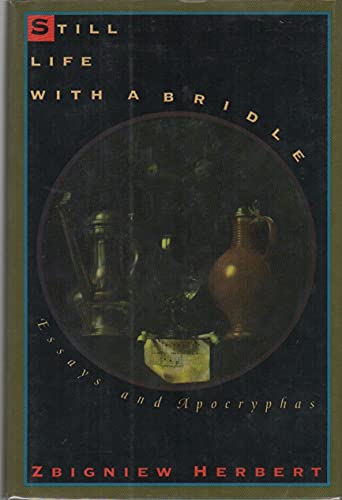
In Still Life with a Bridle, poet and essayist Zbigniew Herbert takes an intriguing look at the cultural, artisitic, and aesthetic legacy of 17th-century Holland. These sixteen essays reveal Hervert's discriminating artistic eye and poetic sensibility, one that revels in irony, humor, and a satirist's appreciation of the absurd. An inveterate museum-goer, he focuses on the art of the Dutch masters, using it as a stepping-off point for a thoroughly individual and entertaining examination of the foibles, genius, and character of the Dutch people as a whole. The result is an unorthodox and revealing glimpse into the past that gives us a keener understanding not only of a distant people, but of ourselves as well.
"synopsis" may belong to another edition of this title.
About the Author
Zbigniew Herbert (1924-1998) was a spiritual leader of the anticommunist movement in Poland. His work has been translated into almost every European language; he has won numerous prizes, most recently the Jerusalem Prize and the T. S. Eliot Prize. His books include Selected Poems, Report from the Besieged City and Other Poems, Mr. Cogito, Still Life with a Bridle, and the new prose collection The King of the Ants, all available from The Ecco Press.
Excerpt. © Reprinted by permission. All rights reserved.
Just after crossing the Belgian-Dutch border, suddenly and without reason or reflection I decided to change my original plan. Instead of the classical road to the north I chose the road to the west, in the direction of the sea. I wanted to get to know Zeeland, even if superficially; I had never been there. All I knew was that I would not experience great artistic revelations.
Until now my travels through Holland had always followed the movement of a pendulum along the coast. That is, to speak graphically, from Bosch's "Prodigal Son" in Rotterdam to "The Night Watch" in Amsterdam's Rijksmuseum, a trajectory typical for someone who devours paintings, books, and monuments, leaving all the rest to those who, like the Biblical Martha, care only for earthly things.
At the same time I realized my limitations, because clearly the ideal traveler knows how to enter into contact with nature, with people and their history as well as their art. Only familiarity with these three overlapping elements can be the starting point of knowledge about a country. This time I allowed myself the luxury of leaving behind "essential and important" things in order to compare monuments, books, and paintings with the real sky, the real sea, and real land.
So we are driving through an enormous plain, a civilized steppe, the road as smooth as an airport runway amid endless meadows similar to the flat green paradise in the polyptych of the van Eyck brothers in Ghent. Though nothing extraordinary happens, though I am prepared because I have read about it a hundred times, changes still take place in my sensory apparatus that are difficult to describe yet at the same time very concrete. My eyes of a city dweller, unused to the expansive landscape, fearfully and uncertainly check the faraway horizon as if learning to fly above an unattainable surface. It is similar to a huge overflow rather than a mainland, which in my experience is always associated with an accumulation of elevations, mountains, rising cities that break the line of the horizon. This is why I was in a state of constant alarm during my journeys in Greece and Italy, a never-ending need to reach a broader "birdlike" perspective that would allow me to take in the whole image, or at least a great part of it. This is why I climbed the steep slope of Delphi, strewn with marble, to see the spot of the mortal duel of Apollo with the beast. This is why I tried to climb Olympus in the illusory hope of embracing the entire Valley of Thessaly from sea to sea (to my misfortune, the gods had an important meeting in the clouds just at that moment, so I saw nothing). I also patiently polished winding steps in the towers of Italian city halls and churches. But my efforts were rewarded only with something that could be called a "torso of a landscape"--splendid, ofcourse splendid fragments. Later they became pale and I arranged them in my memory like postcards, these deceitful images with false colors and false light, untouched by emotion.
Here in Holland, I had a feeling the smallest hill would be enough to take in the entire country: all its rivers, meadows, canals, its red cities, like a huge map that one can bring closer or move farther from the eyes. It was not at all a feeling accessible to lovers of beauty, or purely aesthetic. It was like a particle of the omnipotence that is reserved for the highest beings: to embrace the limitless expanse with its wealth of detail, herbs, people, waters, trees, houses, all that is contained only in God's eye--the enormous magnitude of the world and the heart of things.
Thus we drive through a plain that puts up no resistance, as if the laws of gravity were suddenly suspended. We move with the motion of a sphere on a smooth surface. We are overwhelmed by a powerful sensual feeling, blessed monotony, sleepiness of the eyes, dulled hearing, and the retreat of touch because nothing happens around us to cause anxiety or exaltation. Only later, much later, do we discover the fascinating richness of the great plain.
A STOP in Veere. It is reasonable to begin the sightseeing of a country not from its capitals or spots marked with "three stars" in a guide but precisely from a godforsaken province abandoned and orphaned by history. A matter-of-fact and laconic Baedeker from 1911 1 never part with has devoted twelve cool lines to Veere ("manche Erinerungen aus seiner Blutezeit"), while my precious Guide Michelin flies on the wings of touristlike poesie de circonstance: "Une lumiere douce, une atmosphere ouatee et comme assoupie donnent A Veere l'allure d'une ville de legende ... Ses rues calmes laissent le visiteur sous un charme melancolique."
Indeed Veere, once famous, populous, and rich, is now a degraded, make-believe city; it is deprived of its own life like a moon reflecting the life and light of others. Only in the summer as a "port de plaisance" is it filled with a crowd of merry nomads; afterward it goes underground and leads the secret existence of plants. In the fall it gives the impression of a drawing from which the artist has removed people in order to put city walls, buildings, and facades into relief. Streets and squares are empty, shutters closed. No one answers a ringing at the gates.
It looks as if the town was touched by an epidemic but the whole drama carefully concealed, victims removed behind the deceitful decorations of an idyll. A huge number of shops with antiques. At the day's end their windows look like cemeteries in the gentle light of dusk, huge still lifes.
A cane with a silver handle has a romance with a fan.
The square with the city hall is lit with amber light;
"About this title" may belong to another edition of this title.
Search results for Still Life With A Bridle

Seller Image
Still Life With a Bridle: Essays and Apocryphas
Seller: Raritan River Books, Philadelphia, PA, U.S.A.
Seller rating 5 out of 5 stars

Hardcover. Condition: Very Good. Dust Jacket Condition: Very Good. Hardcover in jacket. Remainder mark to bottom page edge else very good condition: binding sound, text clean, mild shelfwear. Book. Seller Inventory # 5059761
Stock Image
Still Life with a Bridle : Essays and Apocryphas
Published by
HarperCollins Publishers, 2000
ISBN 10: 0880013060
ISBN 13: 9780880013062
Used
Hardcover
Seller: Better World Books, Mishawaka, IN, U.S.A.
Seller rating 5 out of 5 stars
Condition: Good. Former library copy. Pages intact with minimal writing/highlighting. The binding may be loose and creased. Dust jackets/supplements are not included. Includes library markings. Stock photo provided. Product includes identifying sticker. Better World Books: Buy Books. Do Good. Seller Inventory # 11316712-6
Stock Image
Still Life With A Bridle
Seller: Books-R-Keen, DuBois, PA, U.S.A.
Seller rating 4 out of 5 stars

hardcover. Condition: Good. Used items may contain, highlighting, writing, and other previous signs of use. Used items may not contain CD's. access codes and other accompanying items when applicable. Seller Inventory # 53E57703
Stock Image
Still Life With A Bridle
Seller: Books-R-Keen, DuBois, PA, U.S.A.
Seller rating 4 out of 5 stars
hardcover. Condition: Good. Used items may contain, highlighting, writing, and other previous signs of use. Used items may not contain CD's. access codes and other accompanying items when applicable. Seller Inventory # 54E57764
Stock Image
Still Life with a Bridle : Essays and Apocryphas by Zbigniew Herbert (2000,.
Seller: SophiBooks, Manor, TX, U.S.A.
Seller rating 1 out of 5 stars

Condition: As New. Seller Inventory # M5250
Stock Image
Still Life with a Bridle
Published by
Harpercollins, NY, 1991
ISBN 10: 0880013060
ISBN 13: 9780880013062
Used
Hardcover
First Edition
Seller: Daedalus Books, Portland, OR, U.S.A.
Seller rating 4 out of 5 stars
Hardcover. Condition: Very Good+. Dust Jacket Condition: Very Good+. First Edition. Former owner's name and date penned to front endpaper. A nice, solid copy.; 0.9 X 5.8 X 8.4 inches; 162 pages. Seller Inventory # 349747
Stock Image
Still Life with a Bridle: Essays and Apocryphas
Published by
Ecco Press, 1991, 1991
ISBN 10: 0880013060
ISBN 13: 9780880013062
Used
Hardcover
First Edition
Seller: Sutton Books, Norwich, VT, U.S.A.
Seller rating 4 out of 5 stars
Condition: as new. Dust Jacket Condition: as new. Hbk, 162pp, stated 1st edition, slight dulling to dj, otherwise fine, unclipped and now in protective sleeve, internally appears unread and an excellent clean tight and unmarked text. Seller Inventory # EL503
Stock Image
Still Life With a Bridle: Essays and Apocryphas
Published by
Ecco Press, New York, 1991
ISBN 10: 0880013060
ISBN 13: 9780880013062
Used
Hardcover
First Edition
Seller: Object Relations IOBA PBFA, London, United Kingdom
Seller rating 5 out of 5 stars
Hardcover. Condition: Near Fine. Dust Jacket Condition: Near Fine. 1st Edition. 1st ed. Near fine/near fine copy. Seller Inventory # 018951
Buy Used
US$ 20.69
US$ 13.39 shipping
Ships from United Kingdom to U.S.A.
Ships from United Kingdom to U.S.A.
Quantity: 1 available
Seller Image
STILL LIFE WITH A BRIDLE: Essays and Apocryphas
Published by
The Ecco Press, New York, 1991
ISBN 10: 0880013060
ISBN 13: 9780880013062
Used
Hardcover
First Edition
Seller: Type Punch Matrix, Silver Spring, MD, U.S.A.
Seller rating 5 out of 5 stars
Condition: Near Fine. Dust Jacket Condition: dj. First printing. First edition, a very nice copy of this collection of writings by the Polish author, translated by John and Bogdana Carpenter. With praise from Czeslaw Milosz, Joseph Brodsky, and others on back panel. 8.25'' x 5.5''. Quarter black cloth over black boards in pictorial price-clipped dust jacket. 162 pages. Interior clean throughout if trivially toned. Near fine in a near fine jacket. Seller Inventory # 43300
Seller Image
Still Life With A Bridle: Essays and Apocryphas (First American Edition)
Published by
Ecco Press (Penguin), New York, 1991
ISBN 10: 0880013060
ISBN 13: 9780880013062
Used
Hardcover
First Edition
Seller: Dan Pope Books, West Hartford, CT, U.S.A.
Seller rating 5 out of 5 stars
Hardcover. Condition: Fine. Dust Jacket Condition: Fine. 1st Edition. First printing of the first American edition. A fine copy in a fine jacket. A clean, tight copy with price ($19.95) intact on front flap. Comes with archival-quality jacket protector. Note: Barcode sticker on rear jacket cover. Light fading on jacket spine. Very slight spine slant. Although not marked in any such way, this book came from the library of poet and literary critic J.D. McClatchy, from his estate in Stonington, Connecticut. Seller Inventory # McClatchy-378