
Items related to Pushkin: A Biography
Synopsis
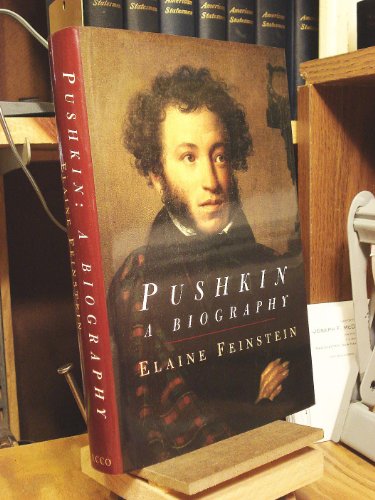
British poet, novelist, and biographer Feinstein recounts the short life of Alexander Sergeevish Puskin (1799-1837), widely recognized as the father of Russian literature. She finds in him an impudent genius, libertine, wounded son, jealous husband, victim of snobbery and censorship, and above all a writer of inexhaustible vision and vitality. Annotation c. Book News, Inc., Portland, OR (booknews.com)
"synopsis" may belong to another edition of this title.
Reviews
Shackled by police surveillance and czarist censorship, Alexander PushkinAarguably the Russian Shakespeare, although few realized it during his lifeAcould publish little that was both safe and up to his standards. Despite penury and political banishment, he produced works like Evgeny Onegin (1823-1831), the Byronic saga of a rake something like his young self, as well as Boris Godunov and The Bronze Horseman. As poet and novelist Feinstein (A Captive Lion: The Life of Marina Tsvetayeva) implies in her accessible biography, Pushkin was his own worst enemy. The impulsive, reckless, disheveled great-grandson of an African slave who was a favorite of Peter the Great, was his own worst enemy. He died, at 37, in a probably unnecessary duel, defending the honor of his wife, a frivolous, flirtatious St. Petersburg court beauty unworthy of his jealousy. The bicentennial year of Pushkin's birth in 1799 will spur other books, but very likely none in English will be more up-to-date in exploiting still-emerging documents about Pushkin's life and death. Feinstein's well-chosen extracts from the poet's writings illuminate his bawdy wit, his lyric intensity, his sensitivity to his attenuated but obvious African heritage, and his melancholy introspection. He once described a passionate woman he had bedded as "A Comet without laws among/ The calculated round of stars"; in Feinstein's biography the words apply just as aptly to the great Russian writer himself. 22 b&w illustrations. (May) FYI: Serena Vitale's Pushkin's Button, one of Feinstein's sources for her account of the fatal duel, was reviewed in Forecasts, January 11.
Copyright 1999 Reed Business Information, Inc.
An accessible biography that emphasizes the contradictions in Pushkin's personality and how they contributed to his early death. In this bicentennial year of Pushkin's birthe, the author establishes herself as a good synthesizer. While Feinstein's (Lawrence and the Women: The Intimate Life of D.H. Lawrence, 1993) biography of Russia's great literary figure is up-to-date on the latest research, it will serve as a readable and reliable English-language biography for the general public rather than a groundbreaking study for literary critics. Feinstein presents Pushkin's life chronologically, from his birth and school days to his undoing in a dramatic duel and painful death. Chapters are concise and predictable. An introductory account of Russian imperial history falls into the trap of excessive shorthand, which leads to empty remarks such as the following about Peter the Great: he ``unquestionably wanted to make Russia great.'' From the start, Feinstein focuses on the juxtapositions within Pushkin's personality and his various situations in life: his perception of himself as ugly and his pride in his African ancestry; his liberal political views and his unsolicited role as the tsar's pet poet; his inheritance of his father's love of gossip and society and his need for solitude for work; and his marriage to the beautiful young wife whose flirtations (if not infidelity) led to an eruption of Pushkin's violent temper and the fatal duel that caused his death. For the general reader, Feinstein conveys some of the social complexity of Pushkin's era and life at the royal court. She also makes a particular effort to make Pushkin's works accessible and understandable in chapters that cover his most productive periods, offering excerpts to illustrate Pushkin's creative genius. Feinstein's Pushkin is a far more conventional biography than Serena Vitale's recent Pushkin's Button, with its marked imaginative flair and foundation of original research. But for the general reader with no knowledge of Russian, it offers a solid introduction to this literary giant. (8 b&w illustrations) -- Copyright ©1999, Kirkus Associates, LP. All rights reserved.
Aleksander Pushkin (1799-1837), Russia's greatest poet, belonged to an old royal family that was trying to keep up with high society on a very meager income. Throughout his life, he battled his lack of funds and his African heritage. Feinstein, a poet, biographer (e.g., The Captive Lion: The Life of Marina Tsvetayeva), and fellow of the Royal Society of Literature, has written a very readable volume, accurately noting Pushkin's lack of activity in the Decembrist Revolution of 1826 but chronicling his literary support for that effort. She vividly describes his marriage to the beautiful Natalia Goncharova and her flirtations at court with Georges-Charles d'Anthes, which led to Pushkin's premature death in a duel protecting her honor. Feinstein liberally quotes from Pushkin's poetry to demonstrate his feelings and actions. The Soviet period (1917-89) distorted Pushkin's writings and influence on Russian society; here, Feinstein takes advantage of recently discovered materials and access to Soviet archives to shed new light on Pushkin's last years. Recommended for public and academic libraries.AHarry V. Willems, Southeast Kansas Lib. Syst., Iola
Copyright 1999 Reed Business Information, Inc.
"About this title" may belong to another edition of this title.
Search results for Pushkin: A Biography

Seller Image
Pushkin: A Biography
Seller: Bay State Book Company, North Smithfield, RI, U.S.A.
Seller rating 5 out of 5 stars

Condition: good. The book is in good condition with all pages and cover intact, including the dust jacket if originally issued. The spine may show light wear. Pages may contain some notes or highlighting, and there might be a "From the library of" label. Boxed set packaging, shrink wrap, or included media like CDs may be missing. Seller Inventory # BSM.1CF4L
Stock Image
Pushkin : A Biography
Published by
HarperCollins Publishers, 1998
ISBN 10: 0880016744
ISBN 13: 9780880016742
Used
Hardcover
Seller: Better World Books: West, Reno, NV, U.S.A.
Seller rating 5 out of 5 stars
Condition: Good. 1st Ecco Ed. Former library copy. Pages intact with minimal writing/highlighting. The binding may be loose and creased. Dust jackets/supplements are not included. Includes library markings. Stock photo provided. Product includes identifying sticker. Better World Books: Buy Books. Do Good. Seller Inventory # 18901717-6
Stock Image
Pushkin: A Biography
Seller: ThriftBooks-Atlanta, AUSTELL, GA, U.S.A.
Seller rating 5 out of 5 stars
Hardcover. Condition: Very Good. No Jacket. Former library book; Missing dust jacket; May have limited writing in cover pages. Pages are unmarked. ~ ThriftBooks: Read More, Spend Less. Seller Inventory # G0880016744I4N11
Stock Image
Pushkin: A Biography
Seller: ThriftBooks-Dallas, Dallas, TX, U.S.A.
Seller rating 5 out of 5 stars
Hardcover. Condition: Very Good. No Jacket. Missing dust jacket; May have limited writing in cover pages. Pages are unmarked. ~ ThriftBooks: Read More, Spend Less. Seller Inventory # G0880016744I4N01
Stock Image
Pushkin: A Biography
Seller: ThriftBooks-Dallas, Dallas, TX, U.S.A.
Seller rating 5 out of 5 stars
Hardcover. Condition: Good. No Jacket. Former library book; Pages can have notes/highlighting. Spine may show signs of wear. ~ ThriftBooks: Read More, Spend Less. Seller Inventory # G0880016744I3N10
Stock Image
Pushkin: A Biography
Seller: ThriftBooks-Atlanta, AUSTELL, GA, U.S.A.
Seller rating 5 out of 5 stars
Hardcover. Condition: Good. No Jacket. Former library book; Pages can have notes/highlighting. Spine may show signs of wear. ~ ThriftBooks: Read More, Spend Less. Seller Inventory # G0880016744I3N10
Stock Image
Pushkin
Published by
Ecco Press, 1998
ISBN 10: 0880016744
ISBN 13: 9780880016742
Used
Hardcover
First Edition
Seller: West With The Night, Tucson, AZ, U.S.A.
Seller rating 5 out of 5 stars
Hard cover. First edition. Sewn binding. Cloth over boards. With dust jacket. 309 p. Contains: Illustrations. Audience: General/trade. Fine in fine dust jacket. whisper of shelfwear to the jacket, First Printing. Seller Inventory # Alibris.0029226
Stock Image
Pushkin: A Biography
Published by
Ecco Press, 1999
ISBN 10: 0880016744
ISBN 13: 9780880016742
Used
Hardcover
First Edition
Seller: Jeff Stark, Barstow, CA, U.S.A.
Seller rating 5 out of 5 stars
Hardcover. Condition: Fine. Dust Jacket Condition: Fine. 1st Edition. fine in a fine jacket - no markings except for a remainder mark on bottom edge - looks new. First Ecco Edition stated and first printing indicated on the copyright page. Seller Inventory # 067772
Stock Image
Pushkin
Published by
Ecco Press, 1999
ISBN 10: 0880016744
ISBN 13: 9780880016742
Used
Hardcover
First Edition
Seller: Monroe Street Books, Middlebury, VT, U.S.A.
Seller rating 4 out of 5 stars

Hardcover. Condition: Very Good. 1st. 309 pages, b&w illustrations. Light edgewear and rubbing to dust jacket. Clean, tight copy. Seller Inventory # 463085
Stock Image
Pushkin
Seller: AwesomeBooks, Wallingford, United Kingdom
Seller rating 5 out of 5 stars
Hardcover. Condition: Very Good. Pushkin This book is in very good condition and will be shipped within 24 hours of ordering. The cover may have some limited signs of wear but the pages are clean, intact and the spine remains undamaged. This book has clearly been well maintained and looked after thus far. Money back guarantee if you are not satisfied. See all our books here, order more than 1 book and get discounted shipping. . Seller Inventory # 7719-9780880016742
Buy Used
US$ 12.82
US$ 5.49 shipping
Ships from United Kingdom to U.S.A.
Ships from United Kingdom to U.S.A.
Quantity: 1 available