What we can learn from a Renaissance nowhere
In 1516, a book was published in Latin with the enigmatic Greek-derived word as its title. Utopia―which could mean either "good-place" or "no-place"―gives a traveler's account of a newly discovered island somewhere in the New World where the inhabitants enjoy a social order based purely on natural reason and justice. As the traveler describes the harmony, prosperity, and equality found there, a dramatic contrast is drawn between the ideal community he portrays and the poverty, crime, and often frightening political conditions of 16th century Europe. Written by Sir Thomas More (1477–1535)―then a rising intellectual star of the Renaissance and ultimately the advisor and friend of Henry VIII who was executed for his devoutly Catholic opposition to the king―Utopia is as complex as its author.
In the form of a Platonic dialogue, Utopia explores topics such as money, property, crime, education, religious tolerance, euthanasia, and feminism. Claimed as a paean to communism (Lenin had More's name inscribed on a statue in Moscow) as often as it has been seen as a defense of traditional medieval values, Utopia began the lineage of utopian thinkers who use storytelling to explore new possibilities for human society―and remains as relevant today as when it was written in Antwerp 500 years ago.
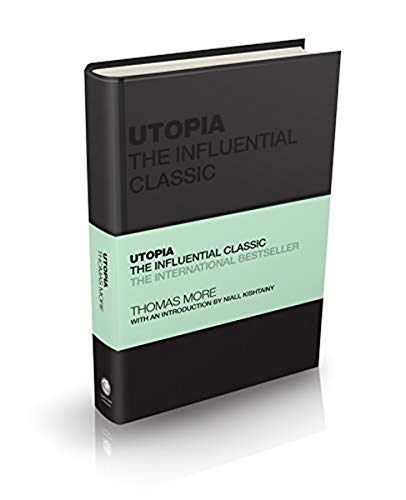
Part of the bestselling Capstone Classics series edited by Tom Butler-Bowdon, this edition features an introduction from writer, economist, and historian Niall Kishtainy.
"synopsis" may belong to another edition of this title.
SIR THOMAS MORE was a rising intellectual star of Renaissance Europe. His brilliance made him an advisor and friend of King Henry VIII. More's Utopia contrasts the squalor and brutal politics of the England of his time with a picture of a peaceful and prosperous society.
NIALL KISHTAINY is a writer with interests in economics and in the history of ideas. He holds a PhD in economics from the University of Warwick and has taught economic history at the London School of Economics. His most recent book, A Little History of Economics, was published by Yale University Press in 2017.
TOM BUTLER-BOWDEN is Series Editor of the Capstone Classics series, and has provided introductions for Plato's Republic, Adam Smith's Wealth of Nations, Machiavelli's The Prince, Florence Scovel Shinn's The Game of Life and How to Play It, and Kahlil Gibran's The Prophet. A graduate of the London School of Economics, he is also the author of 50 Economics Classics (2017) and 50 Politics Classics (2015).
www.butler-bowdon.com
DISCOVER THE ENDURING MYSTERY OF UTOPIA
Since its original publication 500 years ago, Utopia has been embraced by its readers as a timeless exploration of topics like money, property, crime, education, religious tolerance, euthanasia, and feminism. Consisting of a traveller' account of a newly discovered island in which the inhabitants share a common culture and way of life, Utopia stood as a stark contrast to the poverty, crime, and corruption that characterised much of 16th century Europe.
For centuries, the concepts author Sir Thomas More shares in Utopia have resonated with people around the globe.
OTHER TITLES AVAILABLE IN THE CLASSICS SERIES FROM CAPSTONE
A Room of One's Own, Virginia Woolf,
978-0-857-08882-6
Beyond Good and Evil, Friedrich Nietzsche,
978-0-857-08848-2
Letters From a Stoic, Seneca,
978-1-119-75135-9
Meditations, Marcus Aurelius,
978-0-857-08846-8
On the Origin of Species, Charles Darwin,
978-0-857-08847-5
Tao Te Ching, Lao Tzu,
978-0-857-08311-1
The Art of War, Sun Tzu,
978-0-857-08009-7
The Communist Manifesto, Karl Marx and Frederick Engels,
978-0-857-08876-5
The Game of Life and How to Play It, Florence Scovel Shinn,
978-0-857-08840-6
The Interpretation of Dreams Sigmund Freud,
978-0-857-08844-4
The Prince, Niccolo Machiavelli,
978-0-857-08078-3
The Prophet, Kahlil Gibran,
978-0-857-08855-0
The Republic, Plato,
978-0-857-08313-5
The Science of Getting Rich, Wallace Wattles,
978-0-857-08008-0
The Wealth of Nations, Adam Smith,
978-0-857-08077-6
Think and Grow Rich, Napoleon Hill,
978-1-906-46559-9
"About this title" may belong to another edition of this title.
Seller: World of Books (was SecondSale), Montgomery, IL, U.S.A.
Condition: Very Good. Item in very good condition! Textbooks may not include supplemental items i.e. CDs, access codes etc. Seller Inventory # 00084758460
Seller: World of Books (was SecondSale), Montgomery, IL, U.S.A.
Condition: Good. Item in good condition. Textbooks may not include supplemental items i.e. CDs, access codes etc. Seller Inventory # 00086142676
Seller: HPB-Emerald, Dallas, TX, U.S.A.
hardcover. Condition: Very Good. Connecting readers with great books since 1972! Used books may not include companion materials, and may have some shelf wear or limited writing. We ship orders daily and Customer Service is our top priority! Seller Inventory # S_455769207
Seller: GreatBookPrices, Columbia, MD, U.S.A.
Condition: As New. Unread book in perfect condition. Seller Inventory # 41424412
Seller: GreatBookPrices, Columbia, MD, U.S.A.
Condition: New. Seller Inventory # 41424412-n
Seller: Rarewaves.com USA, London, LONDO, United Kingdom
Hardback. Condition: New. What we can learn from a Renaissance nowhere In 1516, a book was published in Latin with the enigmatic Greek-derived word as its title. Utopia-which could mean either "good-place" or "no-place"-gives a traveler's account of a newly discovered island somewhere in the New World where the inhabitants enjoy a social order based purely on natural reason and justice. As the traveler describes the harmony, prosperity, and equality found there, a dramatic contrast is drawn between the ideal community he portrays and the poverty, crime, and often frightening political conditions of 16th century Europe. Written by Sir Thomas More (1477-1535)-then a rising intellectual star of the Renaissance and ultimately the advisor and friend of Henry VIII who was executed for his devoutly Catholic opposition to the king-Utopia is as complex as its author. In the form of a Platonic dialogue, Utopia explores topics such as money, property, crime, education, religious tolerance, euthanasia, and feminism. Claimed as a paean to communism (Lenin had More's name inscribed on a statue in Moscow) as often as it has been seen as a defense of traditional medieval values, Utopia began the lineage of utopian thinkers who use storytelling to explore new possibilities for human society-and remains as relevant today as when it was written in Antwerp 500 years ago. Explore the issues like feminism, euthanasia, and equality through Renaissance eyesEarly communist tract or a defense of medieval values? You decide.Peer inside the enigmatic mind of the man who dared stand up to Henry VIIIAppreciate the postmodern possibilities of Platonic dialogue Part of the bestselling Capstone Classics series edited by Tom Butler-Bowdon, this edition features an introduction from writer, economist, and historian Niall Kishtainy. Seller Inventory # LU-9781119754381
Quantity: 18 available
Seller: Grand Eagle Retail, Bensenville, IL, U.S.A.
Hardcover. Condition: new. Hardcover. In 1516, a book was published in Latin with the enigmatic Greek-derived word as its title. Utopiawhich could mean either good-place or no-placegives a travelers account of a newly discovered island somewhere in the New World where the inhabitants enjoy a social order based purely on natural reason and justice. As the traveler describes the harmony, prosperity, and equality found there, a dramatic contrast is drawn between the ideal community he portrays and the poverty, crime, and often frightening political conditions of 16th century Europe. Written by Sir Thomas More (14771535)then a rising intellectual star of the Renaissance and ultimately the advisor and friend of Henry VIII who was executed for his devoutly Catholic opposition to the kingUtopia is as complex as its author. In the form of a Platonic dialogue, Utopia explores topics such as money, property, crime, education, religious tolerance, euthanasia, and feminism. Claimed as a paean to communism (Lenin had Mores name inscribed on a statue in Moscow) as often as it has been seen as a defense of traditional medieval values, Utopia began the lineage of utopian thinkers who use storytelling to explore new possibilities for human societyand remains as relevant today as when it was written in Antwerp 500 years ago. Explore the issues like feminism, euthanasia, and equality through Renaissance eyes Early communist tract or a defense of medieval values? You decide. Peer inside the enigmatic mind of the man who dared stand up to Henry VIII Appreciate the postmodern possibilities of Platonic dialogue Part of the bestselling Capstone Classics series edited by Tom Butler-Bowdon, this edition features an introduction from writer, economist, and historian Niall Kishtainy. Shipping may be from multiple locations in the US or from the UK, depending on stock availability. Seller Inventory # 9781119754381
Seller: PBShop.store UK, Fairford, GLOS, United Kingdom
HRD. Condition: New. New Book. Shipped from UK. Established seller since 2000. Seller Inventory # FW-9781119754381
Quantity: 15 available
Seller: WorldofBooks, Goring-By-Sea, WS, United Kingdom
Paperback. Condition: Very Good. What we can learn from a Renaissance nowhere In 1516, a book was published in Latin with the enigmatic Greek-derived word as its title. Utopiawhich could mean either "good-place" or "no-place"gives a traveler's account of a newly discovered island somewhere in the New World where the inhabitants enjoy a social order based purely on natural reason and justice. As the traveler describes the harmony, prosperity, and equality found there, a dramatic contrast is drawn between the ideal community he portrays and the poverty, crime, and often frightening political conditions of 16th century Europe. Written by Sir Thomas More (14771535)then a rising intellectual star of the Renaissance and ultimately the advisor and friend of Henry VIII who was executed for his devoutly Catholic opposition to the kingUtopia is as complex as its author. In the form of a Platonic dialogue, Utopia explores topics such as money, property, crime, education, religious tolerance, euthanasia, and feminism. Claimed as a paean to communism (Lenin had More's name inscribed on a statue in Moscow) as often as it has been seen as a defense of traditional medieval values, Utopia began the lineage of utopian thinkers who use storytelling to explore new possibilities for human societyand remains as relevant today as when it was written in Antwerp 500 years ago. Explore the issues like feminism, euthanasia, and equality through Renaissance eyes Early communist tract or a defense of medieval values? You decide. Peer inside the enigmatic mind of the man who dared stand up to Henry VIII Appreciate the postmodern possibilities of Platonic dialogue Part of the bestselling Capstone Classics series edited by Tom Butler-Bowdon, this edition features an introduction from writer, economist, and historian Niall Kishtainy. The book has been read, but is in excellent condition. Pages are intact and not marred by notes or highlighting. The spine remains undamaged. Seller Inventory # GOR011498510
Quantity: 1 available
Seller: Majestic Books, Hounslow, United Kingdom
Condition: New. Seller Inventory # 392320509
Quantity: 3 available