
Items related to The Mathematical Coloring Book: Mathematics of Coloring...
The Mathematical Coloring Book: Mathematics of Coloring and the Colorful Life of its Creators - Softcover
Synopsis
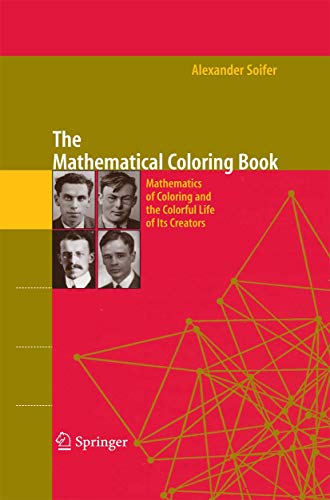
This book is dedicated to problems involving colored objects, and to results about the existence of certain exciting and unexpected properties that occur regardless of how these objects are colored. In mathematics, these results comprise the beautiful area known as Ramsey Theory. Ramsey Theory includes parts of many fields of mathematics, including combinatorics, geometry, and number theory. This book addresses famous and exciting problems of Ramsey Theory, along with the history surrounding the discovery of Ramsey Theory. In addition, the author studies the life of Issai Schur, Pierre Joseph Henry Baudet and B.L. van der Waerden. Due to the author's correspondence with van der Waerden, Erdös, and Schur, this book contains material that has never before been published. Historians of mathematics will herein find much new information, along with old errors corrected and published here for the first time in book form.
"synopsis" may belong to another edition of this title.
About the Author
Alexander Soifer is a Russian born and educated American mathematician, a professor of mathematics at the University of Colorado, an author of some 200 articles on mathematics, history of mathematics, mathematics education, film reviews, etc. He is Senior Vice President of the World Federation of National Mathematics Competitions, which in 2006 awarded him The Paul Erdös Award. 26 years ago Soifer founded has since chaired The Colorado Mathematical Olympiad, and served on both USSR and USA Mathematical Olympiads committees. Soifer’s Erdös number is 1.
Springer has contracted his 7 books. "The Mathematical Coloring Book" is coming out in October 2008; 4 books will appear in 2009; followed by "Life and Fate: In Search of Van der Waerden", and a joint book with the late Paul Erdos “Problems of p.g.o.m. Erdos."
The author's previous books were self-published and received many positive reviews, below are excerpts from reviews of "How Does One Cut A Triangle?:
"Why am I urging you to read this? Mainly because it is such a refreshing book. Professor Soifer makes the problems fascinating, the methods of attack even more fascinating, and the whole thing is enlivened by anecdotes about the history of the problems, some of their recent solvers, and the very human reactions of the author to some beautiful mathematics. Most of all, the book has charm, somehow enhanced by his slightly eccentric English, sufficient to carry the reader forward without minding being asked to do rather a lot of work.
I am tempted to include several typical quotations but I'll restrain myself to two: From Chapter 8 "Here is an easy problem for your entertainment. Problem 8.1.2. Prove that for any parallelogram P, S(P)=5. Now we have a new problem, therefore we are alive! And the problem is this: what are all possible values of our newly introduced function S(F)? Can the function S(F) help us to classify geometry figures?"
And from an introduction by Cecil Rousseau:
‘There is a view, held by many, that mathematics books are dull. This view is not without support. It is reinforced by numerous examples at all levels, from elementary texts with page after page of mind-numbing drill to advanced books written in a relentless Theorem-Proof style. "How does one cut a triangle?" is an entirely different matter. It reads like an adventure story. In fact, it is an adventure story, complete with interesting characters, moments of exhilaration, examples of serendipity, and unanswered questions. It conveys the spirit of mathematical discovery and it celebrates the event as have mathematicians throughout history.’
And this isn't just publishers going over the top - it's all true!"
-- JOHN Baylis in The Mathematical Gazette
Soifer's work can rightly be called a "mathematical gem."
-- JAMES N. BOYD in Mathematics Teacher
This delightful book considers and solves many problems in dividing triangles into n congruent pieces and also into similar pieces, as well as many extremal problems about placing points in convex figures. The book is primarily meant for clever high school students and college students interested in geometry, but even mature mathematicians will find a lot of new material in it. I very warmly recommend the book and hope the readers will have pleasure in thinking about the unsolved problems and will find new ones.
-- PAUL ERDÖS
It is impossible to convey the spirit of the book by merely listing the problems considered or even a number of solutions. The manner of presentation and the gentle guidance toward a solution and hence to generalizations and new problems takes this elementary treatise out of the prosaic and into the stimulating realm of mathematical creativity. Not only young talented people but dedicated secondary teachers and even a few mathematical sophisticates will find this reading both pleasant and profitable.
-- L. M. KELLY in Mathematical Reviews
We do not often have possibilities to look into a creative workshop of a mathematician... The beginner, who is interested in the book, not only comprehends a situation in a creative mathematical studio, not only is exposed to good mathematical taste, but also acquires elements of modern mathematical culture. And (not less important) the reader imagines the role and place of intuition and analogy in mathematical investigation; he or she fancies the meaning of generalization in modern mathematics and surprising connections between different parts of this science (that are, as one might think, far from each other) that unite them... This makes the book alive, fresh, and easily readable. Alexander Soifer has produced a good gift for the young lover of mathematics. And not only for youngsters; the book should be interesting even to professional mathematicians.
V. G. BOLTYANSKI in SIAM Review
From the Back Cover
I have never encountered a book of this kind. The best description of it I can give is that it is a mystery novel I found it hard to stop reading before I finished (in two days) the whole text. Soifer engages the reader's attention not only mathematically, but emotionally and esthetically. May you enjoy the book as much as I did!
Branko Grünbaum
University of Washington
You are doing great service to the community by taking care of the past, so the things are better understood in the future.
Stanislaw P. Radziszowski, Rochester Institute of Technology
They [Van der Waerden s sections] meet the highest standards of historical scholarship.
Charles C. Gillispie, Princeton University
You have dug up a great deal of information my compliments!
Dirk van Dalen, Utrecht University
I have just finished reading your (second) article "in search of van der Waerden". It is a masterpiece, I could not stop reading it... Congratulations!
Janos Pach, Courant Institute of Mathematics
"Mathematical Coloring Book" will (we can hope) have a great and salutary influence on all writing on mathematics in the future.
Peter D. Johnson Jr., Auburn University
Just now a postman came to the door with a copy of the masterpiece of the century. I thank you and the mathematics community should thank you for years to come. You have set a standard for writing about mathematics and mathematicians that will be hard to match.
Harold W. Kuhn, Princeton University
The beautiful and unique Mathematical coloring book of Alexander Soifer is another case of ``good mathematics'' and presenting mathematics as both a science and an art It is difficult to explain how much beautiful and good mathematics is included and how much wisdom about life is given.
Peter Mihók, Mathematical Reviews
"About this title" may belong to another edition of this title.
Search results for The Mathematical Coloring Book: Mathematics of Coloring...

Stock Image
The Mathematical Coloring Book: Mathematics of Coloring and the Colorful Life of its Creators
Published by
Springer, 2014
ISBN 10: 1489996265
ISBN 13: 9781489996268
Used
Soft cover
First Edition
Seller: Jackson Street Booksellers, Omaha, NE, U.S.A.
Seller rating 5 out of 5 stars

Soft cover. Condition: Near Fine. No Jacket. 1st Edition. Near Fine in Softcover. 605pp 8vo. 1st Printing. Seller Inventory # 162935
Stock Image
The Mathematical Coloring Book: Mathematics of Coloring and the Colorful Life of its Creators
Seller: Mispah books, Redhill, SURRE, United Kingdom
Seller rating 4 out of 5 stars

Paperback. Condition: Like New. LIKE NEW. SHIPS FROM MULTIPLE LOCATIONS. book. Seller Inventory # ERICA77314899962656
Buy Used
US$ 349.18
US$ 33.11 shipping
Ships from United Kingdom to U.S.A.
Ships from United Kingdom to U.S.A.
Quantity: 1 available