
Items related to The Book of Dave: A Novel
Synopsis
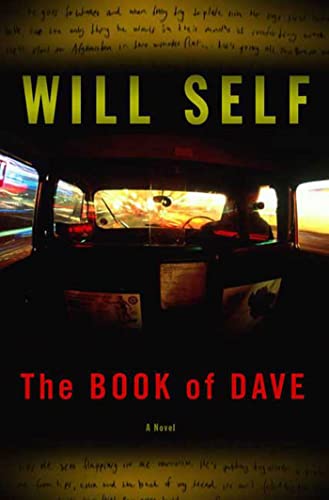
When cabdriver Dave Rudman's wife of five years deserts him for another man, taking their only child with her, he is thrown into a tailspin of doubt and discontent. Fearing his son will never know his father, Dave pens a gripping text―part memoir, part deranged philosophical treatise, and part handbook of "the Knowledge" learned by all London cab drivers. Meant for the boy when he comes of age, the book captures the frustration and anxiety of modern life. Five hundred years later, the Book of Dave is discovered by the inhabitants on the island of Ham, where it becomes a sacred text of biblical proportion, and its author is revered as a mighty prophet.
"synopsis" may belong to another edition of this title.
About the Author
Will Self is the acclaimed author of such books as The Quantity Theory of Insanity, Great Apes, and How the Dead Live. He won the Geoffrey Faber Memorial Prize and was shortlisted for the Whitbread Book of the Year. Will Self lives in London.
Reviews
First, the bad news: Reading Will Self's long, complicated new novel requires regular consultation of its glossary of invented words and a good English-language dictionary. Once decoded, the narrative seethes with domestic violence, misogyny, religious repression, bigotry, public torture, mental illness and cruelty to animals. More than a few scenes are spectacularly disgusting, a hallmark of this prolific British writer's fiction. And have I mentioned the dialogue, which often reads like text messages from baby-talking Cockney space aliens?
The good news is that, while The Book of Dave is sometimes as aggressively off-putting as Self's five previous novels, it's also a richer, more engaging enterprise. In each of those earlier books there lurked a magic page of doom on which the reader became certain that Self had already thoroughly explored his gimmicky premise -- the guy is really a chimpanzee in Great Apes; death is just a more tedious version of life in How the Dead Live -- and would now spend several hundred more pages methodically kicking the life out of it.
No such page exists in the new novel, whose plot is sturdy enough to support its voluptuous prose. Most significantly, the author has worked hard to increase his emotional repertoire from a three-chord punk chorus of rage, contempt and despair to a more expansive range of sensibility.
There's still plenty of rage embodied here in Dave Rudman, a balding, hemorrhoidal London taxi driver who is undergoing a nasty divorce during the first cacophonous years of our current millennium. Dave's wife, Michelle, holds all the cards in the custody battle over their son, Carl. Nothing -- not the "Fathers First" support group Dave attends, not his love for the city or his proud command of "the Knowledge," the rote memorization of its streets and landmarks that all licensed London cabbies must learn -- can assuage the bitterness of his fatherhood denied.
Though he will later come to regret it, Dave compiles his grievances against Michelle during a drug-fueled psychotic breakdown. He types up an assortment of rants, delusional prejudices and a recitation of the Knowledge into a long tirade, a "book of Dave," which he buries in the backyard of his ex-wife's Hampstead house.
Alternating with these chapters is a narrative that unfolds hundreds of years later, after a great flood has turned London and its environs into an archipelago. The most vital relic from the antediluvian world is the "Book of Dave," exhumed long ago from its Hampstead hiding place and worshiped as a bible by a new civilization, with Dave as its god. On its farthermost island, called Ham, residents live a primitive agrarian life, governed by a tyrannical theocracy and organized around their deity's now-sacred preoccupations: 21st-century cabbie lore and child-custody laws. They speak a Cockney-like dialect in which "Hello" becomes "Ware2, guv," evil is "chellish" (after Michelle), priests are "Drivers" and souls are "fares."
In daily prayers, the Hamsters thank Dave fervently for picking them up and beg him not to drop them off, chanting the names of extinct London streets from obsolete cab-driving routes. Men must live separately from women, who are routinely abused and forced to do most of the work. Children are required to observe Changeover, spending half the week with their mums and half with dads, who delegate childcare duties to "opares," or unmarried girls.
Anyone who dares to flout these edicts risks being remanded to the capital for a gaudy public trial followed by agonizing punishments. No actual taxis exist in this post-technological realm; in fact, there are no wheels except in the far-off capital, which boasts a huge, Inquisition-like wheel of torture used to punish heretics. As a futuristic fantasy, Ham looks a lot more like the Hundred Acre Wood than "Blade Runner." It's a hushed nursery dreamscape of fairy-tale forests, stern father figures and giant hairy affectionate beasts called motos, who speak toddler-talk in a "slushy lisp" and do not, as anyone familiar with Self's graphic imagination can be assured, come to a pretty end.
The contrast between Ham's crude culture and Dave's modern London, with its millions of cellphones triggering "the neuralgia of ceaseless communication," is part of the book's larger point about history's circularity. With ingenious symmetry, Self's alternating chapters show how shakily new civilizations are built atop the bones and ghosts of the past, never really progressing, each caught up in its own "centrifugal strivings." Yet each era calls out to others, throwing out hints of its existence that are only dimly apprehended. Stuck in traffic, Dave daydreams about a great flood; stuck on their island, the Hamsters covet inscrutable plastic shards stamped "Made in China."
The symmetry extends to individuals as well as centuries. Dave wanders through London yearning to reclaim his son, Carl, eventually finding a paternal role where he never expected it; while in the future a young boy, also named Carl, searches the same altered territory for a lost father and finds satisfaction in equally surprising ways.
These wistful time-echoes are much more stirring than Self's illustrations of the dangers of fundamentalist faith. His construction of a worst-case vision of religious repression out of the ravings of a floundering secular shlub is the same kind of jokey premise he beat to death in his earlier books, devolving into an empty pageant of caricature. What's most memorable here is not the panoramic vistas of these two dispiriting worlds, but their characters' brief moments of kindness, resonant as heartbeats under the shifting debris.
Reviewed by Donna Rifkind
Copyright 2006, The Washington Post. All Rights Reserved.
Starred Review. Self, the provocative British raconteur who used the Tibetan Book of the Dead to map London (How the Dead Live, 2000) is taking another literary shot across his home city's bow. In his gleaming new puzzlebook, Self creates a dystopian future London, ruled by a cynosure of priests, lawyers and the monarchy. He invents Arpee, the musical language they speak that is based on a sacred text—The Book of Dave—which also serves, satirically, as the society's moral and legal foundation. And who is this deity named Dave? An embittered London cabbie from the distant past—the year 2000.As the book opens, the kingdom of Ingerland is ruled by the elite and ruthless PCO. (Self is riffing on the Public Carriage Office, London's transit authority.) People live according to The Book of Dave, which was recovered after a great flood wiped out London in the MadeinChina era. Flashing back more than 500 years, cabbie Dave Rudman types out his idiosyncratic, misogynist, bile-tinged fantasies while in a fit of antidepressant-induced psychosis and battling over the custody of his child, Carl. His screed becomes both a blueprint for a harsh childrearing climate (mummies and daddies living apart, with the kids splitting time between them) and a full-blown cosmology. As Self moves between eras, he divides the book between Dave's story and the story of the great Flying (slang in the future for "heresy"). The latter involves the appearance of the Geezer (prophet) on the island of Ham (Hampshire) in 508 A.D. (after the "purported discovery of the Book of Dave"), who claims to have found a second Book of Dave annulling the "tiresome strictures" of the first. He is imprisoned by the PCO and mangled beyond recognition, but, 14 years later, his son, Carl Dévúsh, travels from Ham to New London, determined to create a less cruel world that responds to the "mummyself" within. Self's invention of a future language (including dialect Mokni, which combines cabby slang, cockney and the Esperanto of graffiti—and, yes, a dictionary is provided) is wickedly brilliant, with surprising moments of childlike purity punctuating the lexicon's crude surface (a "fuckoffgaff" is a "lawyerly place," while "wooly" means sheep). Self is endlessly talented, and in crossbreeding a fantasy novel with a scorching satire of contemporary mores, he's created a beautiful monster of the future that feeds on the neurotic present—and its parents. (Nov.)
Copyright © Reed Business Information, a division of Reed Elsevier Inc. All rights reserved.
In this tale of an embittered taxi-driver whose psychotic rantings become the creed of a blighted people hundreds of years after his death, Self unleashes his apparently boundless misanthropy on modern London, the origins of religion, and the postapocalyptic future. Dave Rudman, driven mad by divorce and ill-prescribed antidepressants, thinks he is God and writes a vitriolic screed, which he has printed on metal plates and buries in a garden. Discovered by the survivors of a catastrophic flood and adopted as a gospel, it demands the complete separation of mothers and fathers (children to spend exactly half the week with each). Switching between a narrative of Dave's unlucky life and the phonetically rendered "Mokni" speech of his wretched followers, Self achieves an elaborate vision of vicious superstition and hopeless struggle, but his insights never quite repay the effort of engaging with his stylistic pyrotechnics.
Copyright © 2006 Click here to subscribe to The New Yorker
*Starred Review* This searing satire maps the unraveling of London cabbie Dave Rudman's life--and the resulting Book of Dave he prints on metal pages and buries in his former backyard after his ex-wife cuts off visitations with his son. Meanwhile, sometime in the twenty-sixth century or beyond (dating of the period is pegged to "the purported discovery of The Book of Dave"), England has entered a second Dark Age; the country, now called Ing, is broken apart by rising seas and spiritually bankrupted by the twisted teachings of Dave, which mix mad misogynistic dictates with the legendary knowledge of London streets ("the runs and the points") that the city's cabdrivers must internalize. On the former heights of Hampstead, now known as the isle of Ham, villagers live side by side with the gentle motos--walruslike creatures who talk like lisping human children, products of twenty-first-century genetic engineering. As present-day Rudman slowly reclaims his life, the future sons of Ham seek out Dave's rumored second book--the one recanting his earlier ravings and giving mummies and daddies permission to love each other again. But as Dave's ex prophetically muses, "everyday life was made up of a series of small botched actions, which, although instantly forgotten, nonetheless ruined everything." This is as rousing an indictment of organized religion--and especially fundamentalism--as readers are likely to encounter in the post-9/11 canon. Frank Sennett
Copyright © American Library Association. All rights reserved
"About this title" may belong to another edition of this title.
Search results for The Book of Dave: A Novel

Stock Image
The Book of Dave: A Novel
Seller: Half Price Books Inc., Dallas, TX, U.S.A.
Seller rating 5 out of 5 stars

hardcover. Condition: Very Good. Connecting readers with great books since 1972! Used books may not include companion materials, and may have some shelf wear or limited writing. We ship orders daily and Customer Service is our top priority! Seller Inventory # S_480620292
Stock Image
The Book of Dave: A Novel
Seller: HPB Inc., Dallas, TX, U.S.A.
Seller rating 5 out of 5 stars
hardcover. Condition: Very Good. Connecting readers with great books since 1972! Used books may not include companion materials, and may have some shelf wear or limited writing. We ship orders daily and Customer Service is our top priority! Seller Inventory # S_477138244
Stock Image
The Book of Dave: A Revelation of the Recent Past and the Distant Future
Published by
Bloomsbury Publishing PLC, 2006
ISBN 10: 1596911239
ISBN 13: 9781596911239
Used
Hardcover
Seller: World of Books (was SecondSale), Montgomery, IL, U.S.A.
Seller rating 5 out of 5 stars
Hardback. Condition: Good. Seller Inventory # 00110207166
Stock Image
The Book of Dave: A Novel
Seller: World of Books (was SecondSale), Montgomery, IL, U.S.A.
Seller rating 5 out of 5 stars
Condition: Acceptable. Item in acceptable condition! Textbooks may not include supplemental items i.e. CDs, access codes etc. Seller Inventory # 00105847176
Stock Image
The Book of Dave : A Revelation of the Recent Past and the Distant Future
Published by
Bloomsbury Publishing USA, 2006
ISBN 10: 1596911239
ISBN 13: 9781596911239
Used
Hardcover
First Edition
Seller: Better World Books, Mishawaka, IN, U.S.A.
Seller rating 5 out of 5 stars
Condition: Very Good. First Edition. Former library copy. Pages intact with possible writing/highlighting. Binding strong with minor wear. Dust jackets/supplements may not be included. Includes library markings. Stock photo provided. Product includes identifying sticker. Better World Books: Buy Books. Do Good. Seller Inventory # 8024114-75
Stock Image
The Book of Dave : A Revelation of the Recent Past and the Distant Future
Published by
Bloomsbury Publishing USA, 2006
ISBN 10: 1596911239
ISBN 13: 9781596911239
Used
Hardcover
First Edition
Seller: Better World Books, Mishawaka, IN, U.S.A.
Seller rating 5 out of 5 stars
Condition: Good. First Edition. Former library copy. Pages intact with minimal writing/highlighting. The binding may be loose and creased. Dust jackets/supplements are not included. Includes library markings. Stock photo provided. Product includes identifying sticker. Better World Books: Buy Books. Do Good. Seller Inventory # 2949595-6
Stock Image
The Book of Dave: A Novel
Seller: Wonder Book, Frederick, MD, U.S.A.
Seller rating 5 out of 5 stars
Condition: Very Good. Very Good condition. Good dust jacket. A copy that may have a few cosmetic defects. May also contain light spine creasing or a few markings such as an owner's name, short gifter's inscription or light stamp. Seller Inventory # L15B-02987
Stock Image
The Book of Dave: A Novel
Seller: Wonder Book, Frederick, MD, U.S.A.
Seller rating 5 out of 5 stars
Condition: Good. Good condition. Good dust jacket. A copy that has been read but remains intact. May contain markings such as bookplates, stamps, limited notes and highlighting, or a few light stains. Seller Inventory # J11G-00705
Stock Image
The Book of Dave: A Novel
Seller: HPB-Movies, Dallas, TX, U.S.A.
Seller rating 4 out of 5 stars

hardcover. Condition: Very Good. Connecting readers with great books since 1972! Used books may not include companion materials, and may have some shelf wear or limited writing. We ship orders daily and Customer Service is our top priority! Seller Inventory # S_464451504
Stock Image
The Book of Dave: A Novel
Seller: ThriftBooks-Phoenix, Phoenix, AZ, U.S.A.
Seller rating 5 out of 5 stars
Hardcover. Condition: Very Good. No Jacket. May have limited writing in cover pages. Pages are unmarked. ~ ThriftBooks: Read More, Spend Less. Seller Inventory # G1596911239I4N00