
Items related to Assembly Line Design: The Balancing of Mixed-Model...
Assembly Line Design: The Balancing of Mixed-Model Hybrid Assembly Lines with Genetic Algorithms (Springer Series in Advanced Manufacturing) - Softcover
Book 3 of 74: Springer Series in Advanced Manufacturing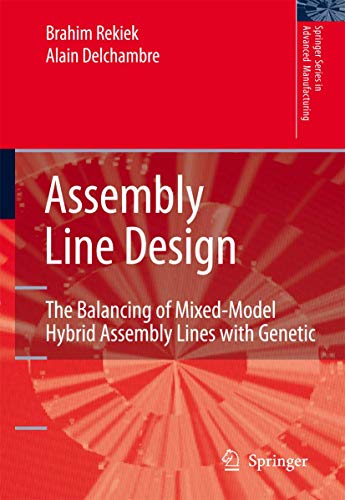
Synopsis
Efficient assembly line design is a problem of industrial importance. Assembly line design is often complex due to the multiple components involved: efficiency, cost and space. The aim is to integrate the design with operations issues, minimising costs.
It is important to give the designer tools to help him meet the different objectives. 3 techniques based on the Grouping Genetic Algorithm are presented which can be used to aid assembly line design:
- ‘equal piles for assembly lines’ deals with assembly line balancing (balancing stations’ loads);
- a method based on a multiple objective grouping genetic algorithm (MO-GGA) deals with resource planning (selection of equipment);
- ‘balance for operation’, deals with the changes during the operation of assembly lines.
This book will interest technical personnel in design, planning and production departments in industry as well as managers in industry. It will also be of use to researchers and postgraduates in mechanical, manufacturing or micro-engineering.
"synopsis" may belong to another edition of this title.
About the Author
Rekiek Brahim received a license in Physics from the Univetsité Abdel Malek Essaadi, Tetouan and the D.E.S in production and robotics at the Université Libre de Bruxelles (U.L.B.), Brussels in 1994 and 1996, respectively. He received his Ph.D. degree in Artificial Intelligence in 2000 from the Université Libre de Bruxelles. Much of his work was carried out in collaboration with industrial companies. From 2001 to 2002, he worked as a member of the Sales Marketing Service at Fabricom Airports Systems, Brussels, Belgium. Since 2002, he has been working as a member of the Projects Management team. He has been an analyst and project manager responsible for the development of the baggage handling systems of many airports. His interests include software architecture, systems design, concurrent engineering, and artificial intelligence.
Alain Delchambre obtained his Master and Phd degrees in Mechanical Engineering from the University of Brussels (ULB) in 1983 and 1990 respectively. After three years in industry, he joined a research centre for the Belgian Metalworking Industry (CRIF/WTCM). Since 1994, he has been a Professor at the Faculty of Applied Sciences in ULB and is head of the CADCAM department. He has published three books and more than 80 papers in the areas of concurrent engineering, computer aided design and genetic algorithms.
From the Back Cover
Efficient assembly line design is a problem of considerable industrial importance. Unfortunately, like many other design processes, it can be time-consuming and repetitive. In addition to this, assembly line design is often complex owing to the number of multiple components involved: line efficiency, cost, reliability and space for example. The main objective is to integrate the design with operations issues, thereby minimising its costs.
Since it is impossible to replace a designer’s intelligence, experience and creativity, it is important to provide him with a set of assistance tools in order to meet the conflicting objectives involved. Assembly Line Design presents three techniques based on the Grouping Genetic Algorithm (a powerful and broadly applicable optimisation and stochastic search technique) which can be used to aid efficient assembly line design:
• ‘equal piles for assembly lines’, a new algorithm introduced to deal with assembly line balancing (balancing stations’ loads);
• a new method based on a multiple objective grouping genetic algorithm (MO-GGA) aiming to deal with resource planning (selection of equipment to carry out assembly tasks);
‘• balance for operation’ (BFO), introduced to deal with the changes during the operation phase of assembly lines.
Assembly Line Design will be of interest to technical personnel working in design, planning and production departments in industry as well as managers in industry who want to learn more about concurrent engineering. This book will also be of value to researchers and postgraduate students in mechanical, manufacturing or micro-engineering.
The Springer Series in Advanced Manufacturing publishes the best teaching and reference material to support students, educators and practitioners in manufacturing technology and management. This international series includesadvanced textbooks, research monographs, edited works and conference proceedings covering all subjects in advanced manufacturing. The series focuses on new topics of interest, new treatments of more traditional areas and coverage of the applications of information and communication technology (ICT) in manufacturing.
"About this title" may belong to another edition of this title.
Search results for Assembly Line Design: The Balancing of Mixed-Model...

Stock Image
Assembly Line Design (eng)
Print on DemandSeller: Brook Bookstore On Demand, Napoli, NA, Italy
Seller rating 5 out of 5 stars

Condition: new. Questo è un articolo print on demand. Seller Inventory # MBTOG3BCJP
Buy New
US$ 108.73
US$ 6.16 shipping
Ships from Italy to U.S.A.
Ships from Italy to U.S.A.
Quantity: Over 20 available
Stock Image
Assembly Line Design : The Balancing of Mixed-model Hybrid Assembly Lines With Genetic Algorithms
Seller: GreatBookPrices, Columbia, MD, U.S.A.
Seller rating 5 out of 5 stars
Condition: New. Seller Inventory # 11863298-n
Seller Image
Assembly Line Design
Published by
Springer, Springer London Okt 2010, 2010
ISBN 10: 1849965552
ISBN 13: 9781849965552
New
Taschenbuch
Seller: BuchWeltWeit Ludwig Meier e.K., Bergisch Gladbach, Germany
Seller rating 5 out of 5 stars
Taschenbuch. Condition: Neu. This item is printed on demand - it takes 3-4 days longer - Neuware -Efficient assembly line design is a problem of industrial importance. Assembly line design is often complex due to the multiple components involved: efficiency, cost and space. The aim is to integrate the design with operations issues, minimising costs.It is important to give the designer tools to help him meet the different objectives. 3 techniques based on the Grouping Genetic Algorithm are presented which can be used to aid assembly line design:- 'equal piles for assembly lines' deals with assembly line balancing (balancing stations' loads); - a method based on a multiple objective grouping genetic algorithm (MO-GGA) deals with resource planning (selection of equipment); - 'balance for operation', deals with the changes during the operation of assembly lines. This book will interest technical personnel in design, planning and production departments in industry as well as managers in industry. It will also be of use to researchers and postgraduates in mechanical, manufacturing or micro-engineering. 180 pp. Englisch. Seller Inventory # 9781849965552
Buy New
US$ 135.77
US$ 25.76 shipping
Ships from Germany to U.S.A.
Ships from Germany to U.S.A.
Quantity: 2 available
Seller Image
Assembly Line Design
Seller: moluna, Greven, Germany
Seller rating 5 out of 5 stars
Condition: New. Seller Inventory # 4288682
Buy New
US$ 116.56
US$ 54.87 shipping
Ships from Germany to U.S.A.
Ships from Germany to U.S.A.
Quantity: Over 20 available
Seller Image
Assembly Line Design : The Balancing of Mixed-Model Hybrid Assembly Lines with Genetic Algorithms
Seller: AHA-BUCH GmbH, Einbeck, Germany
Seller rating 5 out of 5 stars
Taschenbuch. Condition: Neu. Druck auf Anfrage Neuware - Printed after ordering - Efficient assembly line design is a problem of industrial importance. Assembly line design is often complex due to the multiple components involved: efficiency, cost and space. The aim is to integrate the design with operations issues, minimising costs.It is important to give the designer tools to help him meet the different objectives. 3 techniques based on the Grouping Genetic Algorithm are presented which can be used to aid assembly line design:- 'equal piles for assembly lines' deals with assembly line balancing (balancing stations' loads); - a method based on a multiple objective grouping genetic algorithm (MO-GGA) deals with resource planning (selection of equipment); - 'balance for operation', deals with the changes during the operation of assembly lines. This book will interest technical personnel in design, planning and production departments in industry as well as managers in industry. It will also be of use to researchers and postgraduates in mechanical, manufacturing or micro-engineering. Seller Inventory # 9781849965552
Buy New
US$ 144.49
US$ 39.20 shipping
Ships from Germany to U.S.A.
Ships from Germany to U.S.A.
Quantity: 1 available
Stock Image
Assembly Line Design
Seller: Books Puddle, Woodside, NY, U.S.A.
Seller rating 4 out of 5 stars

Condition: New. pp. 180. Seller Inventory # 263112532
Stock Image
Assembly Line Design: The Balancing of Mixed-Model Hybrid Assembly Lines with Genetic Algorithms (Springer Series in Advanced Manufacturing)
Seller: Ria Christie Collections, Uxbridge, United Kingdom
Seller rating 5 out of 5 stars
Condition: New. In English. Seller Inventory # ria9781849965552_new
Buy New
US$ 175.94
US$ 12.38 shipping
Ships from United Kingdom to U.S.A.
Ships from United Kingdom to U.S.A.
Quantity: Over 20 available
Seller Image
Assembly Line Design | The Balancing of Mixed-Model Hybrid Assembly Lines with Genetic Algorithms
Seller: preigu, Osnabrück, Germany
Seller rating 5 out of 5 stars
Taschenbuch. Condition: Neu. Assembly Line Design | The Balancing of Mixed-Model Hybrid Assembly Lines with Genetic Algorithms | Brahim Rekiek (u. a.) | Taschenbuch | Springer Series in Advanced Manufacturing | xviii | Englisch | 2010 | Springer | EAN 9781849965552 | Verantwortliche Person für die EU: Springer Verlag GmbH, Tiergartenstr. 17, 69121 Heidelberg, juergen[dot]hartmann[at]springer[dot]com | Anbieter: preigu. Seller Inventory # 107247803
Buy New
US$ 120.27
US$ 78.40 shipping
Ships from Germany to U.S.A.
Ships from Germany to U.S.A.
Quantity: 5 available
Stock Image
Assembly Line Design
Print on DemandSeller: Majestic Books, Hounslow, United Kingdom
Seller rating 4 out of 5 stars
Condition: New. Print on Demand pp. 180 95 Illus. Seller Inventory # 5816715
Buy New
US$ 193.26
US$ 8.59 shipping
Ships from United Kingdom to U.S.A.
Ships from United Kingdom to U.S.A.
Quantity: 4 available
Seller Image
Assembly Line Design
Published by
Springer, Springer London Okt 2010, 2010
ISBN 10: 1849965552
ISBN 13: 9781849965552
New
Taschenbuch
Seller: buchversandmimpf2000, Emtmannsberg, BAYE, Germany
Seller rating 5 out of 5 stars
Taschenbuch. Condition: Neu. This item is printed on demand - Print on Demand Titel. Neuware -Efficient assembly line design is a problem of industrial importance. Assembly line design is often complex due to the multiple components involved: efficiency, cost and space. The aim is to integrate the design with operations issues, minimising costs.It is important to give the designer tools to help him meet the different objectives. 3 techniques based on the Grouping Genetic Algorithm are presented which can be used to aid assembly line design: ¿equal piles for assembly lines¿ deals with assembly line balancing (balancing stations¿ loads); a method based on a multiple objective grouping genetic algorithm (MO-GGA) deals with resource planning (selection of equipment); ¿balance for operation¿, deals with the changes during the operation of assembly lines.This book will interest technical personnel in design, planning and production departments in industry as well as managers in industry. It will also be of use to researchers and postgraduates in mechanical, manufacturing or micro-engineering.Springer-Verlag KG, Sachsenplatz 4-6, 1201 Wien 180 pp. Englisch. Seller Inventory # 9781849965552
Buy New
US$ 135.77
US$ 67.20 shipping
Ships from Germany to U.S.A.
Ships from Germany to U.S.A.
Quantity: 1 available