
Items related to Molecular Response Functions for the Polarizable Continuum...
Molecular Response Functions for the Polarizable Continuum Model: Physical basis and quantum mechanical formalism (SpringerBriefs in Molecular Science) - Softcover
Book 40 of 220: SpringerBriefs in Molecular Science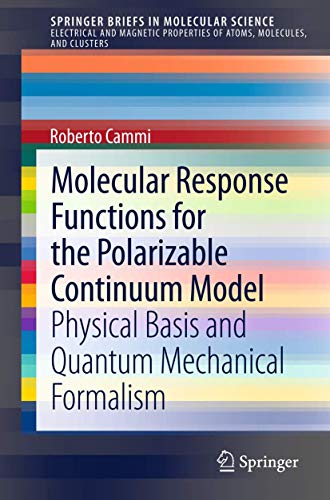
Synopsis
This Brief presents the main aspects of the response functions theory (RFT) for molecular solutes described within the framework of the Polarizable Continuum Model (PCM). PCM is a solvation model for a Quantum Mechanical molecular system in which the solvent is represented as a continuum distribution of matter. Particular attention is devoted to the description of the basic features of the PCM model, and to the problems characterizing the study of the response function theory for molecules in solution with respect to the analogous theory on isolated molecules.
"synopsis" may belong to another edition of this title.
About the Author
Professor, Chemical Physics and Theoretical Chemistry, University of Parma, Ph.D. University of Parma Contributions to Gaussian: Analytical derivatives theory for the Polarizable Continuum Model (PCM) Research Interests Development of coupled-cluster level theories for analytical derivatives and molecular response functions of molecules in solution described with the Polarizable Continuum Model New computational methods for the study of molecular properties and molecular processes at high pressure (of the order of GPa) Cavity field effects for chiroptical response functions of molecules in solution. Solvation thermodynamics
From the Back Cover
This brief presents the main aspects of the response functions theory (RFT) for molecular solutes described within the framework of the Polarizable Continuum Model (PCM). PCM is a solvation model for a Quantum Mechanical molecular system in which the solvent is represented as a continuum distribution of matter. Particular attention is devoted (i) to the description of the basic features of the PCM model, and (ii) to the problems characterizing the study of the response function theory for molecules in solution with respect to the analogous theory on isolated molecules.
"About this title" may belong to another edition of this title.
Search results for Molecular Response Functions for the Polarizable Continuum...

Stock Image
MOLECULAR RESPONSE FUNCTIONS FOR THE POL (eng)
Print on DemandSeller: Brook Bookstore On Demand, Napoli, NA, Italy
Seller rating 5 out of 5 stars

Condition: new. Questo è un articolo print on demand. Seller Inventory # b5e396790c58ce6d57781a17dd91c1a3
Buy New
US$ 53.45
US$ 4.49 shipping
Ships from Italy to U.S.A.
Ships from Italy to U.S.A.
Quantity: Over 20 available
Seller Image
Molecular Response Functions for the Polarizable Continuum Model : Physical Basis and Quantum Mechanical Formalism
Seller: GreatBookPrices, Columbia, MD, U.S.A.
Seller rating 5 out of 5 stars
Condition: New. Seller Inventory # 20086741-n
Stock Image
Molecular Response Functions for the Polarizable Continuum Model: Physical basis and quantum mechanical formalism (SpringerBriefs in Molecular Science)
Seller: Ria Christie Collections, Uxbridge, United Kingdom
Seller rating 5 out of 5 stars
Condition: New. In English. Seller Inventory # ria9783319009865_new
Buy New
US$ 74.65
US$ 12.50 shipping
Ships from United Kingdom to U.S.A.
Ships from United Kingdom to U.S.A.
Quantity: Over 20 available
Seller Image
Molecular Response Functions for the Polarizable Continuum Model
Published by
Springer International Publishing Okt 2013, 2013
ISBN 10: 3319009869
ISBN 13: 9783319009865
New
Taschenbuch
Seller: BuchWeltWeit Ludwig Meier e.K., Bergisch Gladbach, Germany
Seller rating 5 out of 5 stars
Taschenbuch. Condition: Neu. This item is printed on demand - it takes 3-4 days longer - Neuware -This Brief presents the main aspects of the response functions theory (RFT) for molecular solutes described within the framework of the Polarizable Continuum Model (PCM). PCM is a solvation model for a Quantum Mechanical molecular system in which the solvent is represented as a continuum distribution of matter. Particular attention is devoted to the description of the basic features of the PCM model, and to the problems characterizing the study of the response function theory for molecules in solution with respect to the analogous theory on isolated molecules. 76 pp. Englisch. Seller Inventory # 9783319009865
Buy New
US$ 61.85
US$ 25.82 shipping
Ships from Germany to U.S.A.
Ships from Germany to U.S.A.
Quantity: 2 available
Stock Image
Molecular Response Functions for the Polarizable Continuum Model
Seller: Books Puddle, Woodside, NY, U.S.A.
Seller rating 4 out of 5 stars

Condition: New. pp. 76. Seller Inventory # 2698304380
Stock Image
Molecular Response Functions for the Polarizable Continuum Model : Physical Basis and Quantum Mechanical Formalism
Seller: GreatBookPricesUK, Woodford Green, United Kingdom
Seller rating 5 out of 5 stars
Condition: New. Seller Inventory # 20086741-n
Buy New
US$ 74.64
US$ 20.00 shipping
Ships from United Kingdom to U.S.A.
Ships from United Kingdom to U.S.A.
Quantity: Over 20 available
Stock Image
Molecular Response Functions for the Polarizable Continuum Model
Print on DemandSeller: Majestic Books, Hounslow, United Kingdom
Seller rating 4 out of 5 stars
Condition: New. Print on Demand pp. 76 49:B&W 6.14 x 9.21 in or 234 x 156 mm (Royal 8vo) Perfect Bound on White w/Gloss Lam. Seller Inventory # 95141539
Buy New
US$ 88.79
US$ 8.67 shipping
Ships from United Kingdom to U.S.A.
Ships from United Kingdom to U.S.A.
Quantity: 4 available
Stock Image
Molecular Response Functions for the Polarizable Continuum Model: Physical Basis and Quantum Mechanical Formalism
Seller: Revaluation Books, Exeter, United Kingdom
Seller rating 5 out of 5 stars
Paperback. Condition: Brand New. 2013 edition. 58 pages. 8.75x6.00x0.20 inches. In Stock. Seller Inventory # x-3319009869
Buy New
US$ 87.80
US$ 13.34 shipping
Ships from United Kingdom to U.S.A.
Ships from United Kingdom to U.S.A.
Quantity: 2 available
Stock Image
Molecular Response Functions for the Polarizable Continuum Model
Print on DemandSeller: Biblios, Frankfurt am main, HESSE, Germany
Seller rating 4 out of 5 stars
Condition: New. PRINT ON DEMAND pp. 76. Seller Inventory # 1898304374
Buy New
US$ 94.89
US$ 11.17 shipping
Ships from Germany to U.S.A.
Ships from Germany to U.S.A.
Quantity: 4 available
Seller Image
Molecular Response Functions for the Polarizable Continuum Model
Published by
Springer International Publishing, 2013
ISBN 10: 3319009869
ISBN 13: 9783319009865
New
Kartoniert / Broschiert
Seller: moluna, Greven, Germany
Seller rating 5 out of 5 stars
Kartoniert / Broschiert. Condition: New. Dieser Artikel ist ein Print on Demand Artikel und wird nach Ihrer Bestellung fuer Sie gedruckt. Summarizes the Response Function Theory Highlights applications and limitationsSingle author publicationProfessor, Chemical Physics and Theoretical Chemistry, University of Parma, Ph.D. University of Parma Contributions to Gaussi. Seller Inventory # 4496016
Buy New
US$ 55.93
US$ 55.00 shipping
Ships from Germany to U.S.A.
Ships from Germany to U.S.A.
Quantity: Over 20 available