Items related to Inertia and Gravitation: The Fundamental Nature and...
Inertia and Gravitation: The Fundamental Nature and Structure of Space-Time (Lecture Notes in Physics, 897) - Softcover
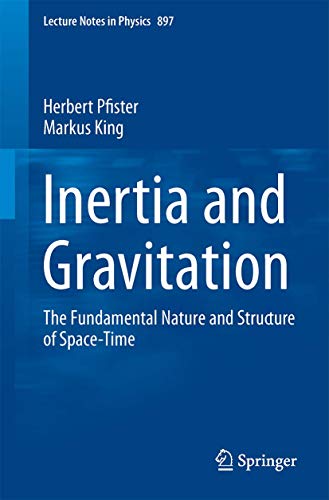

This book focuses on the phenomena of inertia and gravitation, one objective being to shed some new light on the basic laws of gravitational interaction and the fundamental nature and structures of spacetime. Chapter 1 is devoted to an extensive, partly new analysis of the law of inertia. The underlying mathematical and geometrical structure of Newtonian spacetime is presented from a four-dimensional point of view, and some historical difficulties and controversies - in particular the concepts of free particles and straight lines - are critically analyzed, while connections to projective geometry are also explored. The relativistic extensions of the law of gravitation and its intriguing consequences are studied in Chapter 2. This is achieved, following the works of Weyl, Ehlers, Pirani and Schild, by adopting a point of view of the combined conformal and projective structure of spacetime. Specifically, Mach’s fundamental critique of Newton’s concepts of ‘absolute space’ and ‘absolute time’ was a decisive motivation for Einstein’s development of general relativity, and his equivalence principle provided a new perspective on inertia. In Chapter 3 the very special mathematical structure of Einstein’s field equations is analyzed, and some of their remarkable physical predictions are presented. By analyzing different types of dragging phenomena, Chapter 4 reviews to what extent the equivalence principle is realized in general relativity - a question intimately connected to the ‘new force’ of gravitomagnetism, which was theoretically predicted by Einstein and Thirring but which was only recently experimentally confirmed and is thus of current interest.
"synopsis" may belong to another edition of this title.
- PublisherSpringer
- Publication date2015
- ISBN 10 3319150359
- ISBN 13 9783319150352
- BindingPaperback
- Number of pages192
Buy New
Learn more about this copy
US$ 36.90
Shipping:
US$ 2.64
Within U.S.A.
Top Search Results from the AbeBooks Marketplace
Seller Image
Inertia and Gravitation : The Fundamental Nature and Structure of Space-time
Seller:
Rating

Book Description Condition: New. Seller Inventory # 23090275-n
Buy New
US$ 36.90
Convert currency
Stock Image
Inertia and Gravitation : The Fundamental Nature and Structure of Space-Time
Published by
Springer
(2015)
ISBN 10: 3319150359
ISBN 13: 9783319150352
New
Softcover
Quantity: > 20
Seller:
Rating
Book Description Condition: New. PRINT ON DEMAND Book; New; Fast Shipping from the UK. No. book. Seller Inventory # ria9783319150352_lsuk
Buy New
US$ 27.11
Convert currency
Seller Image
Inertia and Gravitation : The Fundamental Nature and Structure of Space-time
Seller:
Rating

Book Description Condition: New. Seller Inventory # 23090275-n
Buy New
US$ 27.11
Convert currency
Seller Image
Inertia and Gravitation: The Fundamental Nature and Structure of Space-Time (Lecture Notes in Physics) by Pfister, Herbert, King, Markus [Paperback ]
Seller:
Rating
Book Description Soft Cover. Condition: new. Seller Inventory # 9783319150352
Buy New
US$ 50.61
Convert currency
Seller Image
Inertia and Gravitation: The Fundamental Nature and Structure of Space-Time (Paperback or Softback)
Published by
Springer 3/20/2015
(2015)
ISBN 10: 3319150359
ISBN 13: 9783319150352
New
Paperback or Softback
Quantity: 5
Seller:
Rating
Book Description Paperback or Softback. Condition: New. Inertia and Gravitation: The Fundamental Nature and Structure of Space-Time 0.61. Book. Seller Inventory # BBS-9783319150352
Buy New
US$ 57.38
Convert currency
Stock Image
Inertia and Gravitation: The Fundamental Nature and Structure of Space-Time (Lecture Notes in Physics, 897)
Published by
Springer
(2015)
ISBN 10: 3319150359
ISBN 13: 9783319150352
New
Softcover
Quantity: > 20
Seller:
Rating
Book Description Condition: New. Seller Inventory # ABLIING23Mar3113020089529
Buy New
US$ 53.74
Convert currency
Stock Image
Inertia and Gravitation: The Fundamental Nature and Structure of Space-Time (Lecture Notes in Physics, 897)
Seller:
Rating
Book Description Condition: New. Book is in NEW condition. 0.8. Seller Inventory # 3319150359-2-1
Buy New
US$ 62.09
Convert currency
Stock Image
Inertia and Gravitation : The Fundamental Nature and Structure of Space-Time
Seller:
Rating
Book Description PF. Condition: New. Seller Inventory # 6666-IUK-9783319150352
Buy New
US$ 43.25
Convert currency
Stock Image
Inertia and Gravitation: The Fundamental Nature and Structure of Space-Time (Lecture Notes in Physics, 897)
Published by
Springer
(2015)
ISBN 10: 3319150359
ISBN 13: 9783319150352
New
Softcover
Quantity: > 20
Seller:
Rating
Book Description Condition: New. Seller Inventory # I-9783319150352
Buy New
US$ 67.00
Convert currency
Seller Image
Inertia and Gravitation
Published by
Springer International Publishing Mrz 2015
(2015)
ISBN 10: 3319150359
ISBN 13: 9783319150352
New
Taschenbuch
Quantity: 2
Seller:
Rating
Book Description Taschenbuch. Condition: Neu. This item is printed on demand - it takes 3-4 days longer - Neuware -This book focuses on the phenomena of inertia and gravitation, one objective being to shed some new light on the basic laws of gravitational interaction and the fundamental nature and structures of spacetime. Chapter 1 is devoted to an extensive, partly new analysis of the law of inertia. The underlying mathematical and geometrical structure of Newtonian spacetime is presented from a four-dimensional point of view, and some historical difficulties and controversies - in particular the concepts of free particles and straight lines - are critically analyzed, while connections to projective geometry are also explored. The relativistic extensions of the law of gravitation and its intriguing consequences are studied in Chapter 2. This is achieved, following the works of Weyl, Ehlers, Pirani and Schild, by adopting a point of view of the combined conformal and projective structure of spacetime. Specifically, Mach's fundamental critique of Newton's concepts of 'absolute space' and 'absolute time' was a decisive motivation for Einstein's development of general relativity, and his equivalence principle provided a new perspective on inertia. In Chapter 3 the very special mathematical structure of Einstein's field equations is analyzed, and some of their remarkable physical predictions are presented. By analyzing different types of dragging phenomena, Chapter 4 reviews to what extent the equivalence principle is realized in general relativity - a question intimately connected to the 'new force' of gravitomagnetism, which was theoretically predicted by Einstein and Thirring but which was only recently experimentally confirmed and is thus of current interest. 192 pp. Englisch. Seller Inventory # 9783319150352
Buy New
US$ 53.79
Convert currency