
Items related to The Measurement of Association: A Permutation Statistical...
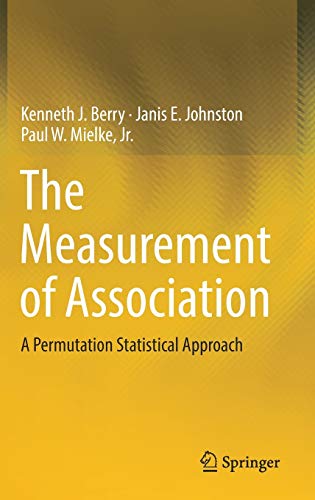
Synopsis
This research monograph utilizes exact and Monte Carlo permutation statistical methods to generate probability values and measures of effect size for a variety of measures of association. Association is broadly defined to include measures of correlation for two interval-level variables, measures of association for two nominal-level variables or two ordinal-level variables, and measures of agreement for two nominal-level or two ordinal-level variables. Additionally, measures of association for mixtures of the three levels of measurement are considered: nominal-ordinal, nominal-interval, and ordinal-interval measures. Numerous comparisons of permutation and classical statistical methods are presented.
Unlike classical statistical methods, permutation statistical methods do not rely on theoretical distributions, avoid the usual assumptions of normality and homogeneity of variance, and depend only on the data at hand. This book takes a unique approach to explaining statistics by integrating a large variety of statistical methods, and establishing the rigor of a topic that to many may seem to be a nascent field. This topic is relatively new in that it took modern computing power to make permutation methods available to those working in mainstream research.
Written for a statistically informed audience, it is particularly useful for teachers of statistics, practicing statisticians, applied statisticians, and quantitative graduate students in fields such as psychology, medical research, epidemiology, public health, and biology. It can also serve as a textbook in graduate courses in subjects like statistics, psychology, and biology.
"synopsis" may belong to another edition of this title.
About the Author
Paul W. Mielke, Jr. is Emeritus Professor at Colorado State University and a fellow of the American Statistical Association. He received a B.A. in mathematics from the University of Minnesota before training in meteorology at the University of Chicago for the U.S. Air Force. He earned an M.A. in mathematics from the University of Arizona and a Ph.D. in biostatistics from the University of Minnesota. In 1963 he joined the Department of Mathematics and Statistics at Colorado State University, retiring in 2002. His research interests are in permutation methods, meteorology, and environmental issues.
Kenneth J. Berry is Professor of Sociology at Colorado State University. He received a B.A. in sociology from Kalamazoo College and a Ph.D. in sociology from the University of Oregon. He was employed by the University of Buffalo for four years before joining the Department of Sociology at Colorado State University in 1970, where he remains. His research interests are in non-parametrictests and measures, permutation methods, and statistical inference.Janis E. Johnston works for the U.S. Government as a data analyst. She received B.S. degrees in mathematics and natural science from the University of Wyoming, her M.A. in sociology from the University of Wyoming, and her Ph.D. from Colorado State University. From 2007 to 2009 she was an American Association for the Advancement of Science, Science & Technology fellow and began government service after the fellowship. Her research interests are in permutation methods, statistical inference, and policy analysis.
From the Back Cover
This research monograph utilizes exact and Monte Carlo permutation statistical methods to generate probability values and measures of effect size for a variety of measures of association. Association is broadly defined to include measures of correlation for two interval-level variables, measures of association for two nominal-level variables or two ordinal-level variables, and measures of agreement for two nominal-level or two ordinal-level variables. Additionally, measures of association for mixtures of the three levels of measurement are considered: nominal-ordinal, nominal-interval, and ordinal-interval measures. Numerous comparisons of permutation and classical statistical methods are presented.
Unlike classical statistical methods, permutation statistical methods do not rely on theoretical distributions, avoid the usual assumptions of normality and homogeneity of variance, and depend only on the data at hand. This book takes a unique approach to explaining statistics by integrating a large variety of statistical methods, and establishing the rigor of a topic that to many may seem to be a nascent field. This topic is relatively new in that it took modern computing power to make permutation methods available to those working in mainstream research.Written for a statistically informed audience, it is particularly useful for teachers of statistics, practicing statisticians, applied statisticians, and quantitative graduate students in fields such as psychology, medical research, epidemiology, public health, and biology. It can also serve as a textbook in graduate courses in subjects like statistics, psychology, and biology.
"About this title" may belong to another edition of this title.
Search results for The Measurement of Association: A Permutation Statistical...

Stock Image
Measurement of Association. A Permutation Statistical Approach.
Seller: Universitätsbuchhandlung Herta Hold GmbH, Berlin, Germany
Seller rating 3 out of 5 stars

XX, 647 p. Hardcover. Versand aus Deutschland / We dispatch from Germany via Air Mail. Einband bestoßen, daher Mängelexemplar gestempelt, sonst sehr guter Zustand. Imperfect copy due to slightly bumped cover, apart from this in very good condition. Stamped. Sprache: Englisch. Seller Inventory # 35963AB
Buy Used
US$ 18.46
US$ 33.61 shipping
Ships from Germany to U.S.A.
Ships from Germany to U.S.A.
Quantity: 1 available
Stock Image
The Measurement of Association (eng)
Print on DemandSeller: Brook Bookstore On Demand, Napoli, NA, Italy
Seller rating 5 out of 5 stars

Condition: new. Questo è un articolo print on demand. Seller Inventory # bc478811645a6201e0eb1311fbb041cc
Buy New
US$ 145.71
US$ 12.32 shipping
Ships from Italy to U.S.A.
Ships from Italy to U.S.A.
Quantity: Over 20 available
Stock Image
Measurement of Association : A Permutation Statistical Approach
Seller: GreatBookPrices, Columbia, MD, U.S.A.
Seller rating 5 out of 5 stars
Condition: As New. Unread book in perfect condition. Seller Inventory # 33408708
Seller Image
Measurement of Association : A Permutation Statistical Approach
Seller: GreatBookPricesUK, Woodford Green, United Kingdom
Seller rating 5 out of 5 stars
Condition: New. Seller Inventory # 33408708-n
Buy New
US$ 190.69
US$ 19.86 shipping
Ships from United Kingdom to U.S.A.
Ships from United Kingdom to U.S.A.
Quantity: Over 20 available
Stock Image
Measurement of Association : A Permutation Statistical Approach
Seller: GreatBookPrices, Columbia, MD, U.S.A.
Seller rating 5 out of 5 stars
Condition: New. Seller Inventory # 33408708-n
Seller Image
The Measurement of Association
Published by
Springer International Publishing Nov 2018, 2018
ISBN 10: 3319989251
ISBN 13: 9783319989259
New
Hardcover
Seller: BuchWeltWeit Ludwig Meier e.K., Bergisch Gladbach, Germany
Seller rating 5 out of 5 stars
Buch. Condition: Neu. This item is printed on demand - it takes 3-4 days longer - Neuware -This research monograph utilizes exact and Monte Carlo permutation statistical methods to generate probability values and measures of effect size for a variety of measures of association. Association is broadly defined to include measures of correlation for two interval-level variables, measures of association for two nominal-level variables or two ordinal-level variables, and measures of agreement for two nominal-level or two ordinal-level variables. Additionally, measures of association for mixtures of the three levels of measurement are considered: nominal-ordinal, nominal-interval, and ordinal-interval measures. Numerous comparisons of permutation and classical statistical methods are presented.Unlike classical statistical methods, permutation statistical methods do not rely on theoretical distributions, avoid the usual assumptions of normality and homogeneity of variance, and depend only on the data at hand. This book takes a unique approach to explaining statistics by integrating a large variety of statistical methods, and establishing the rigor of a topic that to many may seem to be a nascent field. This topic is relatively new in that it took modern computing power to make permutation methods available to those working in mainstream research.Written for a statistically informed audience, it is particularly useful for teachers of statistics, practicing statisticians, applied statisticians, and quantitative graduate students in fields such as psychology, medical research, epidemiology, public health, and biology. It can also serve as a textbook in graduate courses in subjects like statistics, psychology, and biology. 668 pp. Englisch. Seller Inventory # 9783319989259
Buy New
US$ 185.21
US$ 25.77 shipping
Ships from Germany to U.S.A.
Ships from Germany to U.S.A.
Quantity: 2 available
Seller Image
The Measurement of Association
Published by
Springer International Publishing, 2018
ISBN 10: 3319989251
ISBN 13: 9783319989259
New
Hardcover
Seller: moluna, Greven, Germany
Seller rating 5 out of 5 stars
Gebunden. Condition: New. Dieser Artikel ist ein Print on Demand Artikel und wird nach Ihrer Bestellung fuer Sie gedruckt. Provides an overview of permutation statistics methodsIncludes numerous comparisons of permutation and classical statistical methodsShows how permutation statistics methods can be used in medicine, biology, and psychologyIl. Seller Inventory # 234946142
Buy New
US$ 157.13
US$ 54.89 shipping
Ships from Germany to U.S.A.
Ships from Germany to U.S.A.
Quantity: Over 20 available
Stock Image
The Measurement of Association: A Permutation Statistical Approach
Seller: Ria Christie Collections, Uxbridge, United Kingdom
Seller rating 5 out of 5 stars
Condition: New. In English. Seller Inventory # ria9783319989259_new
Buy New
US$ 207.03
US$ 19.78 shipping
Ships from United Kingdom to U.S.A.
Ships from United Kingdom to U.S.A.
Quantity: Over 20 available
Seller Image
Measurement of Association : A Permutation Statistical Approach
Seller: GreatBookPricesUK, Woodford Green, United Kingdom
Seller rating 5 out of 5 stars
Condition: As New. Unread book in perfect condition. Seller Inventory # 33408708
Buy Used
US$ 207.78
US$ 19.86 shipping
Ships from United Kingdom to U.S.A.
Ships from United Kingdom to U.S.A.
Quantity: Over 20 available
Stock Image
The Measurement of Association: A Permutation Statistical Approach
Seller: Mispah books, Redhill, SURRE, United Kingdom
Seller rating 4 out of 5 stars

Hardcover. Condition: New. NEW. SHIPS FROM MULTIPLE LOCATIONS. book. Seller Inventory # ERICA80033199892516
Buy New
US$ 196.36
US$ 33.10 shipping
Ships from United Kingdom to U.S.A.
Ships from United Kingdom to U.S.A.
Quantity: 1 available