
Items related to The Random-Cluster Model (Grundlehren der mathematischen...
The Random-Cluster Model (Grundlehren der mathematischen Wissenschaften, 333) - Hardcover
Book 54 of 184: Ergebnisse der Mathematik und ihrer Grenzgebiete. 3. Folge/A Series of Modern Surveys in Mathematics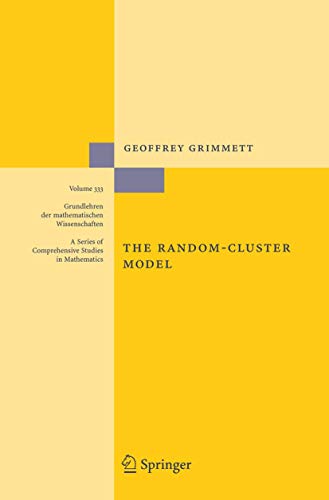
Synopsis
The random-cluster model has emerged as a key tool in the mathematical study of ferromagnetism. It may be viewed as an extension of percolation to include Ising and Potts models, and its analysis is a mix of arguments from probability and geometry. The Random-Cluster Model contains accounts of the subcritical and supercritical phases, together with clear statements of important open problems. The book includes treatment of the first-order (discontinuous) phase transition.
"synopsis" may belong to another edition of this title.
About the Author
PhD (Oxford 1974) under supervision of John Hammersley and Dominic Welsh. Member of the Mathematics Department of Bristol University (1976-1992), and subsequently appointed to the Professorship of Mathematics Statistics at Cambridge University. Author of around 100 articles and five books in probability and related fields, including Percolation (Springer 1999), Probability and Random Processes (with David Stirzaker, Oxford University Press 2001). Managing Editor of "Probability Theory and Related Fields", 2001-2005.
From the Back Cover
The random-cluster model has emerged in recent years as a key tool in the mathematical study of ferromagnetism. It may be viewed as an extension of percolation to include Ising and Potts models, and its analysis is a mix of arguments from probability and geometry. This systematic study includes accounts of the subcritical and supercritical phases, together with clear statements of important open problems. There is an extensive treatment of the first-order (discontinuous) phase transition, as well as a chapter devoted to applications of the random-cluster method to other models of statistical physics.
"About this title" may belong to another edition of this title.
Search results for The Random-Cluster Model (Grundlehren der mathematischen...

Stock Image
The Random-cluster Model
Seller: Basi6 International, Irving, TX, U.S.A.
Seller rating 5 out of 5 stars

Condition: Brand New. New. US edition. Expediting shipping for all USA and Europe orders excluding PO Box. Excellent Customer Service. Seller Inventory # ABEOCT25-240179
Stock Image
The Random-cluster Model
Seller: Romtrade Corp., STERLING HEIGHTS, MI, U.S.A.
Seller rating 5 out of 5 stars
Condition: New. This is a Brand-new US Edition. This Item may be shipped from US or any other country as we have multiple locations worldwide. Seller Inventory # ABBB-161785
Stock Image
The Random-Cluster Model
Seller: Anybook.com, Lincoln, United Kingdom
Seller rating 5 out of 5 stars
Condition: Good. This is an ex-library book and may have the usual library/used-book markings inside.This book has hardback covers. In good all round condition. No dust jacket. Please note the Image in this listing is a stock photo and may not match the covers of the actual item,750grams, ISBN:9783540328902. Seller Inventory # 4139157
Buy Used
US$ 82.68
US$ 17.38 shipping
Ships from United Kingdom to U.S.A.
Ships from United Kingdom to U.S.A.
Quantity: 1 available
Stock Image
The Random-Cluster Model.
Seller: Antiquariat Renner OHG, Albstadt, Germany
Seller rating 5 out of 5 stars
Hardcover. Condition: Wie neu. Berlin, Springer (2006). gr.8°. 37 figs. XIII, 377 p. Hardbound. Grundlehren der mathematischen Wissenschaften, 333.- Like new. Seller Inventory # 96430
Buy Used
US$ 69.45
US$ 50.57 shipping
Ships from Germany to U.S.A.
Ships from Germany to U.S.A.
Quantity: 1 available
Stock Image
The Random-Cluster Model
Seller: Books Puddle, Woodside, NY, U.S.A.
Seller rating 4 out of 5 stars

Condition: Used. pp. 396. Seller Inventory # 26299060
Stock Image
The Random-Cluster Model
Seller: Majestic Books, Hounslow, United Kingdom
Seller rating 4 out of 5 stars
Condition: Used. pp. 396 Illus. Seller Inventory # 7548907
Buy Used
US$ 124.29
US$ 8.66 shipping
Ships from United Kingdom to U.S.A.
Ships from United Kingdom to U.S.A.
Quantity: 1 available
Stock Image
The Random-Cluster Model
Seller: Biblios, Frankfurt am main, HESSE, Germany
Seller rating 4 out of 5 stars
Condition: Used. pp. 396. Seller Inventory # 18299070
Buy Used
US$ 131.14
US$ 11.18 shipping
Ships from Germany to U.S.A.
Ships from Germany to U.S.A.
Quantity: 1 available
Stock Image
The Random-Cluster Model (Grundlehren der mathematischen Wissenschaften, 333, Band 333)
Seller: Studibuch, Stuttgart, Germany
Seller rating 5 out of 5 stars
hardcover. Condition: Gut. 391 Seiten; 9783540328902.3 Gewicht in Gramm: 1. Seller Inventory # 1499402
Buy Used
US$ 103.34
US$ 70.02 shipping
Ships from Germany to U.S.A.
Ships from Germany to U.S.A.
Quantity: 1 available
Seller Image
Random-cluster Model
Seller: GreatBookPrices, Columbia, MD, U.S.A.
Seller rating 5 out of 5 stars
Condition: New. Seller Inventory # 4199547-n
Seller Image
The Random-Cluster Model
Published by
Springer Berlin Heidelberg Jun 2006, 2006
ISBN 10: 3540328904
ISBN 13: 9783540328902
New
Buch
Seller: BuchWeltWeit Ludwig Meier e.K., Bergisch Gladbach, Germany
Seller rating 5 out of 5 stars
Buch. Condition: Neu. This item is printed on demand - it takes 3-4 days longer - Neuware -Therandom-clustermodelwasinventedbyCees[Kees]FortuinandPietKasteleyn around 1969 as a uni cation of percolation, Ising, and Potts models, and as an extrapolation of electrical networks. Their original motivation was to harmonize the series and parallel laws satis ed by such systems. In so doing, they initiated a study in stochastic geometry which has exhibited beautiful structure in its own right, and which has become a central tool in the pursuit of one of the oldest challenges of classical statistical mechanics, namely to model and analyse the ferromagnet and especially its phase transition. The importance of the model for probability and statistical mechanics was not fully recognized until the late 1980s. There are two reasons for this period of dormancy. Although the early publications of 1969-1972 contained many of the basic properties of the model, the emphasis placed there upon combinatorial aspects may have obscured its potential for applications. In addition, many of the geometrical arguments necessary for studying the model were not known prior to 1980, but were developed during the 'decade of percolation' that began 1 then. In 1980 was published the proof that p = for bond percolation on the c 2 square lattice, and this was followed soon by Harry Kesten's monograph on t- dimensionalpercolation. Percolationmovedintohigherdimensionsaround1986, and many of the mathematical issues of the day were resolved by 1989. Interest in the random-cluster model as a tool for studying the Ising/Potts models was rekindled around 1987. 396 pp. Englisch. Seller Inventory # 9783540328902
Buy New
US$ 148.62
US$ 25.85 shipping
Ships from Germany to U.S.A.
Ships from Germany to U.S.A.
Quantity: 2 available