
Identification and Characterization of Neural Progenitor Cells in the Adult Mammalian Brain (Advances in Anatomy, Embryology and Cell Biology, 203) - Softcover
Book 20 of 173: Advances in Anatomy, Embryology and Cell Biology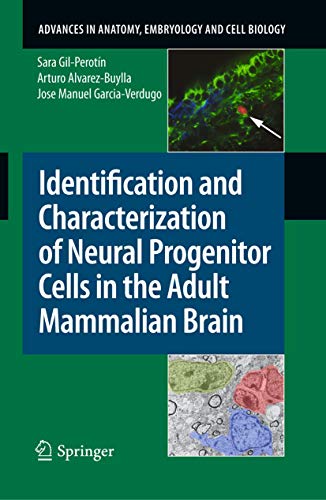
Synopsis
Adult neurogenesis has been questioned for many years. In the early 1900s, a dogma was established that denied new neuron formation in the adult brain. In the last century however, new discoveries have demonstrated the real existence of proliferation in the adult brain, and in the last decade, these studies led to the identification of neural stem cells in mammals. Adult neural stem cells are undifferentiated cells that are present in the adult brain and are capable of dividing and differentiating into glia and new neurons. Newly formed neurons terminally differentiate into mature neurons in the olfactory bulb and the dentate gyrus of the hippocampus. Since then, a number of new research lines have emerged whose common objective is the phenotypical and molecular characterization of brain stem cells. As a result, new therapies are successfully being applied to animal models for certain neurodegenerative diseases or stroke. At present, and in years to come, this finding extends to the adult human brain, and gives reason and hope to all the previous studies.
"synopsis" may belong to another edition of this title.
From the Back Cover
The concept of adult neurogenesis is relatively modern. It has surprised the scientific community and has ruled out the established idea that we are born with a set number of neurons. This discovery has come about progressively throughout the last century. In this work, the authors review some of the methods of research in adult neurogenesis placing emphasis on electron microscopy, a technique in which they are well practiced. Electron microscopy has been essential in the description of the cytoarchitecture of the different cell types populating the subventricular zone (SVZ), an area that underlies the lateral wall of the lateral ventricle, and where new neurons are generated during adulthood. Time-dependent studies have elucidated the temporal profile and lineage progression of SVZ cells from the generation of new cells to the integration into their target tissue, the olfactory bulb. Similarly, adult neurogenesis has been described in the dentate gyrus of the hippocampus, and is being investigated in other regions of the cerebrum and the spinal cord. Neurogenesis was first demonstrated in mice, but has been subsequently observed in other mammals such as rabbits, cows, monkeys, and humans. The meaning of neurogenesis in humans remains unknown, and it is essential to understand it for potential application in the therapy of neurological diseases.
"About this title" may belong to another edition of this title.
Other Popular Editions of the Same Title

Search results for Identification and Characterization of Neural Progenitor...

Seller Image
Identification and Characterization of Neural Progenitor Cells in the Adult Mammalian Brain
Published by
Springer Berlin Heidelberg Apr 2009, 2009
ISBN 10: 3540887180
ISBN 13: 9783540887188
New
Taschenbuch
Seller: BuchWeltWeit Ludwig Meier e.K., Bergisch Gladbach, Germany
Seller rating 5 out of 5 stars

Taschenbuch. Condition: Neu. This item is printed on demand - it takes 3-4 days longer - Neuware -Adult neurogenesis has been questioned for many years. In the early 1900s, a dogma was established that denied new neuron formation in the adult brain. In the last century however, new discoveries have demonstrated the real existence of proliferation in the adult brain, and in the last decade, these studies led to the identification of neural stem cells in mammals. Adult neural stem cells are undifferentiated cells that are present in the adult brain and are capable of dividing and differentiating into glia and new neurons. Newly formed neurons terminally differentiate into mature neurons in the olfactory bulb and the dentate gyrus of the hippocampus. Since then, a number of new research lines have emerged whose common objective is the phenotypical and molecular characterization of brain stem cells. As a result, new therapies are successfully being applied to animal models for certain neurodegenerative diseases or stroke. At present, and in years to come, this finding extends to the adult human brain, and gives reason and hope to all the previous studies. 116 pp. Englisch. Seller Inventory # 9783540887188
Buy New
US$ 126.45
US$ 26.39 shipping
Ships from Germany to U.S.A.
Ships from Germany to U.S.A.
Quantity: 2 available
Seller Image
Identification and Characterization of Neural Progenitor Cells in the Adult Mammalian Brain
Published by
Springer Berlin Heidelberg, 2009
ISBN 10: 3540887180
ISBN 13: 9783540887188
New
Softcover
Seller: moluna, Greven, Germany
Seller rating 5 out of 5 stars
Condition: New. Dieser Artikel ist ein Print on Demand Artikel und wird nach Ihrer Bestellung fuer Sie gedruckt. Adult neurogenesis has been questioned for many years. In the early 1900s, a dogma was established that denied new neuron formation in the adult brain. In the last century however, new discoveries have demonstrated the real existence of proliferation in . Seller Inventory # 4901901
Buy New
US$ 109.06
US$ 56.22 shipping
Ships from Germany to U.S.A.
Ships from Germany to U.S.A.
Quantity: Over 20 available
Stock Image
Identification and Characterization of Neural Progenitor Cells in the Adult Mammalian Brain (Advances in Anatomy, Embryology and Cell Biology, 203)
Seller: Ria Christie Collections, Uxbridge, United Kingdom
Seller rating 5 out of 5 stars
Condition: New. In. Seller Inventory # ria9783540887188_new
Buy New
US$ 171.90
US$ 15.85 shipping
Ships from United Kingdom to U.S.A.
Ships from United Kingdom to U.S.A.
Quantity: Over 20 available
Stock Image
Identification and Characterization of Neural Progenitor Cells in the Adult Mammalian Brain: Vol 203
Seller: Revaluation Books, Exeter, United Kingdom
Seller rating 5 out of 5 stars
Paperback. Condition: Brand New. 1st edition. 104 pages. 9.50x6.25x0.25 inches. In Stock. Seller Inventory # x-3540887180
Buy New
US$ 174.72
US$ 13.23 shipping
Ships from United Kingdom to U.S.A.
Ships from United Kingdom to U.S.A.
Quantity: 2 available
Seller Image
Identification and Characterization of Neural Progenitor Cells in the Adult Mammalian Brain
Published by
Springer, Springer Vieweg Apr 2009, 2009
ISBN 10: 3540887180
ISBN 13: 9783540887188
New
Taschenbuch
Seller: buchversandmimpf2000, Emtmannsberg, BAYE, Germany
Seller rating 5 out of 5 stars
Taschenbuch. Condition: Neu. This item is printed on demand - Print on Demand Titel. Neuware -Adult neurogenesis has been questioned for many years. In the early 1900s, a dogma was established that denied new neuron formation in the adult brain. In the last century however, new discoveries have demonstrated the real existence of proliferation in the adult brain, and in the last decade, these studies led to the identification of neural stem cells in mammals. Adult neural stem cells are undifferentiated cells that are present in the adult brain and are capable of dividing and differentiating into glia and new neurons. Newly formed neurons terminally differentiate into mature neurons in the olfactory bulb and the dentate gyrus of the hippocampus. Since then, a number of new research lines have emerged whose common objective is the phenotypical and molecular characterization of brain stem cells. As a result, new therapies are successfully being applied to animal models for certain neurodegenerative diseases or stroke. At present, and in years to come, this finding extends to the adult human brain, and gives reason and hope to all the previous studies.Springer-Verlag KG, Sachsenplatz 4-6, 1201 Wien 116 pp. Englisch. Seller Inventory # 9783540887188
Buy New
US$ 126.45
US$ 68.85 shipping
Ships from Germany to U.S.A.
Ships from Germany to U.S.A.
Quantity: 1 available
Seller Image
Identification and Characterization of Neural Progenitor Cells in the Adult Mammalian Brain
Seller: AHA-BUCH GmbH, Einbeck, Germany
Seller rating 5 out of 5 stars
Taschenbuch. Condition: Neu. Druck auf Anfrage Neuware - Printed after ordering - Adult neurogenesis has been questioned for many years. In the early 1900s, a dogma was established that denied new neuron formation in the adult brain. In the last century however, new discoveries have demonstrated the real existence of proliferation in the adult brain, and in the last decade, these studies led to the identification of neural stem cells in mammals. Adult neural stem cells are undifferentiated cells that are present in the adult brain and are capable of dividing and differentiating into glia and new neurons. Newly formed neurons terminally differentiate into mature neurons in the olfactory bulb and the dentate gyrus of the hippocampus. Since then, a number of new research lines have emerged whose common objective is the phenotypical and molecular characterization of brain stem cells. As a result, new therapies are successfully being applied to animal models for certain neurodegenerative diseases or stroke. At present, and in years to come, this finding extends to the adult human brain, and gives reason and hope to all the previous studies. Seller Inventory # 9783540887188
Buy New
US$ 126.45
US$ 69.94 shipping
Ships from Germany to U.S.A.
Ships from Germany to U.S.A.
Quantity: 1 available
Stock Image
Identification and Characterization of Neural Progenitor Cells in the Adult Mammalian Brain
Seller: Buchpark, Trebbin, Germany
Seller rating 5 out of 5 stars
Condition: Sehr gut. Zustand: Sehr gut | Sprache: Englisch | Produktart: Bücher | Adult neurogenesis has been questioned for many years. In the early 1900s, a dogma was established that denied new neuron formation in the adult brain. In the last century however, new discoveries have demonstrated the real existence of proliferation in the adult brain, and in the last decade, these studies led to the identification of neural stem cells in mammals. Adult neural stem cells are undifferentiated cells that are present in the adult brain and are capable of dividing and differentiating into glia and new neurons. Newly formed neurons terminally differentiate into mature neurons in the olfactory bulb and the dentate gyrus of the hippocampus. Since then, a number of new research lines have emerged whose common objective is the phenotypical and molecular characterization of brain stem cells. As a result, new therapies are successfully being applied to animal models for certain neurodegenerative diseases or stroke. At present, and in years to come, this finding extends to the adult human brain, and gives reason and hope to all the previous studies. Seller Inventory # 4918730/12
Buy Used
US$ 99.86
US$ 120.49 shipping
Ships from Germany to U.S.A.
Ships from Germany to U.S.A.
Quantity: 1 available