
Items related to René Descartes: Principles of Philosophy: Translated,...
René Descartes: Principles of Philosophy: Translated, with Explanatory Notes (Synthese Historical Library, 24) - Hardcover
Book 28 of 60: Synthese Historical Library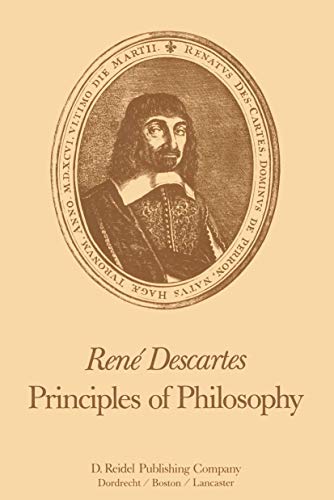
Synopsis
Descartes's Principles 0. / Philosophy is his longest and most ambitious work; it is the only work in which he attempted to actually deduce scientific knowledge from Cartesian metaphysics, as he repeatedly claimed was possible. Whatever the success of this attempt, there can be no doubt that it was enormously influential. Cartesian celestial mechanics held sway for well over a century, and some of the best minds of that period, including Leibniz, Malebranche, Euler, and the Bernoullis, attempted to modify and quantify the Cartesian theory of vortices into an acceptable alternative to Newton's theory of universal gravitation. Thus, the Principles is not only of inherent and historical interest philosophically but is also a seminal document in the history of science and of 17th Century thought. Principles of Philosophy was first published in Latin, in 1644. In 1647, a French translation, done by the Abbe Claude Picot and containing a great deal of additional material and a number of alterations in the original text, was published with Descartes's enthusiastic approval. Unlike some English translations of portions of the Principles, this translation uses the Latin text as its primary source; however, a good deal of additional material from Picot's translation has been included. There are several reasons for this. First, there is good evidence that Descartes himself was responsible for some of the additional material, including, of course, the Preface to the French translation.
"synopsis" may belong to another edition of this title.
About the Author
Ren? Descartes, known as the Father of Modern Philosophy and inventor of Cartesian coordinates, was a seventeenth century French philosopher, mathematician, and writer. Descartes made significant contributions to the fields of philosophy and mathematics, and was a proponent of rationalism, believing strongly in fact and deductive reasoning. Working in both French and Latin, he wrote many mathematical and philosophical works including The World, Discourse on a Method, Meditations on First Philosophy, and Passions of the Soul. He is perhaps best known for originating the statement I think, therefore I am.
Language Notes
Text: English, Latin (translation)
"About this title" may belong to another edition of this title.
Search results for René Descartes: Principles of Philosophy: Translated,...

Stock Image
René Descartes: Principles of Philosophy: Translated, with Explanatory Notes (Synthese Historical Library, 24)
Published by
Springer (edition 1982), 1982
ISBN 10: 9027714517
ISBN 13: 9789027714510
Used
Hardcover
Seller: BooksRun, Philadelphia, PA, U.S.A.
Seller rating 5 out of 5 stars

Hardcover. Condition: Very Good. 1982. It's a well-cared-for item that has seen limited use. The item may show minor signs of wear. All the text is legible, with all pages included. It may have slight markings and/or highlighting. Seller Inventory # 9027714517-8-1
Seller Image
René Descartes: Principles of Philosophy: Translated, with Explanatory Notes (Synthese Historical Library, 24)
Seller: -OnTimeBooks-, Phoenix, AZ, U.S.A.
Seller rating 5 out of 5 stars
Condition: good. A copy that has been read, remains in good condition. All pages are intact, and the cover is intact. The spine and cover show signs of wear. Pages can include notes and highlighting and show signs of wear, and the copy can include "From the library of" labels or previous owner inscriptions. 100% GUARANTEE! Shipped with delivery confirmation, if you're not satisfied with purchase please return item! Ships via media mail. Seller Inventory # OTV.9027714517.G
Stock Image
René Descartes: Principles of Philosophy: Translated, with Explanatory Notes (Synthese Historical Library, 24)
Seller: International Book Project, Lexington, KY, U.S.A.
Seller rating 4 out of 5 stars

hardcover. Condition: Very Good. NOT ex-library. Great condition. Pages are crisp and clean, no highlighting or underlining. Slight wear to the dust jacket. 100% of the proceeds go towards promoting literacy in under-served areas of the world. Seller Inventory # SKU0001241
Stock Image
Rene Descartes : Principles of Philosophy
Seller: Better World Books: West, Reno, NV, U.S.A.
Seller rating 5 out of 5 stars
Condition: Good. 1982nd Edition. Former library copy. Pages intact with minimal writing/highlighting. The binding may be loose and creased. Dust jackets/supplements are not included. Includes library markings. Stock photo provided. Product includes identifying sticker. Better World Books: Buy Books. Do Good. Seller Inventory # GRP31376503
Stock Image
René Descartes: Principles of Philosophy : Translated, with Explanatory Notes
Seller: Buchpark, Trebbin, Germany
Seller rating 5 out of 5 stars
Condition: Hervorragend. Zustand: Hervorragend | Seiten: 360 | Sprache: Englisch | Produktart: Bücher | Descartes's Principles 0. / Philosophy is his longest and most ambitious work; it is the only work in which he attempted to actually deduce scientific knowledge from Cartesian metaphysics, as he repeatedly claimed was possible. Whatever the success of this attempt, there can be no doubt that it was enormously influential. Cartesian celestial mechanics held sway for well over a century, and some of the best minds of that period, including Leibniz, Malebranche, Euler, and the Bernoullis, attempted to modify and quantify the Cartesian theory of vortices into an acceptable alternative to Newton's theory of universal gravitation. Thus, the Principles is not only of inherent and historical interest philosophically but is also a seminal document in the history of science and of 17th Century thought. Principles of Philosophy was first published in Latin, in 1644. In 1647, a French translation, done by the Abbe Claude Picot and containing a great deal of additional material and a number of alterations in the original text, was published with Descartes's enthusiastic approval. Unlike some English translations of portions of the Principles, this translation uses the Latin text as its primary source; however, a good deal of additional material from Picot's translation has been included. There are several reasons for this. First, there is good evidence that Descartes himself was responsible for some of the additional material, including, of course, the Preface to the French translation. Seller Inventory # 1624177/1
Buy Used
US$ 129.55
US$ 120.37 shipping
Ships from Germany to U.S.A.
Ships from Germany to U.S.A.
Quantity: 1 available
Stock Image
René Descartes: Principles of Philosophy: Translated, with Explanatory Notes (Synthese Historical Library, 24)
Seller: Ria Christie Collections, Uxbridge, United Kingdom
Seller rating 5 out of 5 stars
Condition: New. In English. Seller Inventory # ria9789027714510_new
Buy New
US$ 260.30
US$ 15.09 shipping
Ships from United Kingdom to U.S.A.
Ships from United Kingdom to U.S.A.
Quantity: Over 20 available
Seller Image
Principles of Philosophy
Seller: GreatBookPrices, Columbia, MD, U.S.A.
Seller rating 5 out of 5 stars
Condition: New. Seller Inventory # 2360761-n
Seller Image
Principles of Philosophy
Seller: GreatBookPricesUK, Woodford Green, United Kingdom
Seller rating 5 out of 5 stars
Condition: New. Seller Inventory # 2360761-n
Buy New
US$ 260.28
US$ 20.05 shipping
Ships from United Kingdom to U.S.A.
Ships from United Kingdom to U.S.A.
Quantity: Over 20 available
Stock Image
René Descartes: Principles of Philosophy: Translated, with Explanatory Notes (Synthese Historical Library, 24)
Seller: California Books, Miami, FL, U.S.A.
Seller rating 4 out of 5 stars
Condition: New. Seller Inventory # I-9789027714510
Seller Image
Principles of Philosophy
Seller: GreatBookPrices, Columbia, MD, U.S.A.
Seller rating 5 out of 5 stars
Condition: As New. Unread book in perfect condition. Seller Inventory # 2360761