
Items related to Spatial Economics for Building Back Better: The Japanese...
Spatial Economics for Building Back Better: The Japanese Experience (Economics, Law, and Institutions in Asia Pacific) - Hardcover
Book 19 of 29: Economics, Law, and Institutions in Asia Pacific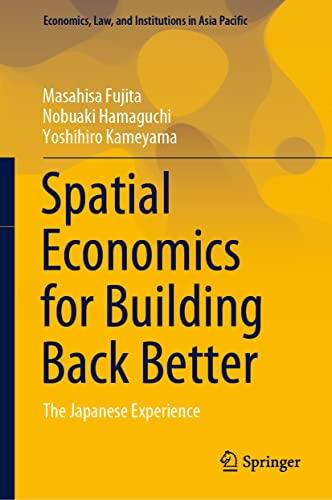
Synopsis
The central theme of this book is national land and infrastructure design in the age of the declining population and the recovery from the Great East Japan Earthquake in the affected regions in Japan. Based on the theory of spatial economics and evidence from Japanese history, the authors show that the growing economy with a population increase develops into a multi-cored and complex structure. In the population decline phase, however, such construction will be destabilized because of agglomeration economies in the central core. Then, a catastrophic shock that strikes may provoke the decline of the lower-rank-size provincial cities and their eventual disappearance if they compete only in lower prices of staple products. Not only is the practice bad for the residents; it also leads to lower national welfare resulting from the loss of diversity and overcrowded big cities. The authors argue that small local towns can recover and will be sustained if they will endeavor in innovative production by making good use of local natural resources and social capital. Under the ongoing declining population in Japan, an undesirable concentration in Tokyo will proceed further with increasing social cost and risk. The recent novel coronavirus pandemic has highlighted that concern.
"synopsis" may belong to another edition of this title.
About the Author
Masahisa Fujita is a member of the Japan Academy and a Fellow of the Econometric Society. He has been a major contributor to spatial economic theory during his 20-year tenure at the University of Pennsylvania and more recently at Kyoto University and Konan University. Professor Fujita is the author or co-author of four books: Spatial Development Planning (1978); Urban Economic Theory (1989, Cambridge University Press), which remains to this day the most authoritative graduate textbook on urban economics; The Spatial Economy (1999, co-authored with Paul Krugman and A.J. Venables), which defines the field of new economic geography; and Economics of Agglomeration (2013, co-authored with J.-F. Thisse).
Nobuaki Hamaguchi is a professor at the Research Institute for Economics and Business Administration at Kobe University. He holds a Ph.D. degree in Regional Science from the University of Pennsylvania. His researchinterests are in regional economic/industrial policies in Japan, global supply chain resilience, Latin American economy, and economic integration in the Asia-Pacific. From 2011 to date, he has been a program director and a faculty fellow of the Research Institute of Economy, Trade, and Industry (RIETI), where he organizes research projects on Japan’s regional economies. He is a member of the Regional Economic and Industrial Policy Committee of the Ministry of Economy, Trade and Industry.
Yoshihiro Kameyama is a professor at the Faculty of Economics, Saga University. He holds a Ph.D. degree in Economics from Kyoto University. His research interests are in regional economic/industrial policies in Japan, transportation infrastructure and industrial clusters, tourism, /transportation economies in East Asia, and consumer behavior and mode choices. Professor Kameyama was awarded the 27th Prize of the Japan Society of Logistics and Shipping Economics in 2018, and 2020 Best Paper Award of The Applied Regional Science Conference. From 2016 to date, he has been a visiting research professor at the Asian Growth Research Institute (AGI), where he works on a joint research project on tourism and /transportation economies in East Asia.
From the Back Cover
The central theme of this book is national land and infrastructure design in the age of the declining population and the recovery from the Great East Japan Earthquake in the affected regions in Japan. Based on the theory of spatial economics and evidence from Japanese history, the authors show that the growing economy with a population increase develops into a multi-cored and complex structure. In the population decline phase, however, such construction will be destabilized because of agglomeration economies in the central core. Then, a catastrophic shock that strikes may provoke the decline of the lower-rank-size provincial cities and their eventual disappearance if they compete only in lower prices of staple products. Not only is the practice bad for the residents; it also leads to lower national welfare resulting from the loss of diversity and overcrowded big cities. The authors argue that small local towns can recover and will be sustained if they will endeavor in innovative production by making good use of local natural resources and social capital. Under the ongoing declining population in Japan, an undesirable concentration in Tokyo will proceed further with increasing social cost and risk. The recent novel coronavirus pandemic has highlighted that concern.
"About this title" may belong to another edition of this title.
Search results for Spatial Economics for Building Back Better: The Japanese...

Stock Image
Spatial Economics for Building Back Better (eng)
Print on DemandSeller: Brook Bookstore On Demand, Napoli, NA, Italy
Seller rating 5 out of 5 stars

Condition: new. Questo è un articolo print on demand. Seller Inventory # CK8QJUVZNE
Buy New
US$ 109.06
US$ 7.64 shipping
Ships from Italy to U.S.A.
Ships from Italy to U.S.A.
Quantity: Over 20 available
Stock Image
Spatial Economics for Building Back Better : The Japanese Experience
Seller: GreatBookPrices, Columbia, MD, U.S.A.
Seller rating 5 out of 5 stars
Condition: New. Seller Inventory # 43984968-n
Stock Image
Spatial Economics for Building Back Better: the Japanese Experience (Economics, Law, and Institutions in Asia Pacific) [Hardcover] [Oct 18, 2021] Fujita, Masahisa; Hamaguchi, Nobuaki and Kameyama, Yoshihiro
Seller: StainesBookhub, Weybridge, SURRE, United Kingdom
Seller rating 2 out of 5 stars

Condition: New. A brand new book in pristine condition. Showing zero signs of shelf wear, creases, or damage. Seller Inventory # SPRINGERNEW12048
Buy New
US$ 110.00
US$ 40.18 shipping
Ships from United Kingdom to U.S.A.
Ships from United Kingdom to U.S.A.
Quantity: 1 available
Stock Image
Spatial Economics for Building Back Better : The Japanese Experience
Seller: GreatBookPrices, Columbia, MD, U.S.A.
Seller rating 5 out of 5 stars
Condition: As New. Unread book in perfect condition. Seller Inventory # 43984968
Seller Image
Spatial Economics for Building Back Better
Published by
Springer Nature Singapore Okt 2021, 2021
ISBN 10: 9811649502
ISBN 13: 9789811649509
New
Hardcover
Seller: BuchWeltWeit Ludwig Meier e.K., Bergisch Gladbach, Germany
Seller rating 5 out of 5 stars
Buch. Condition: Neu. This item is printed on demand - it takes 3-4 days longer - Neuware -The central theme of this book is national land and infrastructure design in the age of the declining population and the recovery from the Great East Japan Earthquake in the affected regions in Japan. Based on the theory of spatial economics and evidence from Japanese history, the authors show that the growing economy with a population increase develops into a multi-cored and complex structure. In the population decline phase, however, such construction will be destabilized because of agglomeration economies in the central core. Then, a catastrophic shock that strikes may provoke the decline of the lower-rank-size provincial cities and their eventual disappearance if they compete only in lower prices of staple products. Not only is the practice bad for the residents; it also leads to lower national welfare resulting from the loss of diversity and overcrowded big cities. The authors argue that small local towns can recover and will be sustained if they will endeavor in innovative production by making good use of local natural resources and social capital. Under the ongoing declining population in Japan, an undesirable concentration in Tokyo will proceed further with increasing social cost and risk. The recent novel coronavirus pandemic has highlighted that concern. 352 pp. Englisch. Seller Inventory # 9789811649509
Buy New
US$ 136.18
US$ 25.84 shipping
Ships from Germany to U.S.A.
Ships from Germany to U.S.A.
Quantity: 2 available
Seller Image
Spatial Economics for Building Back Better
Published by
Springer, Berlin|Springer Nature Singapore|________|Springer, 2021
ISBN 10: 9811649502
ISBN 13: 9789811649509
New
Hardcover
Seller: moluna, Greven, Germany
Seller rating 5 out of 5 stars
Gebunden. Condition: New. Dieser Artikel ist ein Print on Demand Artikel und wird nach Ihrer Bestellung fuer Sie gedruckt. The central theme of this book is national land and infrastructure design in the age of the declining population and the recovery from the Great East Japan Earthquake in the affected regions in Japan. Under the ongoing declining population in Japan, an unde. Seller Inventory # 485171017
Buy New
US$ 116.91
US$ 55.04 shipping
Ships from Germany to U.S.A.
Ships from Germany to U.S.A.
Quantity: Over 20 available
Stock Image
Spatial Economics for Building Back Better: The Japanese Experience (Economics, Law, and Institutions in Asia Pacific)
Seller: Ria Christie Collections, Uxbridge, United Kingdom
Seller rating 5 out of 5 stars
Condition: New. In English. Seller Inventory # ria9789811649509_new
Buy New
US$ 162.72
US$ 15.12 shipping
Ships from United Kingdom to U.S.A.
Ships from United Kingdom to U.S.A.
Quantity: Over 20 available
Stock Image
Spatial Economics for Building Back Better : The Japanese Experience
Published by
Springer Nature Singapore, 2021
ISBN 10: 9811649502
ISBN 13: 9789811649509
Used
Hardcover
Seller: Buchpark, Trebbin, Germany
Seller rating 5 out of 5 stars
Condition: Sehr gut. Zustand: Sehr gut | Seiten: 352 | Sprache: Englisch | Produktart: Bücher | The central theme of this book is national land and infrastructure design in the age of the declining population and the recovery from the Great East Japan Earthquake in the affected regions in Japan. Based on the theory of spatial economics and evidence from Japanese history, the authors show that the growing economy with a population increase develops into a multi-cored and complex structure. In the population decline phase, however, such construction will be destabilized because of agglomeration economies in the central core. Then, a catastrophic shock that strikes may provoke the decline of the lower-rank-size provincial cities and their eventual disappearance if they compete only in lower prices of staple products. Not only is the practice bad for the residents; it also leads to lower national welfare resulting from the loss of diversity and overcrowded big cities. The authors argue that small local towns can recover and will be sustained if they will endeavor in innovative production by making good use of local natural resources and social capital. Under the ongoing declining population in Japan, an undesirable concentration in Tokyo will proceed further with increasing social cost and risk. The recent novel coronavirus pandemic has highlighted that concern. Seller Inventory # 37576160/2
Buy Used
US$ 62.00
US$ 117.96 shipping
Ships from Germany to U.S.A.
Ships from Germany to U.S.A.
Quantity: 1 available
Stock Image
Spatial Economics for Building Back Better: The Japanese Experience (Economics, Law, and Institutions in Asia Pacific)
Seller: Books Puddle, Woodside, NY, U.S.A.
Seller rating 4 out of 5 stars

Condition: New. 1st ed. 2021 edition NO-PA16APR2015-KAP. Seller Inventory # 26386491882
Seller Image
Spatial Economics for Building Back Better : The Japanese Experience
Seller: AHA-BUCH GmbH, Einbeck, Germany
Seller rating 5 out of 5 stars
Buch. Condition: Neu. Druck auf Anfrage Neuware - Printed after ordering - The central theme of this book is national land and infrastructure design in the age of the declining population and the recovery from the Great East Japan Earthquake in the affected regions in Japan. Based on the theory of spatial economics and evidence from Japanese history, the authors show that the growing economy with a population increase develops into a multi-cored and complex structure. In the population decline phase, however, such construction will be destabilized because of agglomeration economies in the central core. Then, a catastrophic shock that strikes may provoke the decline of the lower-rank-size provincial cities and their eventual disappearance if they compete only in lower prices of staple products. Not only is the practice bad for the residents; it also leads to lower national welfare resulting from the loss of diversity and overcrowded big cities. The authors argue that small local towns can recover and will be sustained if they will endeavor in innovative production by making good use of local natural resources and social capital. Under the ongoing declining population in Japan, an undesirable concentration in Tokyo will proceed further with increasing social cost and risk. The recent novel coronavirus pandemic has highlighted that concern. Seller Inventory # 9789811649509
Buy New
US$ 158.00
US$ 39.32 shipping
Ships from Germany to U.S.A.
Ships from Germany to U.S.A.
Quantity: 1 available