About this Item
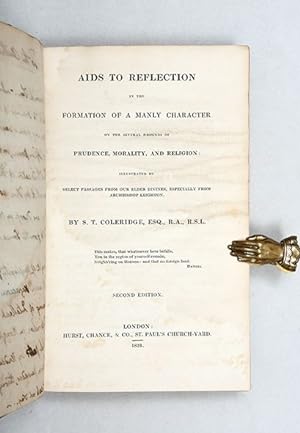
Second edition, this copy annotated by Coleridge's son, Derwent, on the first blank with an original, unpublished manuscript sonnet titled "To the Author", signed and dated "D.C. June 1840", six years after the death of his father, as a memento for the book's owner, Sir William Maynard Gomm, who Wordsworth called his "much esteemed friend" (quoted in Eilenberg, p. 200). Derwent Coleridge (1800-1883) annotated this copy for Gomm during a pivotal moment in his life: a reconvert to Christianity, Derwent published the year before The Scriptural Character of the English Church, wading into the debate against the growing Oxford Movement that later developed into Anglo-Catholicism. In the following year he became the principal of the very first teacher training college, St Mark's College, Chelsea, and he spent the next two decades of his life shaping educational reform. Derwent took over the editorship of his father's works from his sister Sara Coleridge (1802-1852) following her death. Derwent occasionally expressed private dissatisfaction with his father, leaving family affairs behind in 1823 to become self-sufficient as a schoolmaster. Nevertheless, his manuscript poem remains a touching dedication: "While paths by Understanding never trod, / Reason pervades, through Angel-Choirs - to God!". Here Derwent agrees with his father's position, as stated in p. 206, that one's reason, being the "Power of universal and necessary Convictions, the Source and Substance of Truths above Sense", brings one closer to Heaven than one's understanding, which is limited by the fallibility of the human mind and sensory organs. Sir William Maynard Gomm (1784-1875), whose bookplate is found on the front pastedown, was the longest serving soldier in British military history and an avid lover of literature who frequently corresponded with Wordsworth. While still in mourning, Wordsworth wrote to Gomm on 24 March 1843 to describe the funeral of Robert Southey, which had taken place the previous day, and to explain that "Mr. [Samuel?] Rogers [and] I have not been in communication [since] I saw you in London, but be assured I shall bear in memory your message, and deliver it, if he and I live to meet again" (Letters, p. 261). In another instance, the two discussed how services to one's nation can receive no adequate financial recompense; recalling this exchange, Wordsworth wrote "this applies with tenfold force my friend [Gomm] goes on to say, in the case of sound literature in as much as the services here rendered [are] for all states & for all time. Still there has always appeared to me, something monstrous in the existing relation between Author & Bookseller or Publisher, as regards remuneration" (quoted in Eilenberg, p. 200). This question was of great importance to Wordsworth, as he vigourously campaigned Parliament to increase the length of copyright protections, arguing that writers deserved greater financial security in return for the priceless services they offer to mankind. Many decades later, Algernon Charles Swinburne would write in a pair of sonnets titled "Sir William Gomm": "O nursling of the sea-winds and the sea, Immortal England, goddess ocean-born, What shall thy children fear, what strengths not scorn, While children of such mould are born to thee?" (p. 230). Providing aphorisms and commentary designed to instruct the reader, Aids to Reflection challenges them with the question "if you are not a thinking man, to what purpose are you a man at all?" (p. xiv). The first edition was published in 1825. Haney 41. Susan Eilenberg, Strange Power of Speech: Wordsworth, Coleridge, and Literary Possession, 1992; Letters of the Wordsworth Family from 1787 to 1855, vol. III, 1907; Algernon Charles Swinburne, Tristram of Lyonesse, and Other Poems, 1882. Octavo (186 x 111 mm). Contemporary half calf, smooth spine with red label, gilt rules, and blind tooling, marbled sides, sides and corners trimmed with triple blind fillets, brown endpapers, edges spri.
Seller Inventory # 148637
Contact seller
Report this item