
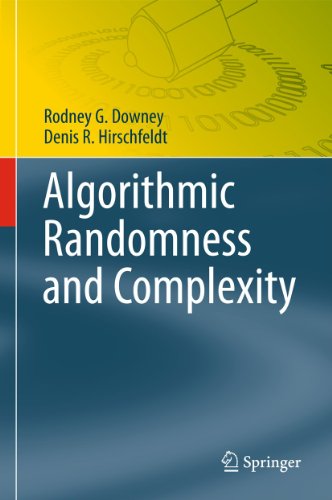
Algorithmic Randomness and Complexity
Downey, Rodney G.; Hirschfeldt, Denis R.
ISBN 10: 0387955674 ISBN 13: 9780387955674
Published by Springer, 2010
Used
Hardcover
From
ThriftBooks-Atlanta, AUSTELL, GA, U.S.A.
Seller rating 5 out of 5 stars

AbeBooks Seller since March 24, 2009
This specific item is no longer available.
About this Item
Description:
Former library book; May have limited writing in cover pages. Pages are unmarked. ~ ThriftBooks: Read More, Spend Less. Seller Inventory # G0387955674I4N10
Synopsis:
Intuitively, a sequence such as 101010101010101010… does not seem random, whereas 101101011101010100…, obtained using coin tosses, does. How can we reconcile this intuition with the fact that both are statistically equally likely? What does it mean to say that an individual mathematical object such as a real number is random, or to say that one real is more random than another? And what is the relationship between randomness and computational power. The theory of algorithmic randomness uses tools from computability theory and algorithmic information theory to address questions such as these. Much of this theory can be seen as exploring the relationships between three fundamental concepts: relative computability, as measured by notions such as Turing reducibility; information content, as measured by notions such as Kolmogorov complexity; and randomness of individual objects, as first successfully defined by Martin-Löf. Although algorithmic randomness has been studied for several decades, a dramatic upsurge of interest in the area, starting in the late 1990s, has led to significant advances. This is the first comprehensive treatment of this important field, designed to be both a reference tool for experts and a guide for newcomers. It surveys a broad section of work in the area, and presents most of its major results and techniques in depth. Its organization is designed to guide the reader through this large body of work, providing context for its many concepts and theorems, discussing their significance, and highlighting their interactions. It includes a discussion of effective dimension, which allows us to assign concepts like Hausdorff dimension to individual reals, and a focused but detailed introduction to computability theory. It will be of interest to researchers and students in computability theory, algorithmic information theory, and theoretical computer science.
From the Back Cover: Intuitively, a sequence such as 101010101010101010… does not seem random, whereas 101101011101010100…, obtained using coin tosses, does. How can we reconcile this intuition with the fact that both are statistically equally likely? What does it mean to say that an individual mathematical object such as a real number is random, or to say that one real is more random than another? And what is the relationship between randomness and computational power. The theory of algorithmic randomness uses tools from computability theory and algorithmic information theory to address questions such as these. Much of this theory can be seen as exploring the relationships between three fundamental concepts: relative computability, as measured by notions such as Turing reducibility; information content, as measured by notions such as Kolmogorov complexity; and randomness of individual objects, as first successfully defined by Martin-Löf. Although algorithmic randomness has been studied for several decades, a dramatic upsurge of interest in the area, starting in the late 1990s, has led to significant advances. This is the first comprehensive treatment of this important field, designed to be both a reference tool for experts and a guide for newcomers. It surveys a broad section of work in the area, and presents most of its major results and techniques in depth. Its organization is designed to guide the reader through this large body of work, providing context for its many concepts and theorems, discussing their significance, and highlighting their interactions. It includes a discussion of effective dimension, which allows us to assign concepts like Hausdorff dimension to individual reals, and a focused but detailed introduction to computability theory. It will be of interest to researchers and students in computability theory, algorithmic information theory, and theoretical computer science.
"About this title" may belong to another edition of this title.
Bibliographic Details
Title: Algorithmic Randomness and Complexity
Publisher: Springer
Publication Date: 2010
Binding: Hardcover
Condition: Very Good
Dust Jacket Condition: No Jacket
Top Search Results from the AbeBooks Marketplace

Seller Image
Algorithmic Randomness and Complexity (Theory and Applications of Computability).
Seller: Universitätsbuchhandlung Herta Hold GmbH, Berlin, Germany
Seller rating 4 out of 5 stars

2010th ed. 16 x 23 cm. 883 pages. Hardcover. Sprache: Englisch. Seller Inventory # 8453VB
Buy Used
US$ 23.49
US$ 34.20 shipping
Ships from Germany to U.S.A.
Ships from Germany to U.S.A.
Quantity: 2 available
Seller Image
Algorithmic Randomness and Complexity (Theory and Applications of Computability)
Seller: Antiquariat Bernhardt, Kassel, Germany
Seller rating 5 out of 5 stars
Karton Karton. Condition: Sehr gut. 855 Seiten, Zust: Gutes Exemplar. Schneller Versand und persönlicher Service - jedes Buch händisch geprüft und beschrieben - aus unserem Familienbetrieb seit über 25 Jahren. Eine Rechnung mit ausgewiesener Mehrwertsteuer liegt jeder unserer Lieferungen bei. Wir versenden mit der deutschen Post. Sprache: Englisch Gewicht in Gramm: 1460. Seller Inventory # 494079
Buy Used
US$ 87.96
US$ 56.89 shipping
Ships from Germany to U.S.A.
Ships from Germany to U.S.A.
Quantity: 1 available
Stock Image
Algorithmic Randomness and Complexity (eng)
Print on DemandSeller: Brook Bookstore On Demand, Napoli, NA, Italy
Seller rating 5 out of 5 stars
Condition: new. Questo è un articolo print on demand. Seller Inventory # VRTS4DHUQQ
Buy New
US$ 148.27
US$ 27.59 shipping
Ships from Italy to U.S.A.
Ships from Italy to U.S.A.
Quantity: Over 20 available
Seller Image
Algorithmic Randomness and Complexity
Print on DemandSeller: moluna, Greven, Germany
Seller rating 5 out of 5 stars
Condition: New. Dieser Artikel ist ein Print on Demand Artikel und wird nach Ihrer Bestellung fuer Sie gedruckt. Authors were awarded the 2016 Shoenfield Prize by the Association for Symbolic Logic for outstanding expository writing in the field of logicEssential resource for researchers and graduate students in theoretical computer scie. Seller Inventory # 5912606
Buy New
US$ 161.19
US$ 55.85 shipping
Ships from Germany to U.S.A.
Ships from Germany to U.S.A.
Quantity: Over 20 available
Stock Image
Algorithmic Randomness and Complexity (Theory and Applications of Computability)
Seller: Ria Christie Collections, Uxbridge, United Kingdom
Seller rating 5 out of 5 stars
Condition: New. In. Seller Inventory # ria9780387955674_new
Buy New
US$ 175.41
US$ 15.99 shipping
Ships from United Kingdom to U.S.A.
Ships from United Kingdom to U.S.A.
Quantity: Over 20 available
Seller Image
Algorithmic Randomness and Complexity
Published by
Springer New York Nov 2010, 2010
ISBN 10: 0387955674
ISBN 13: 9780387955674
New
Hardcover
Seller: BuchWeltWeit Ludwig Meier e.K., Bergisch Gladbach, Germany
Seller rating 5 out of 5 stars
Buch. Condition: Neu. This item is printed on demand - it takes 3-4 days longer - Neuware -Intuitively, a sequence such as 101010101010101010. does not seem random, whereas 101101011101010100., obtained using coin tosses, does. How can we reconcile this intuition with the fact that both are statistically equally likely What does it mean to say that an individual mathematical object such as a real number is random, or to say that one real is more random than another And what is the relationship between randomness and computational power. The theory of algorithmic randomness uses tools from computability theory and algorithmic information theory to address questions such as these. Much of this theory can be seen as exploring the relationships between three fundamental concepts: relative computability, as measured by notions such as Turing reducibility; information content, as measured by notions such as Kolmogorov complexity; and randomness of individual objects, as first successfully defined by Martin-Löf. Although algorithmic randomness has been studied for several decades, a dramatic upsurge of interest in the area, starting in the late 1990s, has led to significant advances. This is the first comprehensive treatment of this important field, designed to be both a reference tool for experts and a guide for newcomers. It surveys a broad section of work in the area, and presents most of its major results and techniques in depth. Its organization is designed to guide the reader through this large body of work, providing context for its many concepts and theorems, discussing their significance, and highlighting their interactions. It includes a discussion of effective dimension, which allows us to assign concepts like Hausdorff dimension to individual reals, and a focused but detailed introduction to computability theory. It will be of interest to researchers and students in computability theory, algorithmic information theory, and theoretical computer science. 855 pp. Englisch. Seller Inventory # 9780387955674
Buy New
US$ 188.46
US$ 26.22 shipping
Ships from Germany to U.S.A.
Ships from Germany to U.S.A.
Quantity: 2 available
Stock Image
Algorithmic Randomness And Complexity
Seller: GreatBookPrices, Columbia, MD, U.S.A.
Seller rating 5 out of 5 stars
Condition: New. Seller Inventory # 5729367-n
Stock Image
Algorithmic Randomness and Complexity (Theory and Applications of Computability)
Seller: California Books, Miami, FL, U.S.A.
Seller rating 4 out of 5 stars
Condition: New. Seller Inventory # I-9780387955674
Seller Image
Algorithmic Randomness and Complexity
Seller: AHA-BUCH GmbH, Einbeck, Germany
Seller rating 5 out of 5 stars
Buch. Condition: Neu. Druck auf Anfrage Neuware - Printed after ordering - Intuitively, a sequence such as 101010101010101010. does not seem random, whereas 101101011101010100., obtained using coin tosses, does. How can we reconcile this intuition with the fact that both are statistically equally likely What does it mean to say that an individual mathematical object such as a real number is random, or to say that one real is more random than another And what is the relationship between randomness and computational power. The theory of algorithmic randomness uses tools from computability theory and algorithmic information theory to address questions such as these. Much of this theory can be seen as exploring the relationships between three fundamental concepts: relative computability, as measured by notions such as Turing reducibility; information content, as measured by notions such as Kolmogorov complexity; and randomness of individual objects, as first successfully defined by Martin-Löf. Although algorithmic randomness has been studied for several decades, a dramatic upsurge of interest in the area, starting in the late 1990s, has led to significant advances. This is the first comprehensive treatment of this important field, designed to be both a reference tool for experts and a guide for newcomers. It surveys a broad section of work in the area, and presents most of its major results and techniques in depth. Its organization is designed to guide the reader through this large body of work, providing context for its many concepts and theorems, discussing their significance, and highlighting their interactions. It includes a discussion of effective dimension, which allows us to assign concepts like Hausdorff dimension to individual reals, and a focused but detailed introduction to computability theory. It will be of interest to researchers and students in computability theory, algorithmic information theory, and theoretical computer science. Seller Inventory # 9780387955674
Buy New
US$ 200.39
US$ 76.10 shipping
Ships from Germany to U.S.A.
Ships from Germany to U.S.A.
Quantity: 2 available
Seller Image
Algorithmic Randomness and Complexity
Published by
Springer-Verlag New York Inc., US, 2010
ISBN 10: 0387955674
ISBN 13: 9780387955674
New
Hardcover
Seller: Rarewaves.com UK, London, United Kingdom
Seller rating 5 out of 5 stars
Hardback. Condition: New. 2010th. This book is concerned with the theory of computability and complexity over the real numbers. This theory was initiated by Turing, Grzegorczyk, Lacombe, Banach, and Mazur and has seen rapid growth in recent years. Computability and complexity theory are two central areas of research in theoretical computer science. Until recently, most work in these areas concentrated on problems over discrete structures, but there has been enormous growth of computability theory and complexity theory over the real numbers and other continuous structures, especially incorporating concepts of "randomness". One reason for this growth is that more and more computation problems over the real numbers are being dealt with by computer scientists - in computational geometry and in the modeling of dynamical and hybrid systems. Scientists working on these questions come from such diverse fields as theoretical computer science, domain theory, logic, constructive mathematics, computer arithmetic, numerical mathematics, and analysis. An essential resource for all researchers in theoretical computer science, logic, computability theory and complexity. Seller Inventory # LU-9780387955674
Buy New
US$ 222.08
US$ 86.75 shipping
Ships from United Kingdom to U.S.A.
Ships from United Kingdom to U.S.A.
Quantity: Over 20 available