About this Item
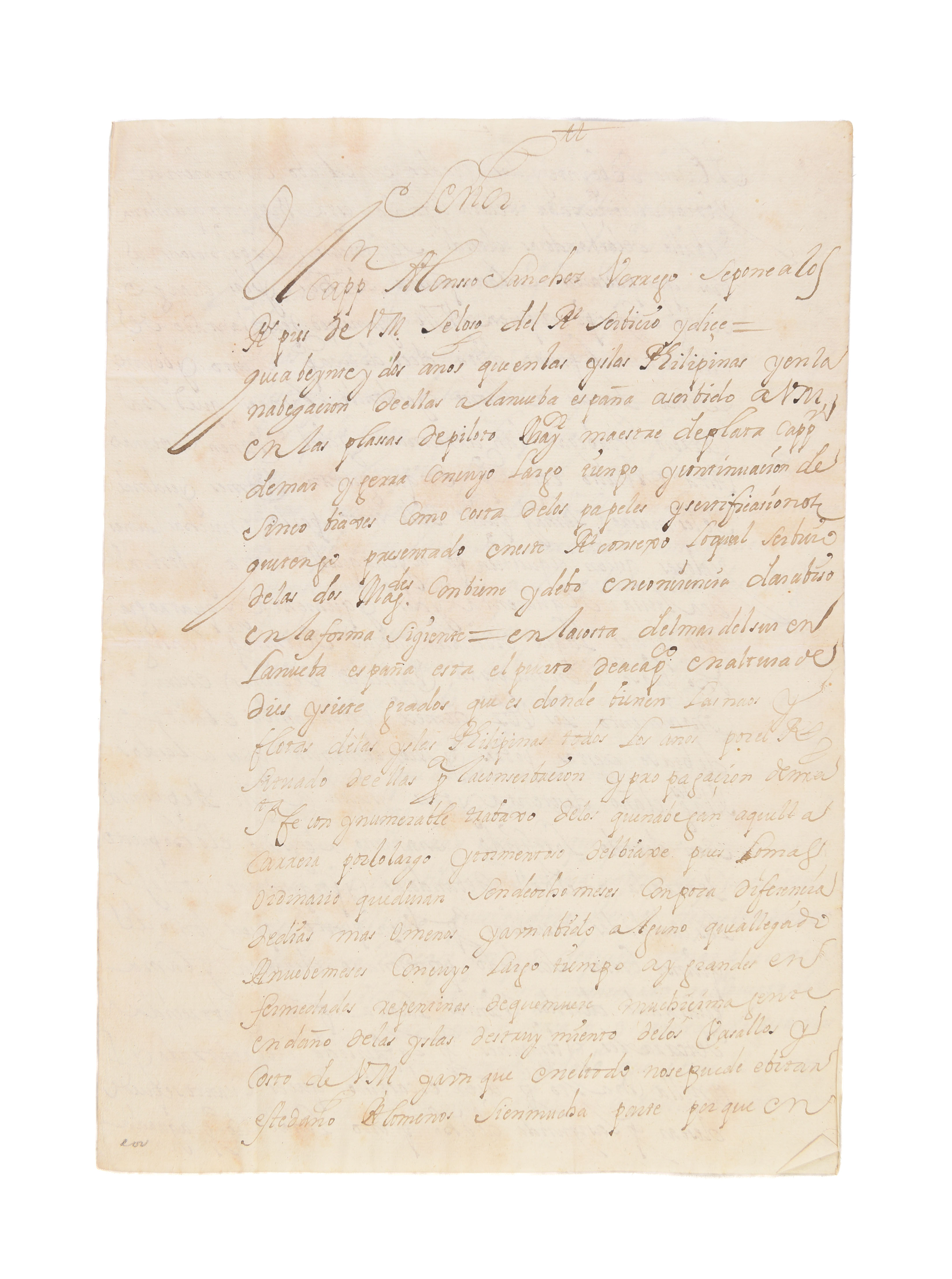
Spanish manuscript in ink. 4pp on wove paper. Folio. Old folds, pale spotting but very good. [Manila?, This unique memorial is a valuable contribution to our knowledge of Spain in the seventeenth-century Pacific. Captain Alonso Sanchez Verrego writes regarding the Valle de Banderas and in particular, Puerto Vallarta with references to the Manila galleon, shipbuilding on the west coast, and an offer to explore the Gulf of California. A century after Cortés' early forays along the coast, this represents a major re-awakening of Spanish ambition. Written in the style of both Pedro Fernández de Quiros (1565-1614) and Diego Luis de San Vitores (1627-72), Verrego's report includes important first-hand commentary of his exploration of the Californian coast and his interactions with Indigenous Americans. At a time when England and Spain were frequently at war, and no less a figure than William Dampier was in Campeche, this would have been an invaluable resource for Spain. Indeed, the first Jesuit mission at Baja was established just twenty years later. This memorial does not appear to have been published. Mexico's Pacific coast was largely unexplored by Europeans until 1523. The first encomienda in that area dates to 1526 and Hernán Cortés established the port at Acapulco for Spain in 1531. The following year, he sent two ill-fated expeditions north with a view to expanding Spain's presence along Mexico's Pacific coast where added protection might be afforded for the planned Spanish galleon, the first of which sailed in 1565. Similarly, Sebastián Vizcaíno (1548-1624) sailed up the same coast as far as San Diego in 1607, but again nothing came of this. By 1675, the galleons were essentially an extension of Spain's Atlantic fleets with strict instructions as to how they were to be constructed, manned and provisioned. Preceding the triangle trade by more than fifty years, the Manila, galleon was one of the very first examples of inter-continental trade. Acapulco wasn't necessarily an ideal port for the galleon. As William Schurz notes in his important article on the subject, "[f]requent proposals were made during the history of the galleon trade to change the terminal from Acapulco, for which there were claimed greater accessibility to Mexico, a superior climate and other advantages. The most serious schemes of this sort were for the transfer to San Blas or to Val de Banderas on the Guadalajara coast." Very little is known of Captain Alonso Sanchez Verrego beyond what he has included in this memorial, but his report is consistent with this. After honouring Charles II, and noting that he?d spent the past twenty-two years, and five consecutive voyages, crossing the Pacific, Sanchez Verrego reports the following information [in translation]: "On the Pacific coast of New Spain there is the port of Acapulco at 17 degrees latitude where the vessels and fleets from the Philippines arrive every year to fetch the Royal allowance for the maintenance and development of the Holy Faith there. These voyages are accomplished with the utmost difficulty by those who navigate that course, for the way is long and tortuous, and as a rule the voyage lasts some eight months with a few days more or less, and some have even taken nine months. During these long voyages, many are the people who have died from sudden and grave maladies, to the common danger of the Islands, the ruin of the serfs, and to your Majesty?s cost. And although this loss cannot altogether be averted, it might yet be possible to mitigate it, for at 22 degrees latitude, at the Cape of Corrientes, and at the mouth of the Bay of California, there is a port which is called El Valle de Banderas, where the first warships were built, which figured in the conquest of the said Islands [i.e. the Philippines] under General Legazpi whom your Majesty favoured." Indeed, the galleon route was established by Andres de Urdaneta and Alonso de Arellano on the San Pedro as part of the return of Legazpi'.
Seller Inventory # 248372
Contact seller
Report this item