About this Item
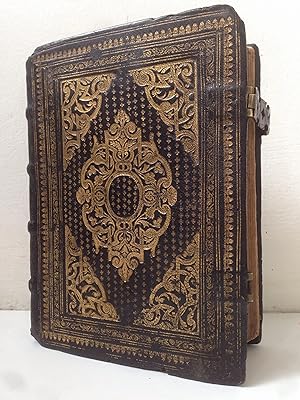
[SPLENDIDLY BOUND] 4to. 1) ff. [iv], 190; 127, [i]; 121, [xi] 2) pp. [x], 93 [i.e. 91], [xi]. Roman letter, some Italic in double column. General and NT titles within heart-shaped woodcut borders with twenty-four small compartments, left, the tents of the twelve tribes; on the right the twelve Apostles, the four Evangelists at centre, additional printed general title, 3 woodcut maps and numerous illustrations in the text of the Old Testament, seventeenth-century manuscript entries on blank leaf between testaments of the Crook family of Luton (between 1674 and 1687). Light age yellowing, very light waterstain to upper part of first few leaves, very occasional marginal stains and spots. A fine copy, crisp and clean in stunning contemporary English, or perhaps Scottish, black calf over thick bevelled wooden boards, covers double gilt ruled to a panel design, dentelle and floral rolls to outer two panels, inner panel with large gilt block stamped corners, large arabesque gilt to centre around central oval, semi of small floral tools gilt, spine with raised bands, three large rose tools gilt to each compartment, brass clasps and catches, (without one clasp), all edges finely gilt and gauffered, combed marbled end-papers, head and tail of spine a little rubbed, corners restored. A rare complete Geneva Bible, with the Psalms, published clandestinely in Amsterdam for the English market with a false date and imprint. The binding is very finely worked and shares the same overall design with many bindings in the British library, often with royal, or noble arms, but most particularly with a Scottish binding Shelfmark C21d12, which also has a floral border. The use of black calf and a decoration of repeated rose tools on the spine is particularly striking and effective. The exiled English community at Geneva, during the reign of Queen Mary, became a centre for Bible study and under the guidance of Whittingham, a new translation of the Bible was undertaken. The present edition was the work of William Whittingham, Anthony Gilby, Thomas Sampson, and perhaps others, revised by Laurence Tomson, with the Franciscus Junius translation of Revelation translated to English by Tomson. The Bible that was produced at Geneva used several devices to help the reader study, understand and interpret. The script was divided into numbered verses for the first time. An argument was also used before each book and chapter to help explain the meaning. The marginal notes amount to 300,000 words or about a third of the complete length. The translators used these scholarly annotations to clarify ambiguous meanings and for cross-referencing. King James, to impose his version, discouraged the printing of the Geneva version from 1611. The authorities of the seventeenth century were also suspicious of these marginal annotations, believing that they encouraged sedition. Indeed, James claimed that some notes were very partial, untrue, seditious, and savouring too much of dangerous and traitorous conceits. His attitude is perhaps unsurprising when notes such as Exodus 1:19 claimed that a disobedient act against a king was lawful. Despite royal antipathy, the Geneva Bible remained popular, often described as the Bible of the people . It was not generally used in the Church of England as the notes were sometimes too Protestant for the Elizabethan religious settlement; it was however used in the Scottish Kirk. Indeed, in 1579 a Scottish edition of the Geneva version was the first Bible to be printed in Scotland. According to Darlow and Moule, between 1560 and 1644 at least 140 editions of the Geneva Bible or Testament appeared. It was the Bible of Shakespeare and as late as 1643, Cromwell s New Model Army was carrying the Soldier s Pocket Bible made up of extracts. This edition contains two false title pages and was certainly produced outside the monopoly of the Stationers Company. Despite the fact that unlicensed foreign texts infringed this monopoly.
Seller Inventory # K65
Contact seller
Report this item