Synopsis
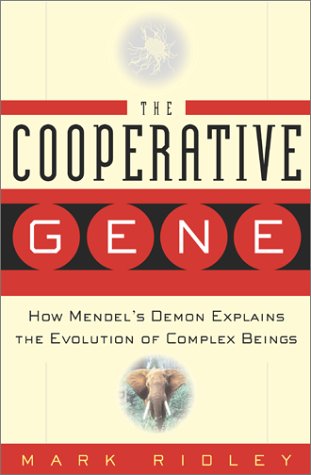
For those who find the conventional gene-eat-gene account of evolution suspiciously similar to the ideology of capitalism, Ridley (zoology, U. of Oxford) points out that complex organisms could not have arisen unless many genes in the case of humans, about 30,000 learned how to work together. His main themes are mutational errors in the copying of DNA and how Mendelian inheritance is designed to prevent selfish genes from taking over. Annotation c. Book News, Inc., Portland, OR (booknews.com)
About the Author
Mark Ridley pursues his research in the Department of Zoology at the University of Oxford. Formerly an assistant professor at Emory University in Atlanta, Ridley has also served as a research fellow at St. Catherine's College, Cambridge, and at Linacre, Oriel, and New Colleges in Oxford, all in England. His previous publications include The Problems of Evolution, Animal Behavior, and the highly acclaimed student textbook Evolution. Ridley frequently contributes to The New York Times, The Sunday Times, Nature, New Scientist, and The Times Literary Supplement. He lives in Oxford, England.
"About this title" may belong to another edition of this title.