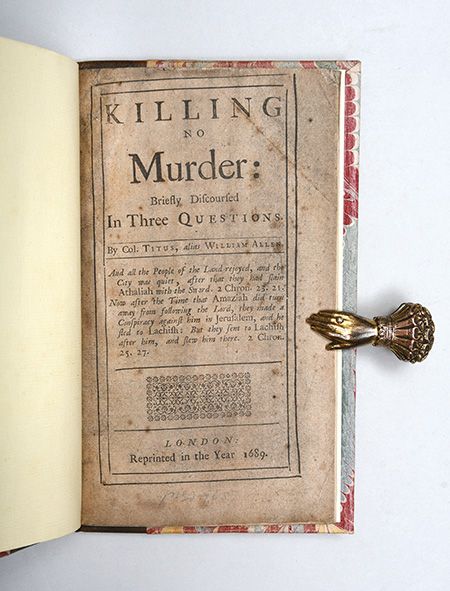
About this Item
A Jacobite reincarnation, after the Glorious Revolution, of this extraordinary and widely circulated 17th-century defence of tyrannicide, originally on first publication in 1657 an appeal for the assassination of Oliver Cromwell, this one of three clandestine editions which appeared following the deposition of James III and ascent of William and Mary, aimed at the new monarchs. Drawing on classical writers including Aristotle, Plato, and Xenophon, and modern writers including Hugo Grotius, the author provides a basis for tyrannicide as a lawful act, and sets out to prove that Cromwell "was a tyrant on a par with Caligula and Nero. However stable, his reign was an abrogation of law which constituted the enslavement of the English people and threatened the outright corruption of English society. In such circumstances the private citizen was perfectly within his rights in seeking to exact the punishment for which responsibility ought normally to rest with God and the magistrate. Tyranny being the suspension of the normal course of law, tyrannicide could not be regarded as an act of murder" (ODNB, William Sexby). The pamphlet was published pseudonymously under "William Allen", and the author has never been satisfactorily identified. The two most likely claimants are Colonel Silius Titus and Edward Sexby, both of whom claimed authorship; most probably they collaborated. Three editions were published in 1689, undoubtedly Jacobite. Parallels between William III and Cromwell were widely drawn; James II had himself drawn the link in his final attempt at reconciliation with the Anglican bishops. Killing No Murder was always recognized in the 17th century as an explicitly pro-Stuart tract, and its publication in 1689 would leave no doubt among its readers who was seen as the illegitimate tyrant. The 1689 republications aimed "to reproduce the past: to identify with a Cromwell, usurper of the Stuarts, another usurper of the Stuarts: and to draw from it the same consequence" (Lutaud, translated, p. 182). These editions were forerunners of further editions which would appear, for the same purpose, around the Jacobite uprising of the 1740s. The tract had an extraordinarily long life - editions were published around the French Revolution against the Bourbons (much removed from the tract's original intent), and apparently surfaced in pre-revolutionary Russia. With the bookplate of Gerald E. Aylmer (1926-2000), a leading historian of 17th-century England, professor of history at the University of York from 1963 until 1978, afterwards master of St Peter's College in Oxford until 1991. ESTC R214304; Goldsmiths' 2785; Wing T1311B. Olivier Lutaud, Des révolutions d'Angleterre à la Révolution française: Le tyrannicide et 'Killing No Murder', 1973. Octavo (187 x 113 mm). Recent half calf, red label, marbled sides. Leaves in first signature bound in variant sequence to ESTC (life of Titus after dedication to Cromwell). Light browning, more pronounced to title. A very good copy.
Seller Inventory # 159781
Contact seller
Report this item