About this Item
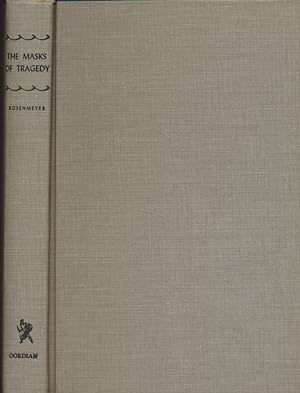
XIII, 248 p. Aus der Bibliothek von Prof. Wolfgang Haase, langjährigem Herausgeber der ANRW und des International Journal of the Classical Tradition (IJCT) / From the library of Prof. Wolfgang Haase, long-time editor of ANRW and the International Journal of the Classical Tradition (IJCT). - minimal bestoßen, Kopfschnitt minimal angegraut, einige Seiten weisen Flecken auf, sonst guter Zustand / minimally scuffed, top edge minimally grayed, some pages have stains, otherwise good condition. - CONTENTS Foreword A Note on the Translations Seven Against Thebes: The Tragedy of War Prometheus Bound: Tragedy or Treatise? . Bacchae and Ion: Tragedy and Religion Ajax: Tragedy and Time Alcestis: Character and Death / FOREWORD It may be asked whether there is room for yet another study of Greek drama. If it is true that the ancient dramas have to be interpreted anew for each succeeding generation and for each cultural group, has this not been done with eminent success? A continuing stream of books and articles dealing with one phase or another of the subject testifies to its lasting popularity. Many of them are works of scholarship, designed for the benefit of the specialist; of these there can never be too many. The present volume does not claim to be one of them. As for the more popular publications, they fall roughly into two classes. The majority are devoted to the study of an author or a period. That is to say, the plays are analyzed under the auspices of a literary biography. This is important; if through an examination of the plays we can gain a greater insight into the personality or the purposes of a Sophocles, we are the beneficiaries. The same is true of the type of study in which a number of dramas are discussed for the sake of arriving at an understanding of the specific "laws or the "idea of tragedy. Even for the iconoclastic playwright there is, one suspects, such a thing as the model play or the norm against which he fashions the product of the moment. The principal disadvantage of this approach, however, has been that sometimes it does not do full justice to a particular play. If the study of the playwright or of the dramatic form is to be exhaustive, the evidence must be complete. That means, a large number of plays have to be taken into consideration. This emphasis on wealth of evidence, along with the demands of the major thesis argued by the critic, makes it impossible to devote as much scope to each play as it deserves. Significantly, no more than eight or ten pages are often thought sufficient for saying what has to be said about a play to make its evidence felt. But a play is not only evidence. Hence a dissatisfaction with this kind of analysis has recently increased the output of studies, both in the form of articles and latterly also in the form of full-length books, which are devoted to the analysis of a single play. Where these unifocal studies have permitted a fuller savoring of a single work of art, without sidetracking us into comparison, statistics, biography, or anthropology, they have been welcome. But even so it is natural that a critic who channels his interpretive acumen into the explication of one play may come to regard this play as the realization of a generic ideal. Though this was not his original intention, he may eventually adopt the same perspective which prevails in the other camp, and see his play as the approximation to a norm, as representative rather than autonomous. It is, of course, humanly impossible to do anything else. Criticism, like other cognitive activities, operates with models and paradigms. But I dare say that what matters about a play is not the extent to which it is like any other play, but the way in which it is itself and different. This is, I suggest, how the ancient audiences received the performances. The jokes of Aristophanes justify the presumption that each play was felt to have it own ethos and its own objective. My purpose, then, in writing these essays is twofold. F.
Seller Inventory # 1181104
Contact seller
Report this item