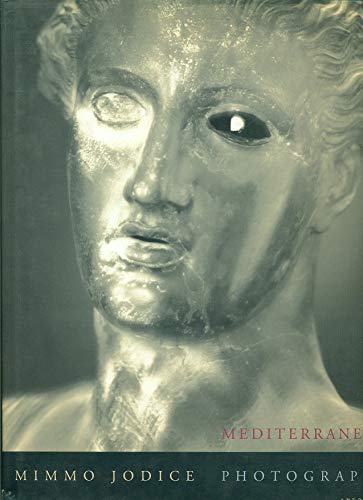
From Italy, France, Spain, Greece, Macedonia, Turkey, Tunisia, Syria, and Jordan, Jodice's luminous photographs evoke a vision of Mediterranean civilization that is a conflation of history and mythology. His dramatic yet ethereal images refuse both classical and contemporary boundaries in a fusion of the topographical and the intimate. Ruined temples, lost cities, heroic landscapes, gods and goddesses, vistas of Vesuvius and of the omnipresent sea transcend the constraints of their historical context in terms of both time and space.
At the same time, Mimmo Jodice's artful darkroom interventions give these images a renewed energy, one that is born of the present material world, but which seems sustained by loftier, more elusive mysteries. He begins with black-and-white negatives, and then works in the darkroom to create the simultaneous presence of a multiplicity of tones. Jodice's treatment of the photographic paper gives the images a suggestion of movement - they vibrate with the sense, as he puts it, that "everything is fleeting and somewhat impregnable."
Jodice's deeply original work reveals not only an experimental creative process, but also an informed and unique vision addressing a subject matter - archaeology - that has never before been considered in this way. His particular interpretations of such Classical icons remind us of the continuing impact of the Mediterranean world on our present lives, and reinstill a sense of epic, of adventure, of wonder, and even of providence - all so often missing in contemporary culture. Jodice provides us with a vision of the Mediterranean that is rich and vast, letting symbolic images become links between the experience of diverse peoples, and between ourselves and our distant ancestors.
Born in 1934 in the Sanita quarter of Naples, Mimmo Jodice has devoted his energies exclusively to photography since 1967. His first book, Chi e devoto, a collaboration with Roberto De Simone, was published in 1969, and shortly thereafter Jodice was appointed professor of photography at the Accademia di Belle Arti di Napoli, where he continues to teach. Jodice's early work documented themes of daily life and social unrest in Naples; the city, with its rich history, has remained an important element of his work. Jodice's photographs have been widely exhibited in Europe, and he has published many books and catalogs which have included essays by such eminent art historians as Carlo Bertelli, Germano Celant, and others. Accompanied by his wife Angela, Jodice has traveled extensively: along China's Silk Route, as well as to Russia, equatorial Africa, and throughout the Mediterranean region.
Predrag Matvejevic, born in 1932 in Mostar, Bosnia-Herzegovina, has taught at the universities of Zagreb, Paris (the Sorbonne Nouvelle), and Rome (La Sapienza). Among his many books, Breviare mediterraneen has been widely acclaimed for its poetic, experiential evocation of the Mediterranean Sea. He is the recipient of several awards and prizes, among them the INA prize for best critical writing and the Malaparte Prize for best book translated into Italian (1991).
George Hersey has been affiliated with Yale University since 1963. He has received numerous honors and awards; he has also been a Fulbright Scholar in Italy; a Fellow of I Tatti, the Harvard Center for Renaissance Studies; and a Visiting Scholar in Italy at the American Academy in Rome. Hersey has published many books, among them Alfonso II and the Artistic Renewal of Naples, 1485-1495, and The Lost Meaning of Classical Architecture: Speculations on Ornament from Vitruvius to Venturi. He is currently working on three books on art and architecture.