About this Item
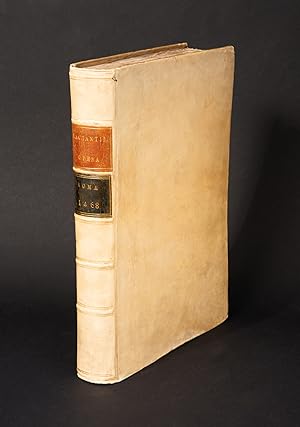
Folio (342 x 230mm.), 218 leaves (of 220, without initial and final blank leaves). Collation: [*12, 1-1110 128 13-1610 1712 18-2010 218], 38 lines, roman type (115R) with printed Greek quotations. On 2/1r (f. 13r) a six-line initial ?M? is supplied in gold on a background of white-vine decoration defined in crimson, blue and green which extends into the margins to form three borders edged in gold; the white-vine decoration in the lower margin of the same page incorporates a green laurel wreath within which is a defaced coat of arms, eight similar initials supplied in gold on white-vine grounds at the beginning of each book, one smaller initial in last quire, smaller initials supplied in alternate red and blue; paragraph marks supplied in alternate red and blue at the beginning of each chapter. A few spots and marginal foxing, light worming at the end, marginal notes by at least two different hands, a couple of ancient restorations in the white margins, overall a very good copy from the library of Augustus Frederick, Duke of Sussex (1773-1843) with his ex-libris; ?I purchased this volume August 14th 1854 ate the sale rooms of Sotheby. It was one of the late Pickering Stock. It had fromerly graced the Library of the late Duke of Sussex? (pencil note on the rear endleaf). XVIII century stiff vellum, spine in compartments with two morocco lettering pieces.Second edition of Lactantius - the first was printed in Subiaco three years earlier by the same Sweynheim and Pannartz ? first appearence in print of De Phoenice Carmen taken from Ovid's Metamorphoses, and the first appearence in print of any part of Dante's Commedia, two terzine about the phoenix (Inferno, XXIV, 106-111) are printed in the last quire. Moreover this is the second or the third book printed in Rome. A very important and rare book.The book contains Lactantius De divinis institutionibus, De ira dei, De opificio dei vel de formatione hominis, De phoenice carmen; Antonius Raudensis: Errata Lactantii; Adam Genuensis's Verse censuring Antonius Raudensi; .Ovidius Naso, Publius: Metamorphoses, (15. 391-402); Dante Alighieri: La Commedia, (Inferno, XXIV, 106-111); Venantius Fortunatus De Christi resurrectione.?Lucius Caecilius Firmianus Lactantius (born AD 240, North Africa?died c. 320, Augusta Treverorum [now Trier, Ger.]), was a Christian apologist and one of the most reprinted of the Latin Church Fathers, whose Divinae Institutiones, a classically styled philosophical refutation of early-4th-century anti-Christian tracts, was the first systematic Latin account of the Christian attitude toward life. Lactantius was referred to as the ?Christian Cicero' by Renaissance humanists. Lactantius was appointed a teacher of rhetoric at Nicomedia (later ?zmit, Tur.) by the Roman emperor Diocletian. When the emperor began persecuting Christians, however, Lactantius resigned his post about 305 and returned to the West. Later, in about 317, he came out of retirement to tutor the emperor Constantine's son Crispus, at Trier. Only Lactantius' writings dealing with Christianity have survived.? (Encyclopedia Britannica) ?His surviving works and the testimonies of his successors demonstrate that he was a poor theologian, being .more adept at showing the incongruity of heathen polytheism than in establishing Christian teaching." (The Oxford Dictionary of the Christian Church) Saint Jerome wrote of him that: "If only Lactantius, almost a river of Ciceronian eloquence, had been able to uphold our cause with the same facility with which he overturns that of our adversaries!" The stated purpose of Lactantius' writings was to present Christianity in a form that would be attractive to philosophical pagans. In practice this resulted in a uneasy amalgam of Christianity, Platonism, Stoicism and Pythagorianism. His views led to his posthumous condemnation as a heretic. Interest in his works was revived during the Renaissance not because of their outstanding theological content, but rathe.
Seller Inventory # bc_227
Contact seller
Report this item