About this Item
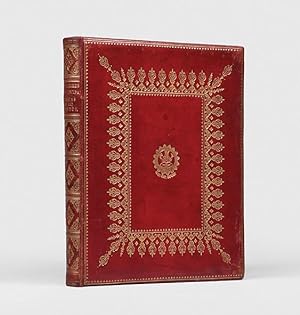
Handsomely presented copy of the uncommon second edition, perhaps correctly the third, of this pioneering work of Indian musicology, first published in 1875. The author founded the Bengal Music School, 1871 and the Bengal Academy of Music, 1881. Here he offers analyses of the Indian raga system including melodies transcribed in his newly devised Indian notation with Sanskrit words, and Western notation with transliterated Sanskrit words. Sourindra Mohun Tagore (1840-1914) was a scion of the wealthy bhadralok "middle class" which emerged in Bengal under British rule, "an ideological construct which was created in response to the political and economic domination by the British on the one hand and the cultural leadership among the colonized people on the other. cultural leaders of the indigenous colonized people" (Bhattacharyya). He studied Sanskrit and English at Hindu College, Calcutta, graduating in 1858. Along with his formal studies "Tagore began learning the sitar from Lakshmi Narayan Mishra of Benaras at the age of 17 and continued studies in other aspects of classical music and musicology with the well-known scholar Kshetra Mohan Goswami. Both the teachers were upper-caste Brahmins so their high-caste and class affiliations were appropriate for their inclusion by the bhadralok modernizers. Tagore also learnt Western music from a German pianist and took much interest in collecting books and ancient manuscripts on Indian music theories and works on European music" (ibid.). In May 1870 he gave a lecture entitled Jatiya Sangita Bishayak Prostab("Discourse on National Music") at the Calcutta Training Academy and was immediately proposed to establish and head a school of music. The Bengal Music School, established on the premises of the Calcutta Normal School in 1871 was the first such establishment in India. The school's syllabus aimed at a well-rounded musical education through training in vocal music, instrumental - sitar and harmonium - and percussion (mridanga), alongside theory classes. It almost certainly for his contributions in the latter field that Tagore is best known. Describing Six Principal Ragas as a "unique work" Bhattacharyya goes on to explain how it was "composed in the tradition of the Ragamala paintings in Mughal India that represented the sixragasand thirty-sixraginisin figural iconography. the seasonal theory ofragascombined with 'emblematical representations' in the form of lithographs. Defining theragaas a personified entity as distinguished from one another through their emotions, Tagore presented sixragasspecific to six seasons in India as follows: Summer, Panchama; Monsoon, Megh; Autumn, Bhairav; Dewy, Sri; Winter, Nat Narayan; Spring, Basant". His aim was to identify a national music, based in a theory that "seamlessly linked back to the ancient Sanskrit texts and yet was also discursively modern. placed within a framework of scientific knowledge, supported by a body of theoretical terms for disciplinary needs, institutionally mediated and openly critical of Western misinterpretations of music in India". Tagore also strove to promote interest in Indian music in other countries, donating collections of Indian instruments to institutions across America and Europe, even sending three as a personal gift to emperor Mutsihito in 1877. In 1902 he established the Tagore Gold Medal for the Royal College of Music in London, which had received its first major donation of musical instruments from him in 1884. The medal is still awarded today. An important work, and extremely attractively produced both in the letterpress and the unusual lithographic illustrations executed in a hybrid traditional-illusionist style, a register made possible by the wider availability of lithography which provided "the subtle gradations of shading essential for emulating illusionist art" (Mitter, pp. 12-13). Doss was one of the artisans "adopting the new process" early (ibid. p. 15). The attractive, presumably locally produced, bin.
Seller Inventory # 161908
Contact seller
Report this item