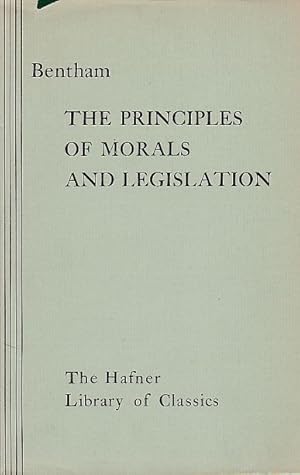
About this Item
378 S., Guter Zustand / good condition. - The work of Jeremy Bentham exerts an influence upon our time perhaps more diversified than that of any other modern philosopher, though during the half Century that followed his death in 1832 it was largely forgotten. Born on January 24, 1748 (February 4 by the Julian calendar then in use), to Jeremiah and Alicia Bentham, Jeremy early showed a precocity which, because it was coupled with an extremely retarded physical development and an unusual tenderness toward men snd animals, made his early life unhappy. At the age of four he was studying Latin; before he was twelve he could write in French more easily than in English and could play the violin ith individual expressiveness. He entered Oxford at the age f twelve, studying law in accordance with his fathers wishes, md graduated at the age of fifteen, paying for his precociousness by a long period of maladjustment. The lectures of Blackstone, the leading teacher in juris-rudencc of his time, left him completely dissatisfied. He as horrified by the evils of legal and political practice; and ü he was unwilling either to benefit by malpractices or to untenance them in others, any ordinary career in the law :r in politics was closed to him. It was during his Oxford or post-Oxford days that Bentham l ountered the Treatise of Human Nature by David Hume. Vter reading it he feit as if scales had fallen from his eyes ind he learned to see that utility was the test and measure of iH virtue. Greatly influenced by this work, Bentham devel-:ed soon afterwards the philosophy he espoused all his life h a consistency unsurpassed in the history of philosophy. bough his principles remained unchanged, he did make many imges in the terminology: what was first called, after Hume, r-ility became, after Beccaria and Priestley, the greatest happiness of the greatest number, and at last in Benthams own phrase, the greatest happiness. A somewhat similar development occurred in other aspects of the theory in the number of sanctions reeognized and the names given them, but these changes were actually little more than clarifications. Bentham first applied the greatest happiness principle in his Fragment on Government, published anonymously, and composed as a part of his analysis of Blackstones Commentaries. Blackstone was given to haphazard diction and empty or misleading, though melodious, prose. The young Bentham, therefore, had little difficulty in demolishing his opponents position. The Fragment was well received and occasioned much speculation about the anonymous author. In time the proud father Jeremiah revealed the truth, and the vogue of the Fragment diminished, for who had heard of Jeremy Bentham? There was, as always, less interest in an unknown author than in an author unknown, whose identity might be speculatively traced to all sorts of interesting people. The work itself, in spite of the later fame of its author, was not republished until 1828, continuing to be little known until 1891 when it was resurrected, for a brief time, by F. C. Montague. Bentham himself had only a poor opinion of the Fragment, referring to the tone of juvenility and tyroship which will be seen pervading the work. Still it contained a good deal of important matter, and was, in Benthams view, The very first publication by which men at large were invited to break loose from the trammeis of authority and ancestor-wisdom in the field of law. For his sons next work, The Defence of Usury, Jeremiah urged publication and Publicity. This essay concerned itself with the hoary, universally accepted theory that money was by nature unproductive: interest, therefore, was bribery and immoral. But laws against interest had proved futile; in practice there prevailed for years a kind of legal compromise with iniquity, the charging of interest being allowed but the rate being limited by law. Even Adam Smith championed this ärrangement, the unpopularity of which was revealed by the general acclaim.
Seller Inventory # 1159322
Contact seller
Report this item