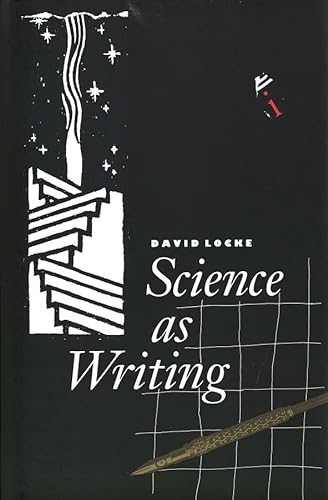
Science as Writing (Hardcover)
David Locke
Sold by Grand Eagle Retail, Bensenville, IL, U.S.A.
AbeBooks Seller since October 12, 2005
New - Hardcover
Condition: New
Ships within U.S.A.
Quantity: 1 available
Add to basketSold by Grand Eagle Retail, Bensenville, IL, U.S.A.
AbeBooks Seller since October 12, 2005
Condition: New
Quantity: 1 available
Add to basketHardcover. For many years it has been assumed that a great gulf exists between science and the humanities, that the writings of science are simply the record of things scientists do and find and are devoid of literary features. Recently this assumption has been challenged by those who regard science and literature as companion endeavors, working side by side to describe, in their respective ways, the world of human experience. Now David Locke, a professor of literature who has also been a scientist, joins the debate, arguing that scientific language can be highly imaginative, expressive, and self-conscious and demonstrating for the first time how the major modes of literary criticism can be keys to the reading of scientific texts.Locke takes up in sequence six critical perspectives on reading. These view literary texts as: essentially a representation of the real world; an expression of its author's thoughts and feelings; an activator of response from its readers; a work of art, interesting in its purely formal properties; an artifact situated in a social milieu; or an instrument that brings the world of phenomena into being. Locke applies these perspectives to the reading of a variety of scientific texts, from works by Galileo and Darwin to writings in contemporary molecular biology and theoretical physics. Locke suggests that attention to the literary qualities of scientific discourse will aid in further opening up the literary canon and widening the practice of literary criticism, even as it sharpens science's growing interest in, and understanding of, its own mode of operation. It has been assumed that a gulf existed between science and the humanities and that the writings of scientists had no literary features. Locke argues that scientific language can be imaginative and expressive and shows how modes of literary criticism can be keys to the reading of scientific texts. Shipping may be from multiple locations in the US or from the UK, depending on stock availability.
Seller Inventory # 9780300054521
"About this title" may belong to another edition of this title.
We guarantee the condition of every book as it¿s described on the Abebooks web sites. If you¿ve changed
your mind about a book that you¿ve ordered, please use the Ask bookseller a question link to contact us
and we¿ll respond within 2 business days.
Books ship from California and Michigan.
Orders usually ship within 2 business days. All books within the US ship free of charge. Delivery is 4-14 business days anywhere in the United States.
Books ship from California and Michigan.
If your book order is heavy or oversized, we may contact you to let you know extra shipping is required.
| Order quantity | 6 to 16 business days | 6 to 14 business days |
|---|---|---|
| First item | US$ 0.00 | US$ 0.00 |
Delivery times are set by sellers and vary by carrier and location. Orders passing through Customs may face delays and buyers are responsible for any associated duties or fees. Sellers may contact you regarding additional charges to cover any increased costs to ship your items.