About this Item
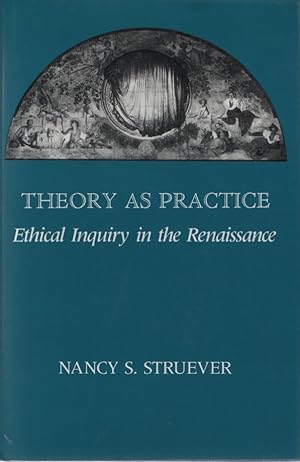
XIII, 246 p. From the library of Prof. Wolfgang Haase, long-time editor of ANRW and the International Journal of the Classical Tradition (IJCT). - Slightly rubbed jacket, allover very good and clean. / Leicht beriebene Jacke, insgesamt sehr gut und sauber. - Nancy Struever's The Language of History in the Renaissance was an early and seminal contribution to the debate on the relation of rhetoric to history. In her second book on the Renaissance, she shifts her focus to ethical inquiry and its practical, or rhetorical, presence. Her examination of the work of five major figures of the periodPetrarch, Nicolaus Cusanus, Lorenzo Valla, Machiavelli, and Montaigne contests accepted notions of the Renaissance Humanists as being merely hermeneuticists. At the same time, she shows how their work can be seen to gloss, or comment usefully on, the ethical theory of such modern philosophers as Peirce, Wittgenstein, Bernard Williams, and Quine. Often viewed as mere readers and interpreters of classical texts, the Renaissance Humanists in Struever's analysis appear instead as serious inquirers, rhetorically presenting their work as available practice. Struever notes three stages of investigation, the first represented by Petrarch, who relocated" ethical inquiry from a theoretical realm to a familiar practice responsive to daily experience. Next, Struever describes how Cusanus and Valla assume Petrarch's relocation, yet confect ethics into discursive disciplines; their strategies, she suggests, illumine and are illuminated by modern philosophy of language. Finally, while both Machiavelli and Montaigne produced strong revisions of discipline, they considered the problems of addressing the non-inquirer as well. Where Machiavelli enjoins tough-minded theorizing, Montaigne demands not an elitist skepticism, but a familiar practice which engages in tending, and repairing, a web of ordinary beliefs. The Renaissance thinkers in this account prove to be reacting against the traditional reduction of ethical inquiry to arid abstractions and a mechanical and unpersuasive moralism. Struever reanimates their inquiries to demonstrate the complex particularity of moral life. A model of erudition and insight, crossing cultures and disciplines in its innovative approach to intellectual history and rhetoric, Theory as Practice is as startling in its implications for present-day philosophy as it is compelling in its importance for Renaissance studies. - Nancy S. Struever is professor in the Department of History and the Humanities Center at the Johns Hopkins University. ISBN 9780226777429 Sprache: Englisch Gewicht in Gramm: 543 Original cloth with dust jacket.
Seller Inventory # 1168603
Contact seller
Report this item