
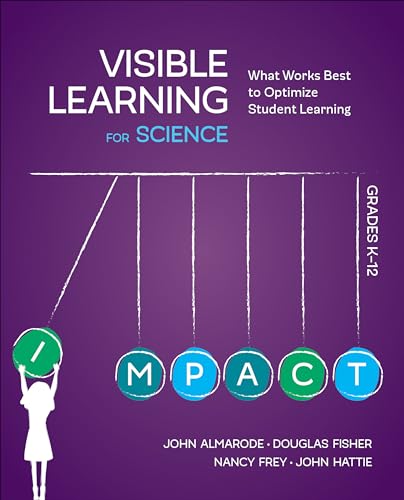
Visible Learning for Science, Grades K-12: What Works Best to Optimize Student Learning
Almarode, John T.
ISBN 10: 1506394183 ISBN 13: 9781506394183
Published by Corwin, 2018
Used
Soft cover
From
World of Books (was SecondSale), Montgomery, IL, U.S.A.
Seller rating 5 out of 5 stars

AbeBooks Seller since December 20, 2007
This specific item is no longer available.
About this Item
Description:
Item in acceptable condition! Textbooks may not include supplemental items i.e. CDs, access codes etc. Seller Inventory # 00104160199
Synopsis:
In the best science classrooms, teachers see learning through the eyes of their students, and students view themselves as explorers. But with so many instructional approaches to choose from―inquiry, laboratory, project-based learning, discovery learning―which is most effective for student success?
In Visible Learning for Science, the authors reveal that it’s not which strategy, but when, and plot a vital K-12 framework for choosing the right approach at the right time, depending on where students are within the three phases of learning: surface, deep, and transfer.
Synthesizing state-of-the-art science instruction and assessment with over fifteen years of John Hattie’s cornerstone educational research, this framework for maximum learning spans the range of topics in the life and physical sciences. Employing classroom examples from all grade levels, the authors empower teachers to plan, develop, and implement high-impact instruction for each phase of the learning cycle:
Surface learning: when, through precise approaches, students explore science concepts and skills that give way to a deeper exploration of scientific inquiry.
Deep learning: when students engage with data and evidence to uncover relationships between concepts―students think metacognitively, and use knowledge to plan, investigate, and articulate generalizations about scientific connections.
Transfer learning: when students apply knowledge of scientific principles, processes, and relationships to novel contexts, and are able to discern and innovate to solve complex problems.
Visible Learning for Science opens the door to maximum-impact science teaching, so that students demonstrate more than a year’s worth of learning for a year spent in school.
About the Authors:
John Almarode is a professor of education at James Madison University. He was awarded the inaugural Sarah Miller Luck Endowed Professorship in 2015 and received an Outstanding Faculty Award from the State Council for Higher Education in Virginia in 2021. John started as a mathematics and science teacher in Augusta County, Virginia. John has written multiple books, book chapters, papers, and reports. His collaborative work with colleagues on what works best in teaching and learning includes How Tutoring Works, Visible Learning in Early Childhood, and How Learning Works, all with Corwin Press.
Douglas Fisher is professor and chair of educational leadership at San Diego State University and a teacher leader at Health Sciences High and Middle College. Previously, Fisher was an early intervention teacher and elementary school educator. In 2022, he was inducted into the Reading Hall of Fame by the Literacy Research Association. He has published numerous articles on reading and literacy, differentiated instruction, and curriculum design, as well as books such as Your Introduction to PLC+, Welcome to Teaching, How Feedback Works, Teaching Reading, and RIGOR Unveiled. Fisher loves being an educator and hopes to share that passion with others.
Nancy Frey is a professor in educational leadership at San Diego State University and a teacher leader at Health Sciences High and Middle College. Her published titles include The Courage to Learn, The Art and Science of Coaching, How Scaffolding Works, and The Illustrated Guide to Visible Learning. Frey is a credentialed special educator, reading specialist, and administrator in California and learns from teachers and students every day.
John Hattie, PhD, is an award-winning education researcher and best-selling author with nearly thirty years of experience examining what works best in student learning and achievement. His research, better known as Visible Learning, is a culmination of nearly thirty years synthesizing more than 2,100 meta-analyses comprising more than one hundred thousand studies involving over 300 million students around the world. He has presented and keynoted in over three hundred international conferences and has received numerous recognitions for his contributions to education. His notable publications include Visible Learning, Visible Learning for Teachers, Visible Learning and the Science of How We Learn, Visible Learning for Mathematics, Grades K-12, and 10 Mindframes for Visible Learning.
"About this title" may belong to another edition of this title.
Bibliographic Details
Title: Visible Learning for Science, Grades K-12: ...
Publisher: Corwin
Publication Date: 2018
Binding: Soft cover
Condition: Acceptable