Order Total (1 Item Items):
Shipping Destination:

Bible Manuscript (5 results)
Skip to main search results
Search filters
Product Type
- All Product Types
- Books (4)
- Magazines & Periodicals (No further results match this refinement)
- Comics (No further results match this refinement)
- Sheet Music (No further results match this refinement)
- Art, Prints & Posters (No further results match this refinement)
- Photographs (No further results match this refinement)
- Maps (No further results match this refinement)
- Manuscripts & Paper Collectibles (1)
Condition Learn more
- New (No further results match this refinement)
- As New, Fine or Near Fine (1)
- Very Good or Good (1)
- Fair or Poor (No further results match this refinement)
- As Described (3)
Binding
- All Bindings
- Hardcover (3)
- Softcover (No further results match this refinement)
Collectible Attributes
- First Edition (No further results match this refinement)
- Signed (No further results match this refinement)
- Dust Jacket (No further results match this refinement)
- Seller-Supplied Images (4)
- Not Print on Demand (5)
Language (2)
Price
- Any Price
- Under US$ 25 (No further results match this refinement)
- US$ 25 to US$ 50 (No further results match this refinement)
- Over US$ 50
Free Shipping
- Free Shipping to U.S.A. (No further results match this refinement)
Seller Location
Seller Rating
-

Die Koridethi Evangelien [Theta] 038 / herausgegeben von Gustav Beerman und Caspar Rene Gregory [copied from 1913 edition]
Published by [Springfield IL: 2000?], Curt Daniel,, 2000
Hardcover. Photocopy. xii, 772 p. (2 pages on recto, verso blank): 2 pl. (Taf. Ia-b), 10 facsimile pl. (Taf. II-XI), 2 maps (A-B); 22 x 28 cm. VG oblong black buckram, spotting on front cover.
-
Bible, in Latin, decorated manuscript on vellum
Published by England, perhaps Oxford, mid 13th century (probably c. 1260), 1260
Seller: Sokol Books Ltd. ABA ILAB, London, United Kingdom
Seller rating 5 out of 5 stars

Manuscript / Paper Collectible
US$ 242,610.04
US$ 56.53 shipping
Ships from United Kingdom to U.S.A.Quantity: 1 available
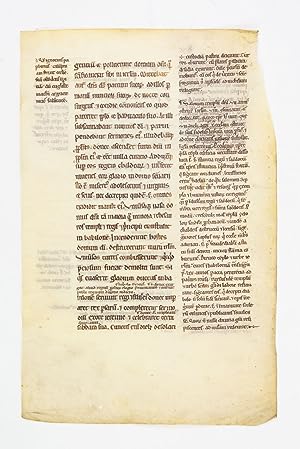
Add to basketHardcover. Condition: Good. Large 8vo, 192 x 130mm. x 80mm. thick. 549 leaves (plus endleaf at front, and including endleaf at back), collation impossible but textually complete. Rubricator made numerous mistakes corrected by contemporaries or near-contemporaries, and despite an apparent jump in II Esdra from chapter III to VII there is no text loss. Double column, 53-54 lines in an excellent professional early gothic bookhand, capitals touched in red, rubricated, small initials in alternate red and blue, chapter numbers and running titles in same, one-hundred-and-seventeen larger initials in variegated red and blue panels with elaborate scrolling penwork with scallop-shapes and patterns of circles and trailing stems in same colours, enclosing swirling foliage, numerous near-contemporary and early marginal additions (some set within geometric shapes in margin picked out with red outlines, and a few pointing hands as well as so-called 'clover marks'. Single hand pointing to a flying bird, most probably the Holy Spirit), two leaves with near-contemporary marginal drawings of God's hand emerging from a cloud and directing Noah and another looking out of the Ark as the dove returned with a sprig of foliage, as well as two diagrams of the levels of the ark with their types of inhabitant drawn "ab augustino". One front endleaf cut away, foot of first text leaf cut away probably to remove ownership inscription, splits to corners of a small number of leaves, slight cockling in places, small spots and stains. In excellent, most presentable condition, later medieval binding of dark brown leather over wooden boards, tooled with fleur-de-lys within chevrons and roll-stamps, sewn on thick thongs, two clasps of leather ties with metal endpieces which attach to metal pegs set in front board, scuffing to boards in places and slight tears at corners of spine, overall good and robust. In folding box. This is a handsome and weighty thirteenth-century most probably English Bible, the format in which most readers of the Middle Ages knew the complete text. Due to its vast size, most Early Medieval Biblical books included only sections of the complete canon, but the needs of students in the fledging university in Paris in the late twelfth and thirteenth centuries lead to advancements in the methods of book production in order to mass-produce complete copies for that market. Script became miniaturised and the words themselves heavily abbreviated in an effort to push resources to their limit, and at the same time libraires or master-book producers divided up master-copies to hand out in sections (or pecia) to multiple copyists at once, dramatically increasing the rate of copying. Thus they survived relatively in large numbers. However their multiple decorated initials and fine script often attracted the attentions of the commercial book dispersers from the nineteenth century onwards, and they have become fewer and fewer in the market in the last century, with examples continuing to fetch record prices. Here the form of the text is mostly that of a more common Parisian Bible, and with the standard abbreviations of Hebrew names in the form "Aaz apprehendens " at its end. Crucially, however, the script and penwork decoration here appear English and the books of Tobit, Judith and Esther are in the order usually identifying English use. In addition, the early notes on Hebrew at the end of the book strongly indicate an early use in a medieval English scholarly setting (see below). What is perhaps most notable about this book is the interest of an early user in the Hebrew Bible. Additions to endleaves at the front of the volume suggest a contemporary or near-contemporary use in theological teaching or preaching, perhaps in a cathedral school (see below), but a page of notes added in the decades after the book's production to blank space before the abbreviations of Hebrew names indicates a more specific use. This begins with the words "Thorath id est lex" with five penlines drawn of.
-
PENTATEUCH, PROPHETS AND HAGIOGRAPHA. CODEX LENINGRAD B 19a. THE EARLIEST COMPLETE BIBLE MANUSCRIPT. 3 VOLUMES.
Language: Hebrew
Published by Makor, Jerusalem -, 1974
Seller: M.POLLAK ANTIQUARIAT Est.1899, ABA, ILAB, Tel-Aviv, Israel
Seller rating 4 out of 5 stars

Original Half Leather. Condition: As New. Limited Edition. Complete in 3 vols. Fine hand bound half leather. Front covers with embossed ornaments. A LIMITED EDITION OF 135 COPIES BY SPECIAL PERMISSION OF THE LENINGRAD LIBRARY ( Codex Leningrad B19a) . Facsimile of the oldest complete manuscript (dated 1008 CE) of the HEBREW BIBLE in Hebrew. Loewinger D.S. Editor. FINE COPY- Heavy item ( additional shipping fees will apply: $ 90.00 in total to the USA and Canada , reg. airmail).
-
TEXT BEGINNING WITH 2 CHRONICLES 36:14
Published by ca. 1175, Abbey of St. Oyan at St.-Claude du Jura, France, 1175
Seller: Phillip J. Pirages Rare Books (ABAA), McMinnville, OR, U.S.A.
Seller rating 3 out of 5 stars

245 x 158 mm. (9 3/4 x 6 1/4"). Single column of text with two columns of gloss, text column with 26 lines in a fine proto-gothic book hand. Verso with scant remnants of mounting tape in a couple of places along one edge. See Gwara, Handlist no. 77. âUpper margin of fore edge unevenly trimmed away (but no text lost), a dozen-and-a-half small, round wormholes (touching just a couple letters), light soiling to edges and other minor imperfections, but still IN FINE CONDITION, the vellum very clean, and the ink dark and legible. The most important innovation in biblical scholarship during the 12th century was the development of the "Glossa Ordinaria" to the Bible. Drawing on the whole earlier tradition of biblical exegesis, but especially that of Latin patristic writers like Augustine and Jerome, scholars working in the French cathedral schools of Laon and Paris systematized this material in an apparatus of marginal and interlinear glosses arranged around the relevant biblical passages. The present leaf, showing a particularly beautiful and regular script, is a lovely example of one such work. The biblical text, appearing in the center column, is differentiated by larger lettering, and gloss appears interlineally and in a column on either side of the main text, all in smaller lettering by the same hand. Scott Gwara notes that the parent manuscript was formerly in the Medieval library of St. Oyan at St.-Claude du Jura, a Benedictine monastery founded as the Abbey of Condat around 425 and later known as St. Oyen (after an obscure saint who served as Condat's fourth abbot). In the 13th century it was renamed St.-Claude. By the 20th century, the manuscript was in the collection of William L. Clements (d. 1934), the bulk of which was sold by his estate between 1934-37. The manuscript was then acquired and dismembered by biblioclast Otto Ege around 1939. Gwara notes that the manuscript was incomplete by the time it reached Ege (containing only 80 leaves), but was "otherwise in excellent condition." The present leaf certainly attests to this assertion, being extremely clean, bright, and with comfortable margins.
-
TEXTS FROM THE TABLE OF CONTENTS OF DEUTERONOMY AND FROM DEUTERONOMY 2:26-3:26
Published by mid-12th century, Perhaps France
Seller: Phillip J. Pirages Rare Books (ABAA), McMinnville, OR, U.S.A.
Seller rating 3 out of 5 stars
Each leaf measures approximately 370 x 240 mm. (14 1/2 x 9 1/2"). Double column, 32 lines in a fine proto-gothic hand. See: Thompson, "An Introduction to Greek and Latin Paleography," p. 436. ?Recovered from a binding and thus with one side of each leaf somewhat browned, soiled and with a few creases, one leaf with several small blotches of red paint in the text (not affecting overall legibility), one corner of each leaf torn away, affecting running title and one to two lines of text, other trivial defects, but still very nice specimens with clear and legible script, and one side of each leaf quite clean and well preserved. Once part of a large and elegant Romanesque Bible, these leaves are excellent examples of a high quality proto-gothic book hand. Sometimes referred to as "praegothica" or "late Caroline," the proto-gothic script is characterized by letterforms that are more or less unchanged from Caroline minuscule, but with a number of traits starting to show elements of gothic script--most notably the addition of feet (appearing here as an upward flick of the pen) on the bottom of minims, but also including the use of more abbreviations, the fusion of certain letter combinations, a more elongated "o," and a straight-backed "a." Whatever the level of its evolution, the script here has very pleasing rounded letterforms that are highly legible and generously spaced. Though the vellum is not unmarred by its former life as binding material, the script here has not lost any of its beauty, revealing a hand that is practiced, regular, and distinctly pleasing to the eye. As Thompson notes, "In the twelfth century the scribes seem to have vied with each other in producing the best types of book-writing of which they were capable, with the result that remarkable precision in the formation of the letter was attained, and that the century may be named as excelling all others for the beauty of its MSS." Our leaves come from Deuteronomy, the Old Testament book consisting primarily of three sermons made by Moses just before entering the Promised Land. One leaf contains brief summaries of chapters 2-18 (with some chapters numbered in the margins), while the other leaf contains part of the first of Moses' speeches, in which he recalls the Israelites' 40-year journey through the wilderness.