
1443 (28 results)
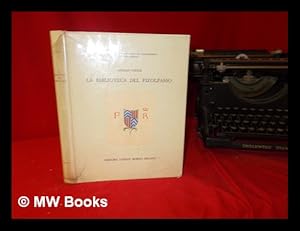
Published by Milano : Hoepli 1961
- Hardcover
- First Edition
Seller: MW Books, New York, NY, U.S.A.MW Books
Contact seller5-star sellerFirst Edition. Good copy bound in full vellum with a leather armorial decoration on the front board. Some slight dust-dulling to the extremities to the edges. Remains well preserved overall; tight, bright, clean and sharp-cornered. Physical description; 243 p., [16] leaves of plates : ill. ; 25 cm. Notes; "Lettere del Pizolpasso…" (in Latin): p. [169]-237. At head of title: Istituto nazionale di studi sul Rinascimento. Sezione lombarda. Includes bibliographical references. Subjects; Pizolpasso, Francesco (ca. 1370-1443) Library Catalogs. Pizolpassi, Francesco approximately (1370-1443) Library ; Catalogs. Pizolpasso, Francesco (ca. 1370-1443) Library Catalogs. Manuscripts, Renaissance Italy Catalogs. Private libraries Italy Catalogs. Manuscripts, Renaissance Italy ; Catalogs. Genres; Bibliography. Biography. Catalogue. Illustrated. 1 Kg.

- Softcover
Seller: Chiron Media, Wallingford, , United KingdomChiron Media
Contact seller5-star sellerCondition: New
US$ 90.79
US$ 20.70 shippingShips from United Kingdom to U.S.A.Quantity: 10 available
Paperback. Condition: New.
 More images
Published by Harmondsworth, Penguin Books, 1963 1963
- Softcover
Seller: Antiquariaat Digitalis, Amsterdam, NetherlandsAntiquariaat Digitalis
Contact seller5-star sellerCondition: Used - Very good
US$ 17.82
US$ 46.14 shippingShips from Netherlands to U.S.A.Quantity: 1 available
Soft cover. Condition: Very Good. Second reprint in Penguin Books, 211, (5) pp., pictorial stiff paper wrappers. Wear at wrappers, age toning. Good and tight copy. 18 x 11 cm.

Language: German
Published by 1834. 1834
Seller: Antiquariat Heinz Tessin, Quickborn, , GermanyAntiquariat Heinz Tessin
Contact seller5-star sellerCondition: Used
US$ 40.40
US$ 4.61 shippingShips from Germany to U.S.A.Quantity: 1 available
14,0 x 11,8 cm. Druckfrisches Exemplar. [SW - Portrait, Porträt, Lithographie].

Published by Milano : Hoepli 1961
- Hardcover
- First Edition
Seller: MW Books Ltd., Galway, , IrelandMW Books Ltd.
Contact seller5-star sellerCondition: Used
US$ 57.03
US$ 16.09 shippingShips from Ireland to U.S.A.Quantity: 1 available
First Edition. Good copy bound in full vellum with a leather armorial decoration on the front board. Some slight dust-dulling to the extremities to the edges. Remains well preserved overall; tight, bright, clean and sharp-cornered. Physical description; 243 p., [16] leaves of plates : ill. ; 25 cm. Notes; "Lettere del Pizolpasso…" (in Latin): p. [169]-237. At head of title: Istituto nazionale di studi sul Rinascimento. Sezione lombarda. Includes bibliographical references. Subjects; Pizolpasso, Francesco (ca. 1370-1443) Library Catalogs. Pizolpassi, Francesco approximately (1370-1443) Library ; Catalogs. Pizolpasso, Francesco (ca. 1370-1443) Library Catalogs. Manuscripts, Renaissance Italy Catalogs. Private libraries Italy Catalogs. Manuscripts, Renaissance Italy ; Catalogs. Genres; Bibliography. Biography. Catalogue. Illustrated. 1 Kg.

Language: German
Published by Leipzig: Saxonia um 1835
- First Edition
- Art Print
Seller: historicArt Antiquariat & Kunsthandlung, Wiesbaden-Breckenheim, , GermanyhistoricArt Antiquariat & Kunsthandlung
Contact seller5-star sellerCondition: Used
US$ 34.46
US$ 13.84 shippingShips from Germany to U.S.A.Quantity: 1 available
1. Kreidelithographie auf rückseitig unbedrucktem Büttenblatt, Darstellung ca. 14,5 x 12,5 cm, Blattgröße ca. 24 x 18 cm, kräftiger Abzug vom Stein, im breiten Rand minimal fleckig 1100 gr.
- Softcover
Seller: Revaluation Books, Exeter, , United KingdomRevaluation Books
Contact seller5-star sellerCondition: New
US$ 163.88
US$ 26.72 shippingShips from United Kingdom to U.S.A.Quantity: 2 available
Paperback. Condition: Brand New. 824 pages. 11.69x8.27x1.63 inches. In Stock.

Published by 1654. 8in x 5in. 1654
Seller: R.G. Watkins Books and Prints, Ilminster, SOMER, United KingdomR.G. Watkins Books and Prints
Contact seller5-star sellerCondition: Used
US$ 20.64
US$ 37.41 shippingShips from United Kingdom to U.S.A.Quantity: 1 available
Engraving, from 'Effigies & vitae Professorvm Academiae Groningae & Omlandiae', trimmed inside platemark.

Published by Paris : Pour les membres de la Société française de reproductions de manuscrits à peintures 1923
- Hardcover
- First Edition
Seller: MW Books, New York, NY, U.S.A.MW Books
Contact seller5-star seller1st edition. Poor copy in the original paper-covered boards. Boards and pages detached. Pages edge-nicked. Text remains clear without blemish. Physical description: 103 pages, LII plate (part folded: 2 illustrations, including portraits, facsimiles); 34 cm. Notes: At head of title: A. de Hevesy. In portfolio."Bibliographie des o…uvrages concernant la bibliothèque de Matthias Corvin": pages [47]-50. "Catalogue de ce qui reste de la bibliothèque de Matthias Corvin": pages [59]-93. Contents: "Catalogue de ce qui reste de la Bibliothe èque de Matthias Corvin": p59-93. Subjects: Matthias I, King of Hungary 1443-1490 Library. Mátyás I, Corvinus, king of Hungary 1440?-1490. Illumination of books and manuscripts; Specimens. Manuscripts; Catalogs. Rare books; Catalogs. Illumination of books and manuscripts; Specimens. Genre: Bibliography. Illustrated. Specimens. 3 Kg.

Published by Paris : Pour les membres de la Société française de reproductions de manuscrits à peintures 1923
- Hardcover
- First Edition
Seller: MW Books Ltd., Galway, , IrelandMW Books Ltd.
Contact seller5-star sellerCondition: Used
US$ 89.11
US$ 16.09 shippingShips from Ireland to U.S.A.Quantity: 1 available
1st edition. Poor copy in the original paper-covered boards. Boards and pages detached. Pages edge-nicked. Text remains clear without blemish. Physical description: 103 pages, LII plate (part folded: 2 illustrations, including portraits, facsimiles); 34 cm. Notes: At head of title: A. de Hevesy. In portfolio."Bibliographie des o…uvrages concernant la bibliothèque de Matthias Corvin": pages [47]-50. "Catalogue de ce qui reste de la bibliothèque de Matthias Corvin": pages [59]-93. Contents: "Catalogue de ce qui reste de la Bibliothe èque de Matthias Corvin": p59-93. Subjects: Matthias I, King of Hungary 1443-1490 Library. Mátyás I, Corvinus, king of Hungary 1440?-1490. Illumination of books and manuscripts; Specimens. Manuscripts; Catalogs. Rare books; Catalogs. Illumination of books and manuscripts; Specimens. Genre: Bibliography. Illustrated. Specimens. 1 Kg.

Albrecht der Beherzte. Herzog von Sachsen und Markgraf von Meissen. Kupferstich von Marchant, Rückseite mit Text.
Albrecht III. - (1443 - 1500)
Language: German
Published by 1708. 1708
Seller: Antiquariat Heinz Tessin, Quickborn, , GermanyAntiquariat Heinz Tessin
Contact seller5-star sellerCondition: Used
US$ 64.16
US$ 4.61 shippingShips from Germany to U.S.A.Quantity: 1 available
33,0 x 21,3 cm. Ränder teils leicht knitterig, weiße Ecke unten rechts mit kleinen hinterlegten Einrissen. Ganze Seite aus der großen Ausgabe der Kurfürsten Bibel. [SW - Porträt, Portrait].

Language: German
- Art Print
Seller: Antiquariat Clemens Paulusch GmbH, Berlin, , GermanyAntiquariat Clemens Paulusch GmbH
Contact seller5-star sellerCondition: Used
US$ 23.76
US$ 31.03 shippingShips from Germany to U.S.A.Quantity: 1 available
Stahlstich v. Payne n. Jäger b. Payne, um 1850, 12,5 x 12,5 (H).

Language: German
- Art Print
Seller: Antiquariat Clemens Paulusch GmbH, Berlin, , GermanyAntiquariat Clemens Paulusch GmbH
Contact seller5-star sellerCondition: Used
US$ 23.76
US$ 31.03 shippingShips from Germany to U.S.A.Quantity: 1 available
Lithographie aus Saxonia, 1835, 14 x 11,8 (H) Begründer der albertinischen Linie des Hauses Wettin.
 More images
Published by Venezia, Giovanni Andrea Valvassori, Venezia 1538
- Hardcover
Seller: Libreria Alberto Govi di F. Govi Sas, Modena, MO, ItalyLibreria Alberto Govi di F. Govi Sas
Contact seller5-star sellerCondition: Used
US$ 11,287.14
US$ 34.61 shippingShips from Italy to U.S.A.Quantity: 1 available
Condition: Buono (Good). 8vo (152x106 mm). [72] leaves. Collation: A-I8. Colophon and printer's device on l. I7v. Leaf I8 is a blank. Large woodcut on the title page and 23 half-page woodcut illustrations in the text. Text in Italian and Latin. Contemporary or slightly later vellum over boards, inked title on spine (spine restor…ed, traces of ties, new endleaves). On the title page ownership inscription ?questo libro sie di fra salvador graziolo da sallo?, whose initials ?F.S.G.S.? are written on the front panel (on the back panel there is another inscription with the initials ?VAGS?). Restoration to the outer upper corner of ll. C1 and C2 slightly affecting the text, otherwise a very good, clean copy.Reprint of the second Valvassori edition of 1533. Del Tuppo's Vita Aesopi was first printed in Naples in 1485 together with Aesop's fables. It had a remarkable success and was reprinted several times until the mid 16th century. With the only expection of the Aquila edition of 1493 which contains both the Vita and the Fabulae, all subsequent editions reproduce only the Vita. Valvassori issued two editions in 1533, one dated 8 March of 74 leaves and one of 72 leaves, on which the present is based.The title-page illustration is a copy of the woodcut used in Vergil's Moretum (Venice, Pasini, September 1525). The 23 woodcut vignettes in the text are copies of those used in the Bonelli edition of 1492.Francesco del Tuppo was a Neapolitan printer, bookseller and man of letters who carried out various administrative tasks for the Aragonese. First as a partner in S. Riessinger's printing house (the first the be established in Naples), then, after 1478, as its director, he printed, among other books, his own translation in an Italian vernacular full of terms from the Neapolitan dialect, of Rinuccio da Castiglione d'Arezzo's Latin version of Aesop's Life. The choice of the subject and the language was certainly motivated by the popularity of the Aesop tradition and Del Tuppo's poor knowledge of Latin (P. Farenga, Del Tuppo, Francesco, in: ?Dizionario Biografico degli Italiani?, vol. 38, Rome, 1990, s.v.).The work is dedicated to Onorato Gaetani, Count of Fondi, promoter and financier of the first edition. The Vita Aesopi is a composite work, made up of removable and interchangeable parts, which can be taken out and added to without altering significantly the narrative structure. Different human types and cultural paradigms from different epochs converge in the figure of the protagonist, which has the double role of agens, as main character in his biographical events, and of auctor, as inventor of the fables closely linked to these events. Over time, however, the second of these two functions prevailed, and some anecdotes originally included in the biographical narrative began to circulate as autonomous tales. This is the case of the tales of the gardener crushed by the greater abundance of wild herbs than of the plants he cultivates in his vegetable garden; of the sheep and the pig led to the slaughterhouse; of the two paths, that of virtue and that of slavery, between which man must choose; of the wolves who, by deception, kill the shepards; of the cicada caught by the hunter; of the pieces of wood mistaken from afar for large ships; of the two foxes and the rooster; of the industrious man who leaves everything to devote himself to agriculture; of the old man who wants to see the city at least once in his life; and of the exocean who escapes the sturgeon only by dying. Every chapter opens with the Latin text followed by Del Tuppo's vernacular version (cf. S. Rovere, L'Esopo napoletano di Francesco del Tuppo, Pisa, 2017, pp. 1-58).Edit 16, CNCE39415; Essling, 617; Sander, 105; S. Rovere, Op. cit., p. 88. Book.
 More images
Il peregrino di M. Giacopo Caviceo da Parma. Nuovamente con somma diligenza revisto, & ristampato. M.D.XXX.VIII.
CAVICEO, Jacopo (1443-1511)-ANSELMI, Giorgio (ca. 1450-1528)
Published by Venezia, Pietro Nicolini da Sabbio 26 settembre 1538, Venezia 1538
- Hardcover
Seller: Libreria Alberto Govi di F. Govi Sas, Modena, MO, ItalyLibreria Alberto Govi di F. Govi Sas
Contact seller5-star sellerCondition: Used
US$ 1,069.31
US$ 34.61 shippingShips from Italy to U.S.A.Quantity: 1 available
Condition: Mediocre (Poor). In 8vo (mm. 155x98). Cc. [8], 271, [1 bianca]. Segnatura: *8 A-LL8. Titolo in cornice xilografica e 4 illustrazioni incise in legno nel testo, una a tre quarti di pagina alla c. A1r e tre vignette più piccole all'inizio di ciascuno dei tre libri di cui si compone l'opera. In fine, a c. KK5v, si trova…la Vita de Giacopo Cauiceo, per Georgio Anselmo. Carattere romano e corsivo. Pergamena semirigida posteriore con nervi passanti e titolo al taglio superiore (restauri e mancanze, leggermente macchiata). Titolo brunito e con una piccola mancanza al recto e al verso, piccole mancanze anche alla carta A1 con perdita di tre lettere, leggere fioriture sparse.Diciassettesima edizione (prima edizione: Parma, 1508) del fortunatissimo romanzo del Caviceo, qui ristampato insieme alla sua biografia scritta dal concittadino Giorgio Anselmi, che rimane a tutt'oggi una delle fonti principali sulla vita del Caviceo.?Ma la fatica più importante del Caviceo è senz'altro il suo romanzo, il Peregrino, in volgare, edito a Parma nel 1508. L'opera si differenzia in maniera netta dal resto della sua produzione letteraria, che è di ispirazione umanistica e scritta in latino, e nasce da sorgenti culturali diverse. Il Peregrino è posto sotto la paternità del Boccaccio che, apparendo in sogno all'autore, canta le lodi di Lucrezia Borgia, dedicataria dell'opera. Il romanzo, volutamente retrodatato dall'autore, è ambientato nella Ferrara di Ercole I. La vicenda è tutta imperniata sulle lunghe peregrinazioni del protagonista prima dell'appagamento del suo sogno d'amore. Innamoratosi fin dal primo incontro di Ginevra, Peregrino desidera ardentemente rivederla, quando riceve da lei uno strano messaggio, grazie alla compiacenza della serva Astanna. Mentre egli cerca affannosamente Ginevra, cade nelle mani di alcuni sbirri che seguono le tracce di un omicida. Scambiato per il colpevole, è sottoposto ad un lungo processo, dal quale esce innocente, grazie alla strenua difesa del grande giurista Antonio dai Liuti. Dopodiché Peregrino tenta di farsi ricevere dall'amata, nascosto dentro a una statua di legno di S. Caterina. Colpevole di sacrilegio, è sollecitato dalla donna a recarsi in Levante per espiare il suo peccato. Ha inizio così il periglioso viaggio del protagonista, accompagnato dal fido amico Acate. Infinite sono le loro avventure prima di raggiungere di nuovo Ferrara. Qui Peregrino apprende con immenso dolore che Ginevra è stata rinchiusa in un monastero; riparte allora per l'Oriente per consultare un oracolo che gli sappia indicare dove è la donna amata. Giunto da un eremita, che lo fa cadere in un sonno pro fondo, visita gli Inferi, e qui trova accomunati i più bei nomi dell'aristocrazia italiana, e anche Astanna che gli rivela dove si trova Ginevra. Tra i vivi egli continua il suo viaggio attraverso l'India, Rodi, Creta e di nuovo sbarca in Italia, a Rimini; lo accoglie amorevolmente Elisabetta Gonzaga. A Ravenna, finalmente, ha la conferma che Ginevra è in un monastero di quella città. Con la complicità della badessa vengono celebrate le nozze dei due amanti. Ma la felicità è di breve durata. Ginevra nove mesi dopo muore di parto e Peregrino, non reggendo al dolore, di lì a poco la segue nella tomba. Il filo narrativo, modellato su temi boccacceschi derivanti soprattutto dall'Amorosa visione e dal Filocolo, è abbastanza esile e continuamente interrotto dai monologhi o dai dialoghi di. tipo amoroso, a sfondo filosofico e di carattere erudito, da dibattiti giudiziari e da lunghi excursus consolatori. Ma, al di là dell'ispirazione boccaccesca, il Caviceo affronta con il Peregrino un genere del tutto nuovo, quello della prosa di fantasia, che aveva quale immediato precedente Sabadino degli Arienti; diversamente da lui il Caviceo tenta tuttavia di unificare la materia frammentaria delle novelle in un racconto unico, riprendendo in questo il tentativo di Francesco Colonna. Del resto il Peregrino ci riporta all'opera del frate veneziano anche per la lingua. Book.
 More images
Published by Niccolo Zoppino, Venezia 1526
- Hardcover
Seller: White Lands Rare Books, Torino, TO, ItalyWhite Lands Rare Books
Contact seller4-star sellerCondition: Used
US$ 2,376.24
US$ 46.14 shippingShips from Italy to U.S.A.Quantity: 1 available
Condition: Buono (Good). Legatura coeva in piena pelle con impressioni a secco e in oro, titoli entro decorazioni circolari ai piatti contornate da cornice dorata e decorata a secco, dorso a 3 nervi con parte del titolo manoscritto, tagli dorati con intarsi circolari (leggermente allentata e con tracce di restauro, carte di guar…dia riposizionate da mano inesperta con bandella di carta incollata al piatto anteriore). Giorgio Fanan (exlibris). Grande vignetta xilografica al frontespizio, apertura del primo libro entro elaborata cornice xilografia, vignetta incisa in legno all'inizio di ogni libro (qualche lieve macchia e traccia di polvere). Il 'Peregrino' è l'unica opera in volgare composta dal Caviceo; è divisa in 3 libri, ciascuno dei quali è introdotto da una vignetta xilografica che raffigura il Pellegrino che parla ?a Violante, a Hacate e a Theodoro? ?Romanzo del sacerdote parmense Iacopo Caviceo, pubblicato nel 1508. E? la storia boccaccesca degli amori di due giovani, Peregrino e Ginevra, che l?autore finge d?aver ascoltato (in tre tempi) dall?ombra del protagonista stesso apparsogli in visione. e reso piccante dalle numerose allusioni a uomini contemporanei e dalla lubricità di parecchi episodi. Godette al suo tempo di una grandissima popolarità; in mezzo secolo fu ristampato 19 volte e tradotto in francese e in castigIiano" (Diz. Opere Bompiani, IV, p. 394). Book.
 More images
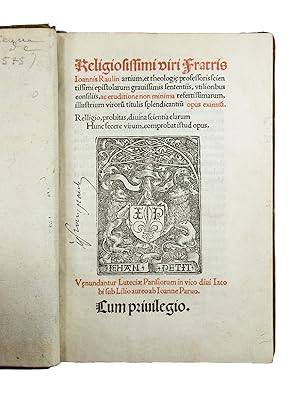
Published by Paris, Antoine Aussourd for Jean Petit, Paris 1521
- Hardcover
Seller: Govi Rare Books LLC, Woodside, New York City, NY, U.S.A.Govi Rare Books LLC
Contact seller4-star sellerCondition: Buono (Good). 4to. (8), clxvi, (i.e. clxx), (1) leaves (with errors in the foliation). aa4, bb4, a-q4/8, r-s4, t-v8, x4, y8, z8, &8, 94, A8, B4, C4, D8 (-D8 blank). Title printed in red and black with the printer's device. Eighteenth century marbled calf, gilt spine with five raised bands, red morocco label, red edges…, marbled endpapers.Adams, R-182; G. Guedet, L'art de la lettre humaniste, (Paris, 2004), p. 299; B. Moreau, Inventaire chronologique des éditions parisiennes du 16e siècle, (Paris, 1985), III, p. 149, no. 391. FIRST EDITION of this collection of 56 letters published by the author's nephew Robert Raulin. ?On trouve, dans la correspondence de Raulin, la même doctrine de réforme par le retour aux vertus monastiques: chasteté du corps, ?abstinence' de l'esprit, devotion, paix et concorde, obéissance ou plus simplement ?la pauvreté et la charité' ? (G.T. Bedouelle, Jean Raulin, in: ?Dictionaire de Spiritualité?, Paris, 1932-1995, 13, pp. 156). These ideas are clearly expressed in the letter to the friars of St. Alban in Basel (ll. LVv-LIXr).?Several ideas may be drawn from his correspondence. First, Raulin relied heavily upon his long term relationships in the clerical milieu, bishops and heads of monasteries, to push his reform efforts forward. He labored primarily with and among the Benedictines, with a few exceptions, and crossed into other monastic orders only as the need arose. Second, many of Raulin's correspondents were relationships that he had developed during his time as chancellor of Navarre; many were former colleagues and students. It is possible that Raulin had begun to sow the seeds of clerical reform among colleagues and students while at Navarre. Later, as his ideas matured and his plan unfolded, those relationships proved useful and strategic for clerical reform. A third idea we can draw from his correspondence is that he appears to have had a precise strategy - he wrote those in positions of leadership who might more successfully accomplish reform in the monasteries. The majority of his letters are addressed to those in ecclesiastical authority, bishops, abbots, and priors, who had greater authority to bring reform to the monasteries. Fourth, his reliance on political help to accomplish reform was minimal, although he did use civil authority to force entry into a few monasteries and to impose his reforms. Fifth, the College of Navarre was a center of reformist and humanist activity since the time of Gerson, early in the fifteenth century. Twenty-five letters of the fifty-six were addressed to former Navarrists, nine former graduates and professors of Navarre during the twenty-five plus years that Raulin was associated with the school. Eight letters were addressed to the like-minded principle of the College of Montaigu and close friend, Jean Standonck, who was also involved in clerical reform. A sixth idea is seen in the nature of Raulin's letters. They fall into three main categories: 1) letters of encouragement to continue in the struggle for reform; 2) letters of admonishment to those who were not taking an active enough of approach in the reform; and 3) letters asking for help or influence to push the reform forward. Based on the existing correspondence, clerical reform, both monastic and episcopal reform was the central theme in Raulin's Epistolae? (H.K. Foreman, Jean Raulin, 1443-1515, and the ?Ideal Clergy': a Study of Clerical Reform in Early Sixteenth Century France, Thesis, Aberdeen, 2008, pp. 69-70).Added is a speech Raulin held at the Collège de Navarre and the famous oration on church reform held in the monastery of Cluny, Collatio de perfecta religionis plantatione, incremento, et instauratione, published for the first time at Basel by Sebastian Brant in 1498. At the end is found a poem by Nicolas Barthélémy de Loches and one by Sebastian Brant. Epistola liminaris. Raulin, Robert to Selve, Jean de (l. aa2r)Poncher, Étienne (l. Iv)[Amboise, Louis d'], Bishop of Albi (l. IVv)id. (l. Ix. Book.

Porträt. Brustbild. Stahlstich (anonym), ca. 15 x 10 cm, um 1850.
Corvinus, Matthias eigentlich Hunyadi (* 1443 Kolozsvár/Klausenburg, Siebenbürgen - 1490 Wien) 1458-1490 König des Königreichs Ungarn und in Personalunion auch des Königreichs Kroatien, 1469-1490 (Gegen-)König von Böhmen; Eroberer weiter Teile der Habsburgischen Erblande, die er 1485-1490 von Wien aus beherrschte.
- Art Print
Seller: Antiquariat Michael Eschmann, Groß-Gerau, GermanyAntiquariat Michael Eschmann
Contact seller5-star sellerCondition: Used
US$ 53.47
US$ 25.38 shippingShips from Germany to U.S.A.Quantity: 1 available
0. Rechts unten leicht braunfleckig. Sprache: Deutschu.

- Art Print
Seller: Antiquariat Michael Eschmann, Groß-Gerau, GermanyAntiquariat Michael Eschmann
Contact seller5-star sellerCondition: Used
US$ 53.47
US$ 25.38 shippingShips from Germany to U.S.A.Quantity: 1 available
0. Sprache: Deutschu.

Language: German
Published by (Kempten 1756). 1756
- Art Print
Seller: Antiquariat Braun, Gengenbach, , GermanyAntiquariat Braun
Contact seller5-star sellerCondition: Used - Very good
US$ 59.41
US$ 46.14 shippingShips from Germany to U.S.A.Quantity: 1 available
Condition: Gut. Ca. 31 x 21 cm (bis zum Plattenrand beschnitten und in älterer Zeit flächig auf getöntem Untersatzpapier montiert). *Rudolf Stüssi war 1430 bis 1443 Bürgermeister von Zürich. - Von 1430 bis zu seinem Tod war Rudolf Stüssi 13. Bürgermeister der Stadt Zürich. 1433 reiste er als Vertreter der Reichsstadt Zürich zur…Kaiserkrönung Sigismunds von Luxemburg nach Rom, wo er zum Ritter geschlagen wurde. Während seiner Amtszeit versuchte Stüssi das Herrschaftsgebiet der Stadt Zürich stark zu erweitern. Über dem Streit um das Erbe von Graf Friedrich VII. von Toggenburg mit dem Kanton Schwyz brach 1436 der Alte Zürichkrieg zwischen der Eidgenossenschaft und Zürich aus. In der älteren Schweizer Geschichtsschreibung wird dabei immer wieder stark auf den persönlichen Konflikt zwischen dem als stolz und herrisch beschriebenen Stüssi und dem Landammann von Schwyz, Ital Reding dem Älteren, Bezug genommen. Sprache: Deutsch Gewicht in Gramm: 1010 Blatt aus dem großformatigen Porträtwerk "Portraits aller Herren Burger-Meistern, der vortrefflichen Republique, Stadt und Vor-Orths Zürich" (1756).

Papst Julius II. Halbfigur im Sitzen mit Mozetta und Scheitelkappe. Kupferstich von Steinla nach dem Gemälde von Raphael um 1830
Julius II. (1443-1513), Papst der Römisch Katholischen Kirche; Raffael Sanzio da Urbino (1483-1520), auch Raffael Santi genannt, italienischer Maler und Architekt, einer der bedeutesten Künstler der italienischen Hochrenaissance; Moritz Steinla (1791-1853), deutscher Kupferstecher
Language: German
Published by ohne Orts- und Verlagsangabe 1830
- First Edition
- Signed
- Art Print
Seller: historicArt Antiquariat & Kunsthandlung, Wiesbaden-Breckenheim, , GermanyhistoricArt Antiquariat & Kunsthandlung
Contact seller5-star sellerCondition: Used
US$ 95.05
US$ 13.84 shippingShips from Germany to U.S.A.Quantity: 1 available
1. großer Original-Kupferstich von Steinla (in der Platte signiert) auf China auf rückseitig unbedruckten Büttenkarton aufgewalzt mit dekorativ abgesetztem Plattenrand, bildliche Darstellung ca. 25 x 20 cm, Kartongröße ca. 39,5 x 29,5 cm (jeweils Höhe x Breite), rückseitig alter Sammlerstempel, Trägerkarton am Rand leicht angest…aubt, ansonsten gut erhalten, selten 2100 gr.

Language: Italian
- Hardcover
- Print on Demand
Seller: S N Books World, Delhi, , IndiaS N Books World
Contact seller5-star sellerLeatherbound. Condition: NEW. BOOKS ARE EXEMPT FROM IMPORT DUTIES AND TARIFFS; NO EXTRA CHARGES APPLY. Leather Binding on Spine and Corners with Golden leaf printing on spine. Bound in genuine leather with Satin ribbon page markers and Spine with raised gilt bands. A perfect gift for your loved ones. Reprinted from 1869 edition.… NO changes have been made to the original text. This is NOT a retyped or an ocr'd reprint. Illustrations, Index, if any, are included in black and white. Each page is checked manually before printing. As this print on demand book is reprinted from a very old book, there could be some missing or flawed pages, but we always try to make the book as complete as possible. Fold-outs, if any, are not part of the book. If the original book was published in multiple volumes then this reprint is of only one volume, not the whole set and contains approximately 20 pages. IF YOU WISH TO ORDER PARTICULAR VOLUME OR ALL THE VOLUMES YOU CAN CONTACT US. Resized as per current standards. Sewing binding for longer life, where the book block is actually sewn (smythe sewn/section sewn) with thread before binding which results in a more durable type of binding. Language: Italian.
 More images
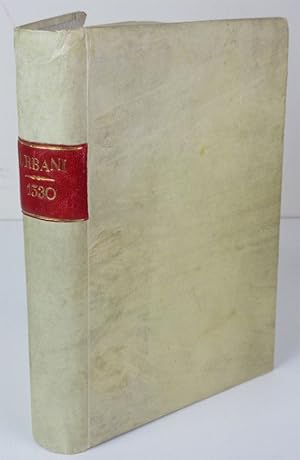
Urbani Grammaticae Institutiones, Graecae, Nunc Denuo Summa Diligentia Excusae, & a Mendis Hactenus Minus Observatas Vindicatae. Adhec Quid Operae (Praeter Sufficientem Principalium Locorum Nunc Additum Indicem) Expectabis, Epistola Subsequenti Reperies
Bolzanius Bellunensis, Urbanus (1443-1524) ; Bolzanio, Urbano
Published by Valentinus Curio, Basel 1530
Seller: Leaf and Stone Books, Toronto, ON, CanadaLeaf and Stone Books
Contact seller5-star sellerCondition: Used - Good
US$ 1,600.00
US$ 10.00 shippingShips from Canada to U.S.A.Quantity: 1 available
Vellum. Condition: Good. No Dust Jacket. Second Edition. [4], 215, [i] ff. Index. Front and back original blanks present. Small quarto. In modern full vellum with red/gilt spine label. September, 1530. 2nd revised Basel edition. Printer's device on title page, numerous historiated initials after Holbein, and some spectacular typ…esetting. Renewed endpapers, old/contemporary inscriptions on front blank (which has some old repairs) and title, Greek inscription on last blank. (The inscriptions indicate a possible sojourn in Spain. ) Front blank has an old repair and some worming, last blank has some worming, as well. Text is generally clean, a few leaves have some old ink stains, some light humidity marks in places, 3 leaves near the front have a small hole affecting text, quire g is bound in out of order but everything is present. Some pages trimmed at the top edge slightly clipping the header, but otherwise clean and unmarked, paper is sturdy and attractive with very little foxing. OCLC 48902291. The first Greek grammar written in Latin by Bolzanio at the behest of his friend Aldus Manutius, who published the first edition (without permission, apparently) in 1497. Bolzanio, a well-known Greek scholar who tutored Leonardo de Medici's son, the future Pope Leo X, later revised and enlarged the grammar. It was his most important work, a Renaissance tour de force, in which he describes the nouns, verbs and parts of speech of Greek in Latin. The book is full of charts of declensions, etc. , and the typesetting work must have been staggering. This 1530 edition contains a preface of the Golden Words of Pythagoras with interlinear Greek and Latin. A handsome copy of this important Renaissance Greek grammar, immensely popular in the early 1500s, this edition quite scarce. In Latin with lots of Greek. ; 4to 11" - 13" tall; 430 pages.

Porträt. Brustbild mit Helm und Rüstung, halbrechts. Kupferstich von Clausner, 17 x 13,5 cm, um 1800.
Stüssi, Rudolf (1408 Zürich - 1443 in der Schlacht bei St. Jakob an der Sihl, von Zürich). Schweizer Politiker. 1414-25 und 1442 vertrat S. die Meisenzunft im Zürcher Rat, 1426-29 wirkte er als Zunftmeister der Meisen und 1430-41 und 1443 als Bürgermeister von Zürich. Er amtierte 1415 als Vogt von Männedorf, 1417 als Vogt von Höngg und 1427 als eidg. Vogt in den Freien Ämtern.
- Art Print
Seller: Antiquariat Michael Eschmann, Groß-Gerau, GermanyAntiquariat Michael Eschmann
Contact seller5-star sellerCondition: Used
US$ 95.05
US$ 25.38 shippingShips from Germany to U.S.A.Quantity: 1 available
0. Sprache: Deutschu.

- Hardcover
- Print on Demand
Seller: S N Books World, Delhi, , IndiaS N Books World
Contact seller5-star sellerLeatheBound. Condition: New. Leatherbound edition. Condition: New. Leather Binding on Spine and Corners with Golden leaf printing on spine. Bound in genuine leather with Satin ribbon page markers and Spine with raised gilt bands. A perfect gift for your loved ones. Reprinted from 1928 edition. NO changes have been made to the or…iginal text. This is NOT a retyped or an ocr'd reprint. Illustrations, Index, if any, are included in black and white. Each page is checked manually before printing. As this print on demand book is reprinted from a very old book, there could be some missing or flawed pages, but we always try to make the book as complete as possible. Fold-outs, if any, are not part of the book. If the original book was published in multiple volumes then this reprint is of only one volume, not the whole set. IF YOU WISH TO ORDER PARTICULAR VOLUME OR ALL THE VOLUMES YOU CAN CONTACT US. Resized as per current standards. Sewing binding for longer life, where the book block is actually sewn (smythe sewn/section sewn) with thread before binding which results in a more durable type of binding. Pages: 118 Language: Japanese Pages: 118.

Language: Arabic
- Hardcover
- Print on Demand
Seller: S N Books World, Delhi, , IndiaS N Books World
Contact seller5-star sellerLeatherbound. Condition: NEW. BOOKS ARE EXEMPT FROM IMPORT DUTIES AND TARIFFS; NO EXTRA CHARGES APPLY. Leatherbound edition. Condition: New. Leather Binding on Spine and Corners with Golden leaf printing on spine. Bound in genuine leather with Satin ribbon page markers and Spine with raised gilt bands. Pages: 398. A perfect gift… for your loved ones. Reprinted from 1922 edition. NO changes have been made to the original text. This is NOT a retyped or an ocr'd reprint. Illustrations, Index, if any, are included in black and white. Each page is checked manually before printing. As this print on demand book is reprinted from a very old book, there could be some missing or flawed pages, but we always try to make the book as complete as possible. Fold-outs, if any, are not part of the book. If the original book was published in multiple volumes then this reprint is of only one volume, not the whole set. IF YOU WISH TO ORDER PARTICULAR VOLUME OR ALL THE VOLUMES YOU CAN CONTACT US. Resized as per current standards. Sewing binding for longer life, where the book block is actually sewn (smythe sewn/section sewn) with thread before binding which results in a more durable type of binding. Language: Arabic Pages: 398.
Language: German
- Art Print
Seller: J & J LUBRANO MUSIC ANTIQUARIANS LLC, Syosset, NY, U.S.A.J & J LUBRANO MUSIC ANTIQUARIANS LLC
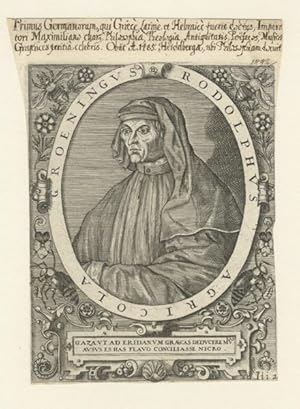
Contact seller5-star sellerCa. 155 x 106 mm. 99. Unevenly trimmed; remnants of mounting paper to verso; very small tear to upper margin; early annotations in manuscript to blank upper margin. A German humanist and philosopher, Agricola was also active as a musician. "[He] is regarded as one of the most important figures in the transmission to northern Eur…ope of Italian humanism. His interest in music and his practical musical ability distinguish him from many of his contemporary humanistic scholars and mark a turning point in the relationship between this broad intellectual movement and music. He was later strongly influential in the development of philosophy and education in Germany, and was greatly admired by Erasmus and Melanchthon." Lewis Lockwood in Grove Music Online.

- Softcover
- Print on Demand
Seller: AHA-BUCH GmbH, Einbeck, GermanyAHA-BUCH GmbH
Contact seller5-star sellerCondition: New
US$ 136.02
US$ 81.29 shippingShips from Germany to U.S.A.Quantity: 1 available
Taschenbuch. Condition: Neu. nach der Bestellung gedruckt Neuware - Printed after ordering - The War Diaries for the Great War, held under WO95, represent one of the most popular record collections held at the National Archives, Kew, London. For researchers and family historians, the War Diaries contain a wealth of information o…f far greater interest than the army could ever have predicted. They provide unrivalled insight into daily events on the front line and are packed with fascinating detail. They contain no modern editing, opinions or poorly judged comments, just the war day by day, written by the men who fought this 'War to end all Wars. They are without question, the most important source of information available on the war on the Western Front.Full colour facsimile of each page with specially created chronological index.What is a War Diary The headquarters of each unit and formation of the British Army in the field was ordered to maintain a record of its location, movements and activities. For the most part, these details were recorded on a standard army form headed 'War diary or intelligence summary'.What details are given Details given vary greatly, depending on the nature of the unit, what it was doing and, to some extent, the style of the man writing it. The entries vary from very simple and repetitive statements like 'Training' up to many pages of description when a unit was in battle. Production of the diary was the responsibility of the Adjutant of the headquarters concerned.Is there any other information or documents with the diaries Some diaries have other documentation attached, such as maps, operational orders and after-action reports.


