
1740 Seutter (2 results)
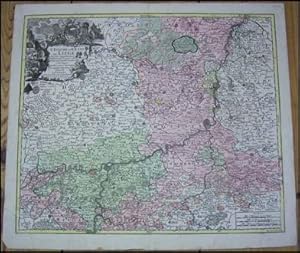
Published by Augsburg, um 1740. 1740
Seller: Antiquariat Thomas Mertens, Berlin, GermanyAntiquariat Thomas Mertens
Contact seller4-star sellerCondition: Used
US$ 47.69
US$ 63.66 shippingShips from Germany to U.S.A.Quantity: 1 available
Kartengröße 49 x 57 cm, mit Kartusche. Mittelfalz hinterlegt, am Rand gering fleckig. Linke untere Ecke alt angesetzt.

Mappa Geographica Regionem Mexicanam et Floridam Terrasque adjacentes, ut et Anteriores Americae Insulas, Cursus itidem et Reditus Navigantium versus flumem Missisipi et alias Colonias ob oculos ponens cura et sumtibus.
1740 Seutter / Lotter Map of Mexico, Louisiana, Florida, the Caribbean
- Map
Seller: Geographicus Rare Antique Maps, Brooklyn, NY, U.S.A.Geographicus Rare Antique Maps
Contact seller4-star sellerGood. Light soiling in upper left quadrant, very light worming loss on upper right border. Uneven toning along edge and centerfold, with one repair just east of the Yucatan Peninsula. Size 19.5 x 22.5 Inches. An old-color example of Mattheus Seutter's c. 1740 map of North America below the Great Lakes, including Mexico and the C…aribbean. It reflects improvements in European cartography of the New World in the late 17th and early 18th centuries, as well as the ongoing competition between colonial empires, namely the contemporaneous War of Jenkins' Ear (1739-1748). A Closer Look Coverage embraces from the Great Lakes to the northern portion of South America. The map distinguishes geographic regions and colonial claims (according to the 1713 Peace of Utrecht) by hand-coloring, though not always consistently (for example, the Florida Peninsula and Texas are shaded the same as 'Florida,' corresponding to the French territory of Lower Louisiana, though both were Spanish possessions). Detail includes rivers, lakes, mountains, settlements, forts, Native American groups, islands, hazards, shoals, anchorages, and major maritime routes. Annotations in Latin and French provide context. At bottom-left, a lively scene depicts a naval battle and privateers examining treasure, reflecting ongoing privateer warfare between Spain, France, England, and other European powers in the Americas, especially the Caribbean. Four insets appear at right, depicting the ports of Portobello in Panama, Havana, Cartagena, and Veracruz, with soundings, anchorages, and information on fortifications and recent battles given. At top-left, four scales are provided within a decorative cartouche. The War of Jenkins' Ear The War of Jenkins' Ear (October 22, 1739 - October 18, 1748), known in Spain as the Guerra del Asiento , was fought between England and Spain. Fought over trade (slave trade), the stated cause of war was that Spain considering withdrawing from the 'lucrative' asiento , an agreement granting Britain limited trading rights in Spanish America. It became known as the War of Jenkins' Ear over one hundred years after the fighting began when historian and essayist Thomas Carlyle referred to the war by that name in his 1859 work History of Friedrich II . Robert Jenkins was the captain of the British brig Rebecca , which the Spanish 'coast guard' boarded in 1731 on suspicion of smuggling. The Spanish commander cut off Jenkins' left ear during the incident. The event drew widespread British ire as an 'insult to British honor' and a cause for war. The British and Spanish fought in the Caribbean from 1739 through 1742, when the War of the Austrian Succession (1740 - 1748) demanded Spanish and British attention, and the appetite for the Caribbean war waned. The War of Jenkins' Ear ended with the same treaty that ended the War of the Austrian Succession, the 1748 Treaty of Aix-la-Chapelle. Publication History and Census This map was prepared by Mattheus Seutter and engraved by Tobias Conrad Lotter around the year 1740. It is undated, but the inset depicts the British fleet of Admiral Vernon entering the bay of Portobello in 1739, which serves as a terminus post quem . It was likely produced within the context of the War of Jenkins' Ear, which increased tumult in the hotly contested New World European colonies. The map is based on Guillaume Delisle's groundbreaking 1703 map 'Carte des environs du Mississippi,' the first to accurately depict the full course of the Mississippi River. Seutter's work added the battle scene at bottom-left, the port insets at right, and information to bring the map up to date. In 1770, Lotter reissued the map, replacing the then-deceased Seutter's name and title with his own. Given the uncertainty of the map's date and the intermingling of digital and physical examples in institutional collections, a precise census is difficult to establish, but it looks to be listed among the holdings of some 20 institutions in the OCLC. References: OCLC.

