

Order Total (1 Item Items):
Shipping Destination:

Ancient China (16 results)
Skip to main search results
Search filters
Product Type
- All Product Types
- Books (16)
- Magazines & Periodicals (No further results match this refinement)
- Comics (No further results match this refinement)
- Sheet Music (No further results match this refinement)
- Art, Prints & Posters (No further results match this refinement)
- Photographs (No further results match this refinement)
- Maps (No further results match this refinement)
- Manuscripts & Paper Collectibles (No further results match this refinement)
Condition Learn more
- New (2)
- As New, Fine or Near Fine (4)
- Very Good or Good (7)
- Fair or Poor (No further results match this refinement)
- As Described (3)
Binding
Collectible Attributes
- First Edition (7)
- Signed (No further results match this refinement)
- Dust Jacket (1)
- Seller-Supplied Images (7)
- Not Print on Demand (16)
Language (2)
Free Shipping
Seller Location
Seller Rating
-

wells, henry
Published by university of south carolina press, 1968
Seller: Jay W. Nelson, Bookseller, IOBA, Austin, MN, U.S.A.
Association Member: IOBA
Seller rating 5 out of 5 stars

First Edition
Hardcover. Condition: Very Good+. Dust Jacket Condition: Very Good. 1st Edition. Price-clipped. Couple tears to jacket.
-

National Geographic Magazine June 1981 / "Somalia's Hour of Need;" "The Dispossessed;" "Down the Ancient Appian Way;" "American Red Cross: A Century Old;" "Two Years Teaching in China;" "San Francisco Bay - Its Beauty and Battles;" "Saving the Philippine Eagle"
Published by National Geographic Society, 1981
US$ 10.31
US$ 14.67 shipping
Ships from United Kingdom to U.S.A.Quantity: 1 available
Add to basketSoft cover. Condition: Very Good. 160 pages. "Somalia's Hour of Need;" "The Dispossessed;" "Down the Ancient Appian Way;" "American Red Cross: A Century Old;" "Two Years Teaching in China;" "San Francisco Bay - Its Beauty and Battles;" "Saving the Philippine Eagle".
-

The Rise of Tea Culture in China: The Invention of the Individual (Asia/Pacific/Perspectives)
Book 32 of 40: Asia/Pacific/PerspectivesLanguage: English
Published by Rowman & Littlefield Publishers, 2018
ISBN 10: 1538117819 ISBN 13: 9781538117811
paperback. Condition: New. Reprint. Ships in a BOX from Central Missouri! UPS shipping for most packages, (Priority Mail for AK/HI/APO/PO Boxes).
-
Published by Honolulu Academy of Arts, 1990
First Edition
SOFTCOVER. Condition: Near Fine. 1st Edition. Square 12mo; softcover; 23 pp. Tight binding; interior clean throughout; Near Fine.
-
Examination of Chinese Bronzes. Written by John C. Ferguson. An article published by the Smithsonian Institution in 1914 : 6 Pages.
Published by Smithsonian Institution, Washington, 1914
US$ 11.95
US$ 15.88 shipping
Ships from United Kingdom to U.S.A.Quantity: 3 available
Add to basketBooklet - Unbound Pages. Condition: Very Good. A short examination of Chinese bronzes, discussing their casting, decoration, dating, and the cultural insights they provide. 6 Pages. An authentic standalone article, extracted from a larger volume. Not a reprint or reproduction, but an original work in its own right. Preserved in a modern card cover, prepared for practicality - an unassuming but serviceable presentation that favours function over finery. Size: 16 x 24 cms. Category: Smithsonian Institution; Cosmo Books : 29 years on ABE, 47 years taking care of customers. A bookseller you can rely on.
-
CHINA. ANCIENT BRIDGE AT CHAPOO . , A FINE ORIGINAL ANTIQUE VIEW
Language: English
Published by Peter Jackson, London, 1843
Seller: K Books Ltd ABA ILAB, York, YORKS, United Kingdom
Association Member: ABA ILAB PBFA
Seller rating 5 out of 5 stars
First Edition
US$ 34.22
US$ 26.01 shipping
Ships from United Kingdom to U.S.A.Quantity: 1 available
Add to basketSingle Sheet Engraving. Condition: Very Good. No Jacket. ALLOM (illustrator). First Edition. AN ORIGINAL ANTIQUE VIEW IN CHINA, 7.6 X 5 INCHES, 19 X 13 CMS, MOUNTED [MATTED] AND READY TO FRAME, MOUNT SIZE APPROX 12 X 9 INCHES, 30 X 20 CMS, EXCELLENT CONDINTION, ENGRAVED IN 1843, HAND COLOURED, COLOURING NOT CONTEMPORARY BUT DELICATELY AND SKILLFULLY EXECUTED, WE PACK VERY WELL BETWEEN 2 SHEETS OF THICK HARDBOARD AND DISPATCH QUICKLY BY FIRST CLASS MAIL .SHOWS . FINE VIEW OF. ANCIENT BRIDGE AT CHAPOO.
-
CHINA. ANCIENT TOMBS NEAR AMOY. . . ANTIQUE VIEW ENGRAVED IN 1843CHINA. GRAND TEMPLE OF POO TOO AT CHUSAN
Language: English
Published by Peter Jackson, London, 1843
Seller: K Books Ltd ABA ILAB, York, YORKS, United Kingdom
Association Member: ABA ILAB PBFA
Seller rating 5 out of 5 stars
First Edition
US$ 34.22
US$ 26.01 shipping
Ships from United Kingdom to U.S.A.Quantity: 1 available
Add to basketSingle Sheet Engraving. Condition: Very Good. No Jacket. ALLOM (illustrator). First Edition. AN ORIGINAL ANTIQUE VIEW IN CHINA, 7.6 X 5 INCHES, 19 X 13 CMS, MOUNTED [MATTED] AND READY TO FRAME, MOUNT SIZE APPROX 12 X 9 INCHES, 30 X 20 CMS, EXCELLENT CONDINTION, ENGRAVED IN 1843, HAND COLOURED, COLOURING NOT CONTEMPORARY BUT DELICATELY AND SKILLFULLY EXECUTED, WE PACK VERY WELL BETWEEN 2 SHEETS OF THICK HARDBOARD AND DISPATCH QUICKLY BY FIRST CLASS MAIL .SHOWS VIEW OF . . ANCIENT TOMBS NEAR AMOY.
-
![Seller image for ??????.[Chen Sheng Wu Guang qi yi]. [Uprising of Chen Sheng and Wu Guang]. for sale by Asia Bookroom ANZAAB/ILAB](https://pictures.abebooks.com/inventory/md/md30846188138.jpg)
??????.[Chen Sheng Wu Guang qi yi]. [Uprising of Chen Sheng and Wu Guang].
Published by ???????.[Liaoning ren min chu ban she]., ??.[Shenyang]., 1973
Seller: Asia Bookroom ANZAAB/ILAB, Canberra, ACT, Australia
Association Member: ANZAAB ILAB
Seller rating 5 out of 5 stars
First Edition
1st edition. Folding map titled "Situation Map of the Peasant War during the Late Qin Dynasty", black and white illustrations, 48pp, ex-library with two neat labels, light signs of wear, good in paperback. Text in Chinese. 18.4 x 13.1cm. The peasant movement (209 B.C.) was regarded as the very first peasant rebellion on written record in the Chinese history. Due to the very harsh Qin law, the army officers Chen Sheng and Wu Guang would had been executed for just being late for their official duties. Instead of facing the death penalty, the pair organised an army of 900 peasants to fight against the Qin government.
-

HuaiAn Unearthed Ancient Paint & Calligraphy Art From Ming Dynasty Tomb.
Published by Beijing, China: Culture Relic Publisher., 1988
Seller: Wittenborn Art Books, San Francisco, CA, U.S.A.
Seller rating 5 out of 5 stars
Condition: Good. Folio. 60pp., Water Proof cover. Very Good with minor crease on cover. Text in Chinese.
-
Condition: Fine. The book is in fine condition.
-
Condition: Fine. The book is in fine condition.
-
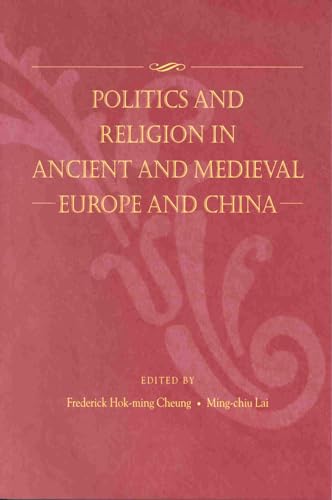
US$ 259.52
US$ 13.34 shipping
Ships from United Kingdom to U.S.A.Quantity: 2 available
Add to basketPaperback. Condition: Brand New. illustrated edition. 162 pages. 8.75x5.75x0.50 inches. In Stock.
-
Travels of Rabbi Benjamin, son of Jonah, of Tudela: through Europe, Asia, and Africa : from the ancient Kingdom of Navarre, to the frontiers of China faithfully translated from the original Hebrew, and enriched with a dissertation, and notes, critical, historical, and geographical: in which the true character of the author, and intention of the work, are impartially considered.
Language: English
Published by Printed for the translator; and sold by Messrs. Robson, New Bond-Street; J. Murray, in Fleet-Street; T. Davis, Holborn; W. Law, Ave-Maria-Lane, And at No. 7, Canterbury-Square, Southwark, London, London, England, 1783
First Edition
Hardcover. Condition: Good. No Jacket. 1st Edition. First Edition in English. xiii (including Subscriber List),1 errata p, 171 pages. 178 x104 mm. Minor water stains. Sarton II, 414.The binding is not the original one. Benjamin MiTudela (of Tudela) left Tudela, Spain between 1159 and 1163, returning in 1172. He traveled for more than 10 (some believe 14) years, visiting Jewish and non-Jewish communities around the world, and kept a diary that proved invaluable to historians. There is no general account of the Mediterranean world or of the Middle East in the mid 12th century which approaches that of Benjamin of Tudela in importance, whether for Jewish or general history. He indicates distances between towns he visited, tells who stood at the head of the Jewish communities, and who were the most notable scholars. He gives the number of Jews he found in each place, though it is not clear in many instances whether he is speaking of individuals or households, and in some cases such as Baghdad, the figures seem to be exaggerated. He notes economic conditions, describes the activity of merchants in Barcelona, Montpellier, Alexandria, etc. and writes of the occupations of the Jews: the dyers in Brindisi, the silk-weavers in Thebes, the tanners in Constantinople, and the glass-workers in Aleppo and Tyre. He was deeply interested in Jewish scholarship, and his accounts of intellectual life in Provence and Baghdad are especially important, as is his characterization of the organization of synagogue life in Egypt. Sects, too, engaged his attention: the Samaritans in Eretz Israel, the Karaites in Constantinople, a heretical sect in Cyprus which he relates observed the Sabbath from dawn to dawn. His characterizations of non-Jewish life are vivid. His account of the Assassins of Lebanon and of the Ghuzz Turks are primary historical sources, and he may be the first European of modern times to mention China by the present name. His work has been translated into almost every European language and is used as a primary source-book by all medieval historians. He traveled from Tudela, north Spain, to Barcelona, to Provence, giving a full account of the cities and the scholars of the region, and described in detail the economic life. From Marseilles he sailed to Genoa, traveled through Pisa to Rome, where he must have spent a fairly long time since he provides a detailed description of its antiquities, though he mistakingly interpreted many of these as associated with Jewish history. He wrote about the Roman Jewish community and its relations with the much-opposed Pope Alexander III. After Rome he headed south describing, sometimes at length, the conditions in Salerno, Amalfi, Melfi, Benevento, and Brindisi. He sailed by way of Corfu to Arta, and then through Greece, where he noted the Jewish silk-weavers in various places, and the agricultural colony at Crissa on Mt. Parnassus. He apparently spent a long time in Constantinople, providing the best 12th century description of both Jewish and non-Jewish conditions there. He sailed through the Aegean archipelago to Cyprus, crossed to the mainland, headed south via Antioch, Sidon, Tyre, and Akko to Eretz Israel, which was still under the rule of the Crusaders. He traveled throughout the country, giving a detailed account of the Holy Places (often calling them by their French names. Thus Hebron is St. Abram de Bron). On the whole, his descriptions are far more objective than those of Christian pilgrims of the age, and he provides us with added insight by focusing on Jerusalem and its Jewish community. From Tiberias he traveled to Damascus, then Baghdad. His account of the Druze was the first in the non-Arabic literature. His account of Baghdad was more extensive than any other. He drew a graphic picture of the court of the caliph and the charitable foundations of the city. He describes the organization of the still-surviving talmudic academies and the glories and functions of the Exilarch. After Baghdad, his accounts are historically suspect. . .
-
Shoyo Volume Saizo Zenhon Monument Chapter Compiled in 2 volumes Edited by Chugoku Katoku Koki Zen Honbu Public version
Published by Shanghai Book Publishing Company, 2023
Condition: Fine. Name: Koyo-maki Saizo Zenhon Monument Book Compilation Compilation: 2 volumes Edited by Chugoku Katoku Koki Zen Honbu Author: Edited by Chugoku Katoku Koki Zen Honbu Quality: Brand New Publication t.
-
Jyuhasshi ryaku . go taizen [Complete and Abridged . Eighteen Histories.]
Published by Osaka: Meiji 15 [1882]., 1882
Seller: Arader Galleries - AraderNYC, New York, NY, U.S.A.
Seller rating 5 out of 5 stars
First Edition
Hardcover. 1st Edition. 8vo., (7 x 5 inches). Xylographically printed on double leaves folded in the oriental manner. Title printed on pink paper, text on 16 unnumbered double leaves, 11 double-page hand-coloured maps of China (only, of 12) on numbered double leaves 1-10 & 12, 1 unnumbered text double leaf at end. (Small marginal dampstain to top corner.) Original yellow paper-covered boards with printed paper title slip (upper cover dampstained and coming away from front pastedown, extremities lightly rubbed). FIRST EDITION THUS, this atlas and history of ancient China was published in the long tradition of the Abridged Eighteen Histories, a popular work of history first used in China during the Song dynasty (960-1279). By the 16th century, the Eighteen Histories had disappeared from China, but were enthusiastically adopted by Japan. During the Song, most authors accepted that there were seventeen standard histories and the Tzu-chih t'ung-chien, 'Comprehensive Mirror for the Aid of Government', by Ssu-ma Kuang (1019-1086). These were then compiled under the Chinese title Shi Ba Shi Lue, evolving during the Yuan dynasty (1271-1368) to become a concise general history. By the time of the Ming dynasty (1368-1644), it was widely disseminated in many variant editions. At this time, the Eighteen Histories spread to Japan, and was widely distributed and read. By the time of the Meiji Restoration, the history started to reflect contemporary Japanese concerns, absorbing a Japanese world view coupled with western influences. They were immensely popular, and had a profound impact on Japanese society and culture. Despite their incessant publication, there are few copies extant, particularly in the west. The present example, published prior to the first Sino-Japanese War (1894-1895), is a most uncommon item describing the geography and society of the Chu dynasty (907-951) and the Song. The beautifully stylized maps illustrate dynastic borders and the diverse topography of China, delineated with vibrant colours. The text gives the names of emperors and cities as well as statistical information about populations. Worldcat reports a number of Meiji period Jyuhasshi ryaku, but none for 1882.
-
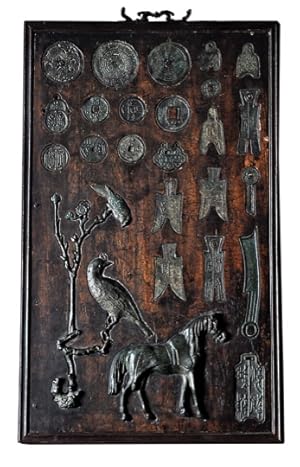
China, probably end of 18th century.
Published by 1790, 1790
Seller: Charlotte Du Rietz Rare Books (ILAB), Stockholm, Sweden
Seller rating 2 out of 5 stars

Wooden panel (59 x 35 cm) with 25 bronze casts of ancient Chinese coins and amulets inserted. A solid piece of wood with small scratches and minor wear, parts of old Chinese label on reverse. Mounted in a later wooden frame. The collection shows examples of old coins and charms in the shape of spades, knives, rings, and two large symbolic figures: a horse and two birds in a tree. China was one of the first countries to use metal coinage and its ancient coin history can be traced back more than two thousand years. The Chinese also produced "coin-like" charms and talismans which were used to suppress evil spirits and to bring "good luck" or "good fortune". During the Zhou Dynasty (1046-256 BC) some of the first forms of money were cast in the shapes of tools, for example as spades, shovels or knives. Thereafter the "round money" appeared and during the Han Dynasty a round shaped coin named "wu zhu" was introduced. It was minted for more than 700 years from 118 BC to 618 AD. This panel contains nine spade-shaped coins or charms which we believe are the earliest examples in the collection. Two pieces have the knife shape. Three large examples of "open charms" are included with illustrations of a dragon, the zodiac and the eight trigrams. In addition there are seven pieces of different kinds of round coins or charms and two pendant charms, all decorated with different characters and symbols. We believe that the panel dates from the latter part of the 18th century and sits firmly in the context of the Emperor Qianlong?s unequalled obsession with Chinese history, art and literature. Reigning from 1735 to 1796, he created and conserved unparalleled collections of all ages and aspects of Chinese culture while honouring Manchu and Confucian traditions. This panel, with a patina consistent with its (likely) date, was probably used as a teaching aid, and reflects the Emperor?s interest in promoting and preserving the glories and utility of the Chinese past. A most unusual and impressive work.


![Seller image for Jyuhasshi ryaku . go taizen [Complete and Abridged . Eighteen Histories.] for sale by Arader Galleries - AraderNYC](https://pictures.abebooks.com/inventory/md/md1233844961.jpg)
