

Order Total (1 Item Items):
Shipping Destination:

Cathode Ray (11 results)
Skip to main search results
Search filters
Product Type
- All Product Types
- Books (11)
- Magazines & Periodicals (No further results match this refinement)
- Comics (No further results match this refinement)
- Sheet Music (No further results match this refinement)
- Art, Prints & Posters (No further results match this refinement)
- Photographs (No further results match this refinement)
- Maps (No further results match this refinement)
- Manuscripts & Paper Collectibles (No further results match this refinement)
Condition Learn more
- New (No further results match this refinement)
- As New, Fine or Near Fine (5)
- Very Good or Good (4)
- Fair or Poor (1)
- As Described (1)
Binding
Collectible Attributes
- First Edition (1)
- Signed (No further results match this refinement)
- Dust Jacket (1)
- Seller-Supplied Images (3)
- Not Print on Demand (11)
Language (1)
Free Shipping
- Free Shipping to U.S.A. (No further results match this refinement)
Seller Location
Seller Rating
-
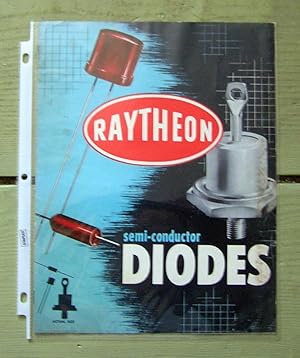
Stapled softcover pamphlet. Condition: Good. Product information. 8 pages, index & descriptive charts/tables, Germanium and silicon diodes, rectifiers. Slight musty odor, edgewear & creasing, some spotting.
-

Second Thoughts on Radio Theory
Published by 'Wireless World' by Iliffe & Sons, 1955
Seller: World of Rare Books, Goring-by-Sea, SXW, United Kingdom
Seller rating 5 out of 5 stars

Condition: Good. 1955. First Published. 409 pages. No dust jacket. Grey cloth. Black and white illustrations throughout. Pages and illustrations have light tanning and foxing throughout. Pencil inscriptions and sticker to front pastedown and endpaper. Binding remains firm. Boards have light shelf-wear with corner bumping. Light tanning to spine and edges.
-
Second thoughts on radio theory
Published by Iliffe and Sons, 1955
Seller: BoundlessBookstore, Wallingford, United Kingdom
Seller rating 5 out of 5 stars
Hardcover. Condition: Good. Light wear to boards. Content is clean with light age tone. Spotting to end papers. DJ with some edge wear, a few tears and creasing.
-

US$ 37.27
US$ 18.27 shipping
Ships from United Kingdom to U.S.A.Quantity: 1 available
Add to basketCondition: Fair. This is an ex-library book and may have the usual library/used-book markings inside.This book has hardback covers. In fair condition, suitable as a study copy. No dust jacket. Please note the Image in this listing is a stock photo and may not match the covers of the actual item,700grams, ISBN:
-
US$ 34.59
US$ 26.86 shipping
Ships from United Kingdom to U.S.A.Quantity: 1 available
Add to basketHardcover. Condition: Good. No Jacket. B0000CJ77X. no dustjacket. binding tight. 1st edition. Hardcover. Size: 8vo - over 7¾ - 9¾" tall. Book.
-
Weekly Shonen Champion No. 51 1980 No. 27 1986 Cover artist: Masaya Sono Kagashiro! Kagashiro!
Published by Akita shoten, 1981
Condition: Fine. Number of books: 1 book.
-
Weekly Shonen Champion 1985 52nd December 4th 1988 Cover artist Dookuman ``Netsusaki!! Hanazawa High School''
Published by Akita shoten, 1981
Condition: Fine. Number of books: 1 book.
-
Weekly Shonen Champion 1981 No. 48 November 6 1988 No. Cover artist Endo Koichi Anoano Tongara
Published by Akita shoten, 1981
Condition: Fine. Number of books: 1 book.
-
Weekly Shonen Champion 1986 No. 53 December 11 1986 Cover artist Hiroyuki Sato Kibun wa Groovy
Published by Akita shoten, 1981
Condition: Fine. Number of books: 1 book.
-
Weekly Shonen Champion 1986 No. 49 November 13 1986 Cover artist Tezuka Osamu Nanairo Parakeet
Published by Akita shoten, 1981
Condition: Fine. Number of books: 1 book.
-
Ueber ein Verfahren zur Demonstration und zum Studium des zeitlichen Verlaufes variabler Ströme" (On a Method for the demonstration and study of currents varying with time).
Seller: Herman H. J. Lynge & Søn ILAB-ABF, Copenhagen, Denmark
Seller rating 4 out of 5 stars

First Edition
Leipzig, Johann Ambrosius Barth, 1897. No wrappers. In "Annalen der Physik und Chemie, Neue Folge", Bd. 60, No 3. Pp. 401-576, textillustr. and 2 folded plates. (the entire issue offered, "Heft 3"). Braun's paper: pp. 552-559 a. 6 textillustrations (showing the Braun tube and its operations). Clean and fine. First printing of this groundbreaking paper being the first description of the principles governing the "BRAUN TUBE", which moves the elctron beams of alternating voltage, the principle on which ALL TELEVISON TUBES operate. - Braun shared the Nobel Prize for 1909 with Marconi "in recognition of their contributions to the development of wireless telegraphy"."Cold cathode tube with side anode, annular diaphragm to control spot size, and built-in fluorescent screen. Beam deflection by one external coil with the trace viewed indirectly in a rotating mirror, or by two coils at right angles for direct viewing. Excitation by hand-drive influence machine (friction generator) or by an induction coil. This "indicator tube", which enabled Braun to demonstrate how a variety of periodic and transient electrical phenomena could be visually examined, is the ancestor of electric oscilloscopes, televison picture tubes, and other electron-beam display devices."( Shiers & Shiers "Early Televison. A Bibliography to 1940", No. 263)."The first oscilloscope, or Braun tube, was introduced in 1897. In order to study high-frequency alternating currents Braun used the alternating voltageto move the electron beam within the cathode tube. The trace on the face of the cathode tube represented the amplitude and frequency of the alternating-current voltage. He then produced a graph of this trace by use of a rotating mirror. The Braun tube was a valuable laboratory instrument, and modifications of it are a basic devise in electronic testing and research. The principle of the Braun tube, moving a electron beam by means of alternating voltage, is the principle on which all televison operate."(DSB II, pp. 427-428).In 1909 he shared the Nobel Prize for physics with Guglielmo Marconi for their development of wireless telegraphy.


