
Adolph Friedlander (8 results)
 More images
- Softcover
Seller: Wimbauer Buchversand, Hagen, NRW, GermanyWimbauer Buchversand
Contact seller5-star sellerCondition: Used - Good
US$ 4.77
US$ 17.36 shippingShips from Germany to U.S.A.Quantity: 1 available
kart. Condition: Befriedigend. 296 S. : überwiegend Ill. (farb.) ; 18 cm Exemplar aus dem Verlagsarchiv.- Kanten gering berieben, Titelschild fehlt /// Standort Wimregal HOM-44.156 ISBN 9783883790916 Sprache: Deutsch Gewicht in Gramm: 456.

- Softcover
Seller: Antiquariat Rohde, Hamburg, GermanyAntiquariat Rohde
Contact seller5-star sellerCondition: Used - As new
US$ 17.76
US$ 52.07 shippingShips from Germany to U.S.A.Quantity: 1 available
broschiert. Condition: Wie neu. 296 S. : überwiegend Ill. (farb.) ; 18 cm neuwertiger Zustand, wirkt ungelesen, minimale Lagerspuren am Einband Sprache: Deutsch Gewicht in Gramm: 470.

- Softcover
Seller: Antiquarische Fundgrube e.U., Wien, , AustriaAntiquarische Fundgrube e.U.
Contact seller5-star sellerCondition: Used
US$ 9.54
US$ 63.65 shippingShips from Austria to U.S.A.Quantity: 1 available
Softcover/Paperback. 296 S. Kanten etw. bestoßen, Buchschnitt etw. bestaubt u. fleckig, Kanten etw. bestoßen // Bildende Kunst, Kunstgewerbe, Musik, Tanz, Theater, Film, Rundfunk SL01 9783883790916 *.* Sprache: Deutsch Gewicht in Gramm: 550.
- Softcover
Seller: Neusser Buch & Kunst Antiquariat, Neuss, NRW, GermanyNeusser Buch & Kunst Antiquariat
Contact seller5-star sellerCondition: Used
US$ 13.71
US$ 86.79 shippingShips from Germany to U.S.A.Quantity: 1 available
0. 18 cm. 296 S. : überwiegend Ill. (farb.) kart., Deckelbildchen fehlt kl. schwarzer Fleck a. Buchrücken, ans. gut. Zust. Die bibliophilen Taschenbücher ; 91 Sprache: Deutschu 0,450 gr.
- Softcover
Seller: Neusser Buch & Kunst Antiquariat, Neuss, NRW, GermanyNeusser Buch & Kunst Antiquariat
Contact seller5-star sellerCondition: Used
US$ 13.71
US$ 86.79 shippingShips from Germany to U.S.A.Quantity: 1 available
0. 18 cm. 296 S. : überwiegend Ill. (farb.) kart., Deckelbildchen fehlt gut. Zust. Die bibliophilen Taschenbücher ; 91 Sprache: Deutschu 0,450 gr.
 More images
Published by Adolph Friedlander 1913
- Softcover
- Map
Seller: Barry Lawrence Ruderman, La Jolla, CA, U.S.A.Barry Lawrence Ruderman
Contact seller5-star sellerCondition: Used - Very good
US$ 2,800.00
US$ 14.50 shippingShips within U.S.A.Quantity: 1 available
No Binding. Condition: VG. This striking chromolithographed poster, printed by Friedl nder in Hamburg celebrates Colonel Gaston Bordeverry, The World s Greatest Marksman, assisted by Miss Ruby de Fontenoy, America s Most Famous Lady Shot.&nbs. Evidence of discoloration along several folds, with minor loss. This striking chr…omolithographed poster, printed by Friedl nder in Hamburg celebrates Colonel Gaston Bordeverry, The World s Greatest Marksman, assisted by Miss Ruby de Fontenoy, America s Most Famous Lady Shot. The reference to Bordeverry's Reception by President Th. Roosevelt at Washington, likely refers to a real White House audience that most likely took place during Bordeverry s autumn 1905 vaudeville engagement in Washington, when the sports-minded president welcomed the celebrated French sharpshooter. Born about 1870, Colonel Bordeverry exchanged army service for the vaudeville stage, astonishing spectators by playing pianos, carillons and even entire operatic overtures with rifle fire, and by sketching portraits and monograms in bullet holes. His signature feat the nerve-tingling disrobing of an assistant by removing buttons and ribbons with live rounds became a benchmark of marksmanship theater. Ruby Blackledge, who adopted the stage name Ruby de Fontenoy, joined the act around 1909, mastering Bordeverry s repertoire so completely that promoters justly billed her as the most accomplished lady shot in America. After the colonel s death on 20 May 1913, Ruby inherited the act and carried its daring routines into the 1920s, sustaining his reputation while forging her own. The upper half of the poster includes portraits of Bordeverry (in scarlet tunic and gold-braid kepi) and Ruby (in matching uniform) against an architectural rendering of the White House. The colonel sabre at his side shakes hands with President Roosevelt, flanked by a file of top-hatted dignitaries. The lower panel, compresses the act into four tableaux: at upper left Bordeverry paints bullet-portraits of notable men; at upper right he and Ruby sound tuned bells with rifle shots; along the bottom a sequence shows Ruby clad first in a tricolor gown, then in Union-Jack livery, and finally in a green evening dress as successive garments are shot away; while an inset at lower right depicts the reinforced upright piano upon which Bordeverry fired to play patriotic melodies. Across the foot runs the bilingual boast: Le tout avec des carabines r p tition. All with repeating rifles. On stage the program opened in semidarkness, a spotlight picking out tiny targets glass balls, wax candles, cigarette tips each demolished in rapid succession before Bordeverry scrolled his initials and Roosevelt s likeness in bullet holes. Critics marvelled that scarcely a wrong note is struck when the colonel, ten paces from a specially wired chime-frame, hammered out La Marseillaise or arias from Cavalleria Rusticana with rifle fire while a quartet supplied vocal harmonies. Mid-bill came the sensational disrobing a lady routine. Ruby de Fontenoy advanced while the colonel coolly clipped away ribbons, buttons and sashes until an entirely new costume first the French tricolor, then the British ensign, and finally a fashionable evening dress stood revealed. Reviewers called it one of the nerviest feats on the vaudeville stage, and Winnipeg papers in 1906 recorded audiences marvelling at his prowess with a gun when the stunt reached Canada. For the patriotic finale, Bordeverry wheeled round to the reinforced upright piano illustrated here. Each bullet depressed a key, producing a brassy yet recognizable rendition of Yankee Doodle while Ruby unfurled the Stars-and-Stripes and a cascade of miniature flags descended from a tower behind them. Billboard (2 September 1905) reported that the . Map.

- Softcover
Seller: Antiquariat BehnkeBuch, Neu Kaliß, , GermanyAntiquariat BehnkeBuch
Contact seller5-star sellerCondition: Used
US$ 14.30
US$ 115.72 shippingShips from Germany to U.S.A.Quantity: 1 available
17,5*12 cm. OBroschur. 296 S. : überwiegend Ill. (farb.) Einband berieben und bestossen, schiefgelegen, Titelschild teils gelöst, Ecken und Kapitale leicht gestaucht, sonst gut. K24-04 ISBN 3883790915 Wichtiger Hinweis: Aufgrund der EPR-Regelung zur Zeit KEIN Versand in EU-Länder. Due to EPR, there is currently no delivery to EU…-countries. Sprache: Deutsch Gewicht in Gramm: 600.
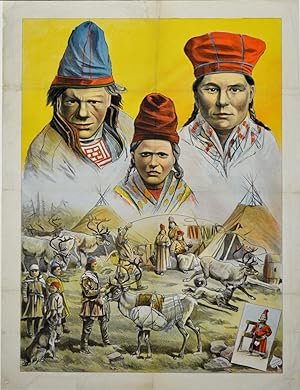
Published by Hamburg Carl Hagenbeck c1875 1875
Seller: Aquila Books(Cameron Treleaven) ABAC, Calgary, AB, CanadaAquila Books(Cameron Treleaven) ABAC
Contact seller3-star sellerCondition: Used - Near fine
US$ 1,472.46
US$ 19.00 shippingShips from Canada to U.S.A.Quantity: 1 available
Condition: Near fine. Original lithographic advertising poster. (77.5 X 56.5 cm.) Old fold lines are visible. A small amount of restoration has been done, mainly on blank edges. Colours are vibrant with the image being quite clean and clear. The image depicts a Sami (Lapland) family with the mother, father and daughter being bei…ng shown in head and shoulders view in the top half of the image. The bottom half shows the day to day activities of a family and reindeer herding. The bottom right has a small inset image of what appears to be a midget dressed up in Sami clothes. The poster was produced for Carl Hagenbeck in the 1870's by Adolph Friedlander (17 April 1851 7 July 1904), who was a famed German lithographer of posters and a publisher hailing from Hamburg. He produced thousands of posters during his career. Hagenbeck was born on June 10, 1844, to Claus Gottfried Carl Hagenbeck (18101887), a fishmonger who ran a side business buying and selling exotic animals. When Hagenbeck was 14, his father gave him some seals and a polar bear. His collection of animals grew until he needed large buildings to keep them. Hagenbeck left his home in Hamburg to accompany hunters and explorers on trips to jungle regions and snow-clad mountains. He captured animals in nearly every continent in the world. In 1874, he decided to exhibit Samoan and Sami people (then known as "Laplanders") as "purely natural" populations, with their tents, weapons, sleds, near a group of reindeer. This poster seems to be the result of that effort. He also tried exhibiting 8 Labrador Inuit in 1880, all of which perished from Small pox. The image seems quite uncommon.


