

Order Total (1 Item Items):
Shipping Destination:

After 1733 (32 results)
Skip to main search results
Search filters
Product Type
- All Product Types
- Books (22)
- Magazines & Periodicals (No further results match this refinement)
- Comics (No further results match this refinement)
- Sheet Music (1)
- Art, Prints & Posters (8)
- Photographs (No further results match this refinement)
- Maps (1)
- Manuscripts & Paper Collectibles (No further results match this refinement)
Condition Learn more
- New (No further results match this refinement)
- As New, Fine or Near Fine (No further results match this refinement)
- Very Good or Good (9)
- Fair or Poor (No further results match this refinement)
- As Described (23)
Binding
- All Bindings
- Hardcover (4)
- Softcover (No further results match this refinement)
Collectible Attributes
- First Edition (2)
- Signed (1)
- Dust Jacket (No further results match this refinement)
- Seller-Supplied Images (29)
- Not Print on Demand (32)
Language (3)
Free Shipping
- Free Shipping to U.S.A. (No further results match this refinement)
Seller Location
Seller Rating
-

Baroque Vocal Music II: Italian and Spanish Sacred Music, c. 1680-1745. Works by Francesco Gasparini, Nicola Porpora, Gian Domenico Paternio, Antonio Martin y Coll, and Francisco Valls. Selected and introduced by Kenneth Cooper.
Language: English
Published by Garland Publishing, New York & London, 1988
ISBN 10: 0824009398 ISBN 13: 9780824009397
Sheet Music
US$ 55.27
US$ 16.10 shipping
Ships from United Kingdom to U.S.A.Quantity: 1 available
Add to basketPublisher's red cloth. Three Centuries of Music in Score: facsimiles of scores made under the works projects administration, vol.12. Size: Folio. xviii, 206, [ii] pp.
-

"Temple de Diane sur le bord de la Mer dans le Golphe de Bayes." - Baia Bacoli Tempio di Diana Italia Italy Italien
Language: French
Published by Paris ca. 1780., 1780
Seller: Antiquariat Steffen Völkel GmbH, Seubersdorf, Germany
Seller rating 5 out of 5 stars

Art / Print / Poster First Edition
Blattmasse ca.20 x28 cm. - Prächtiger originalKupferstich von ca. 1780 aus der Erstausgabe von Saint Non's berühmter "Voyage pittoresque ou description des Royaumes de Naples et de Sicilie". -- leicht fleckig - sonst gut erhalten. || Original engraving from c. 1780. From the 1st edition of Saint Non's "Voyage pittoresque ou description des Royaumes de Naples et de Sicilie". -- slightly stained - otherwise in good condition. // Wir, das Antiquariat Steffen Völkel, kaufen und verkaufen alte Bücher, Handschriften, Zeichnungen, Autographen, Grafiken und Fotografien. Wir sind stets am Ankauf von kompletten Bibliotheken, Sammlungen und Nachlässen interessiert. Sprache: Französisch.
-

"Vue du Temple de Mercure sur le bord de la Mer dans le Golphe de Bayes" - Baia Bacoli Tempio di Mercurio Italia Italy Italien / Tempel des Merkur
Language: French
Published by Paris ca. 1780., 1780
Seller: Antiquariat Steffen Völkel GmbH, Seubersdorf, Germany
Seller rating 5 out of 5 stars
Art / Print / Poster First Edition
Blattmasse ca.20 x28 cm. - Prächtiger originalKupferstich von ca. 1780 aus der Erstausgabe von Saint Non's berühmter "Voyage pittoresque ou description des Royaumes de Naples et de Sicilie". -- leicht fleckig - sonst gut erhalten. || Original engraving from c. 1780. From the 1st edition of Saint Non's "Voyage pittoresque ou description des Royaumes de Naples et de Sicilie". -- slightly stained - otherwise in good condition. // Wir, das Antiquariat Steffen Völkel, kaufen und verkaufen alte Bücher, Handschriften, Zeichnungen, Autographen, Grafiken und Fotografien. Wir sind stets am Ankauf von kompletten Bibliotheken, Sammlungen und Nachlässen interessiert. Sprache: Französisch.
-

Country House, No. 1.
Published by [Paris: French Publisher, circa 1785]., 1785
Seller: Wittenborn Art Books, San Francisco, CA, U.S.A.
Seller rating 5 out of 5 stars
Art / Print / Poster
Condition: Good. Etching on laid paper. 19 x 24.5 cm (sheet). Good, light specks of foxing, some soiling throughout.
-

Parsis ou Guebre Agonisant, dont l'Ame est recue par un Chien.
Published by [Amsterdam, Holland: Dutch Publisher, circa 1789]., 1789
Seller: Wittenborn Art Books, San Francisco, CA, U.S.A.
Seller rating 5 out of 5 stars
Art / Print / Poster
Condition: Good. Engraving. 22 x 27 cm (sheet). Very Good, some light foxing in the margins, sheet corners creases, small tear at bottom sheet edge.
-

Malade Agonisant qui recoit sur son visage l'urine d'une Vache.
Published by [Amsterdam, Holland: Dutch Publisher, circa 1789]., 1789
Seller: Wittenborn Art Books, San Francisco, CA, U.S.A.
Seller rating 5 out of 5 stars
Art / Print / Poster
Condition: Good. Engraving. 16 x 20.5 cm (sheet). Very Good, print affixed to another support sheet.
-
Recueil de Lions, dessinez d'après nature par divers maitres. Par Bernard Picart. Divisé en six Livres chacun de six feuilles . First edition.
Published by Amsterdam: Bernard Picart and Paris : Chereau., 1729
Seller: Wittenborn Art Books, San Francisco, CA, U.S.A.
Seller rating 5 out of 5 stars
Condition: Good. Oblong 4to. 25.5 x 18.8cm. Contemporary marbled calf and gilt spine.[2], 6pp. Engraved title page followed by 42 engravings on 36 plates. Very good with unfoxed plates.OCLC Number / Unique Identifier:469747697; Nissen ZBI 3167; Brunet IV, 630; Nagler XII, 414, 123.
-
LES // METAMORPHOSES // D'OVIDE, // EN LATIN, // TRADUITES EN FRANÇOIS, // AVEC DES REMARQUES, // ET DES // EXPLICATIONS HISTORIQUES. // PAR MR. L'ABBE BANIER,// DE L'ACADEMIE ROYALE DES INSCRIPTIONS // ET BELLES LETTRES. // Ouvrage enrichi de Figures en taille douce, // Gravées par B. PICART, & autres habiles Maitres. // TOME PREMIER [and ] [SECOND] // [vignette] // A AMSTERDAM. 2 volumes in one. First edition.
Published by Amsterdam : Printed for the Wetsteins and Smith, MDCCXXXII. [1732], 1732
Seller: Wittenborn Art Books, San Francisco, CA, U.S.A.
Seller rating 5 out of 5 stars
Condition: Good. Folio. . Contemporary roan with gilt spine, worn along edges of spine, but tight Pages fresh and crisp. Very good. Bookplates and old ink inscription of previous private owners on inside front cover. 30 x 48.5 cm. Text in French and Latin. . See collation below.OCLC only lists the English language edtion of the same year.References : Brunet III: 599; Cohen de Ricci: 768. .In -folio relié pleine basane brune, dos à nerfs orné et doré (Reliure de l'époque). [5] ff., 247 pp., [1] f., (249 254) pp., [2] ff. Orné d'un frontispice, une vignette armoriée de dédicace et de 130 figures in texte à mi-page d'après Lebrun, Leclere, Maas, Picard, Punt, J. Romain, Tosca, de Wit and Vandelaar par divers sculpteurs. Edition bilingue francol-atine imprimée sur 2 colonnes. Bon état, oxydation des ff. et rousseurs, usures à la reliure.
-

Village des Environs de Lillo sur l'Escaut. Vue de Middelbourg en Leelande.
Published by [Wien, Austria: Weirotter, ca. 1771]., 1771
Seller: Wittenborn Art Books, San Francisco, CA, U.S.A.
Seller rating 5 out of 5 stars
Art / Print / Poster
Condition: Good. Two etchings on laid watermarked paper with margins. 17 1/4 x 12 in. sheet. Good, light foxing. Text in French.
-

Petit Port Pres de Rotterdam, 1777. 11e. Vue des Environs de Harlem, Plate 61, reverse image and different title than catalogue raisonne.
Published by [Wien, Austria: Weisbrod, ca. 1800]., 1800
Seller: Wittenborn Art Books, San Francisco, CA, U.S.A.
Seller rating 5 out of 5 stars
Art / Print / Poster
Condition: Good. Two etchings on laid watermarked paper with margins. 17 1/4 x 12 in. sheet. Good, light foxing, stitch tears along left sheet edge.From Oeuvre de F.E. Weirotter der Landschaftsradierer, das Graphische Werk. (Catalogue Raisonné).
-

Bourg du Brabant du cote d'Anvera. Petit Village sur Lac de Harlem.
Published by [Wien, Austria: Weirotter]., 1775
Seller: Wittenborn Art Books, San Francisco, CA, U.S.A.
Seller rating 5 out of 5 stars
Art / Print / Poster
Condition: Good. Two etchings on laid watermarked paper with margins. 17 1/4 x 12 in. sheet. Good, light foxing. Text in French.
-
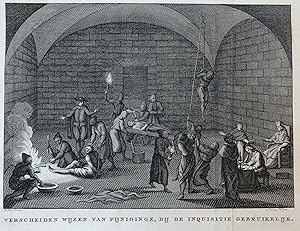
Antique print, etching | 'Verscheiden wijzen van pijniginge bij de inquisitie gebruikelijk', published ca. 1770, 1 p.
Seller: Antiquariaat Arine van der Steur / ILAB, Den Haag, Netherlands
Seller rating 4 out of 5 stars

A dungeon with a clergyman seated at the right, watching various methods of torture being carried out, including strappado. torture methods employed by the inquisitionSigned below: 'B. Picard inv.'; 'C. Philips Jz fecit'.Title below: 'Verscheiden wijzen van pijniginge bij de inquisitie gebruikelijk'.[NL] Kerker waarin leden van de Inquisitie gevangenen op diverse wijzen martelen. Rechts een kardinaal die toekijkt. Etching on laid paper, cut within the margins; total: 214 x 269 mm; two vertical folds, tape on verso and in upper left corner, some small smudges.
-
Navegación Especulativa, y Práctica, con la Explicación de algunos Instrumentos, que están mas en uso en los Navegantes . .
Seller: Douglas Stewart Fine Books, Armadale, VIC, Australia
Association Member: ANZAAB ILAB
Seller rating 4 out of 5 stars
Manila : Impresa en el Convento de Nuestra Señora de los Angeles de la Orden de Nro. Seraphico Padre San Francisco, 1734. First edition. Folio (315 x 210 mm), contemporary limp vellum (lacking ties, some age staining, small loss at front bottom corner), spine with title in manuscript in black ink; printed on rice and rag paper; title page set within decorative border; pp [22], 392, [4], with 13 folding engraved copper plates (lacking pp. 103 - 106; and pp. 191 - 194; plate 11 in facsimile; pp. 195 - 191 in duplicate), numerous woodcut illustrations and diagrams, tables, engraved head- and tailpieces; some of the plates with browning or offsetting, occasional very light spotting, title with small hole at fore-edge margin; a very good example, housed in a custom morocco clamshell case, ornately gilt. Extremely rare first edition ofthe first navigation manual printed in the Philippines. The author, José Gonzalez Cabrera Bueno (c. 1670 - after 1733), was an admiral and a master navigator on the route taken by Spanish ships between Acapulco (New Spain) and Manila. His work addresses comprehensively all of the theoretical and practical aspects of navigation; the plates, by the Filipino engraver Nicolás de la Cruz Bagay, illustrate the various instruments used in this science. It also contains extensive mathematical tables and specific sailing directions for the coast of California and west coast of Mexico as far as Acapulco, the Pacific, the ports of Asia, and the route from the Philippines to Spain via the Cape of Good Hope. The manual was highly regarded and continued to be used well after Cabrera Bueno's lifetime; for example, in the California expeditions of navigators Gaspar de Portolá, Vicente Vila, and Juan Pérez. This work is significant not only for its early instructions for sailing to the Philippine Islands, but also for its early description of what is now the state of California in the United States. Medina, Manila 189; Palau 105121; Wagner, Spanish Southwest 97 Tremendously rare, with a single example appearing at auction in the past half century (Swann Galleries, New York, 16 October 2018, USD $55,000) Provenance : Col. John Scott (1830?1903), Scottish shipbuilder and bibliophile; Royal Institution of Naval Architects (by gift) Christies, December 4, 1974, lot 199; John Howell, noting 'plate 11, which is often missing, supplied in superb facsimile'; private collection, acquired 1980.
-
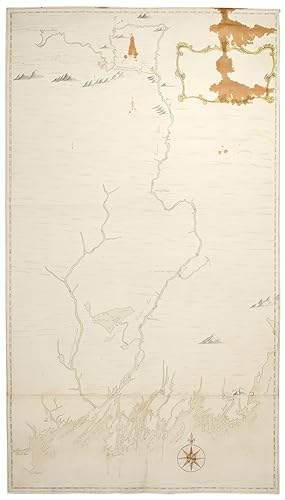
Manuscript Map of the Kennebec River in Maine, from its Mouth Extending to a Point North Approximately 100 Miles above Fort Western
Published by New England, 1765
Seller: Donald A. Heald Rare Books (ABAA), New York, NY, U.S.A.
Seller rating 5 out of 5 stars
Map
Pen-and-ink with grey and light green wash, on two joined sheets of laid paper, with an unlettered cartouche in the upper right corner in yellow wash, a compass rose additionally decorated in green, red, and yellow, period ink inscription on verso: "Kennebec River by Capt. Small." Provenance: Sir Francis Bernard, Colonial Governor of Massachusetts (1712-1779); by descent to Robert Spencer Bernard, Nether Winchendon House, Buckinghamshire, England. The earliest known survey of the upper Kennebec River, here in manuscript. In November 1969, noted historian of cartography William P. Cumming discovered in the family home of Sir Francis Bernard, "a collection of maps that, in purpose and type, differed so markedly from the more usual military, coastal, and general colonial maps of the time that it stands out in both interest and importance." [Cumming] The present manuscript map, done on a scale of approximately 4 1/2 miles to the inch, shows much of the length of the Kennebec, from its mouth to a point approximately 100 miles north of Fort Western, with its various tributaries and islands depicted. At the bottom of the map, the coast of Maine is shown in much detail, depicting the numerous small islands and inlets from Penobscot Bay in the north to Cape Elizabeth in the south. Numerous forts along the coast are shown, including George's Fort, Brunswick Fort, and Pemmaquid Fort; a church is depicted at the mouth of Royall's River near North Yarmouth. West of the Kennebec, a portion of the "Sagadehock" or "Amorescoggin" River is shown. Along the lower Kennebec, Fort Francfort, Fort Western, and Fort Halifax are identified. Toponyms north of Fort Halifax include "Norridge Walk" and "An Indian Carrying Place" (i.e. portage route) which is drawn via hachured line. Bernard became the Colonial Governor of Massachusetts in late 1759, shortly after British troops were victorious in the Battle of Quebec. That decisive French and Indian War victory opened a vast region for renewed English settlement and trade, thus necessitating the need for more accurate surveys of the roads and inland waterways. The present manuscript map was surveyed and drawn by the talented military mapmaker Francis Miller in 1765 for Bernard, the details of which are recounted by Bernard in a 1766 letter to Lord Barrington: "I am desired to certify to your Lordship, that at the beginning of the Year 1764 Genl Gage at my Request, gave Leave to Ensign Francis Miller of the 45th regiment, then stationed in Newfoundland to come to Boston to assist me in some Works of Public Surveying, which I had undertaken in pursuance of resolutions of the general Assembly and partly by Orders from England. Mr Miller being then at an outpost and not easily relieved did not arrive at Boston till Nov in that Year, when the Season for actual Surveying was over. He was employed that Winter and Spring following in protracting the Surveys made that Summer, among which was a compleat Route from Fort Pownal on the River Penobscot to Quebec [i.e. Chadwick's surveys], and some other curious explorations of the Eastern parts of New England hitherto unknown to Englishmen: of which, elegant Maps drawn by Mr. Miller have been transmitted to the Board of Trade." [Bernard to Barrington, 11 January 1766, quoted in The Barrington-Bernard Correspondence, p. 103, emphasis added.] The present map based on the surveys of little known Maine surveyor John Small would appear to have been among these "curious explorations." Small (c.1722-1761), learned surveying from his father Samuel Small of Scarborough, Maine, and actively engaged surveying in that region from a young age. In 1745, he was commissioned in the Army, serving at the first expedition against Louisburg and again in 1757-58 in Upstate New York, including action at Ticonderoga. In 1758-59, he served as a surveyor on Pownall's Expedition to the Penobscot River and the construction of Fort Pownall, and was commissioned as captain in 1759 for service in A.
-
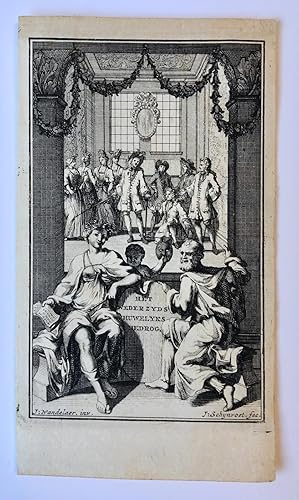
Antique title page | Het Wederzyds huwelyks bedrog, published ca. 1714, 1 p.
Seller: Antiquariaat Arine van der Steur / ILAB, Den Haag, Netherlands
Seller rating 4 out of 5 stars
Frontispiece to Pieter Langendijk's 'Het Wederzijds huwelijksbedrog,' a comedy.The frontispiece shows a scene of the play in the background, while in the front are allegorical figures, wih a putto holding a mask in his hand.Titled at bottom center and signed: 'J: Wandelaer inv. / J: Schynvoet. fec.' ca. 1714. Etching and engraving on paper, with small margins; total: 153 x 86 mm; despite some traces of wear in great condition.
-

'De inquisitie-zaal' anonieme gravure, tonende een rechtsprekend geestelijke, een griffier en een beklaagde. [EN] The room of the inquisition where a suspect is questioned by the judge. l Engraving on paper; total: 213 x 254 mm.
-
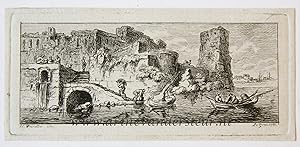
Miniature antique print I River landscape with ruined buildings on the left, published 1788, 1 p.
Seller: Antiquariaat Arine van der Steur / ILAB, Den Haag, Netherlands
Seller rating 4 out of 5 stars
Small scale copy after Weirotter's composition with a view on a river landscape with ruined buildings on the left.Signed on the bottom left: 'FE Weirotter inv.' and on the bottom right corner: 'Le Gros 1788'.On verso collector's mark of the Albertina [L.5f].[NL] Kleinschalige kopie naar Weirotters compositie met zicht op een rivierlandschap met links verwoeste gebouwen. Etching on paper with some margin; plate mark: 50 x 114 mm, total: 54 x 120 mm; on verso traces of previous mounting.
-
![Seller image for [Antique print, etching] Lion standing [set title: Receuil de Lions, series A]/Staande leeuw, published 1729. for sale by Antiquariaat Arine van der Steur / ILAB](https://pictures.abebooks.com/inventory/md/md30824111002.jpg)
[Antique print, etching] Lion standing [set title: Receuil de Lions, series A]/Staande leeuw, published 1729.
Seller: Antiquariaat Arine van der Steur / ILAB, Den Haag, Netherlands
Seller rating 4 out of 5 stars
Plate belonging to part A of the series 'Recueil de lions', showing a landscape with a lion standing, turned to the right. Carries Dürer's monogram AD at the top right. At the bottom inscribed: 'Albert Duur del. B. Picart sculp.'Lettered at the bottom left: 'A.' Numbered at the bottom right: '2.'Printed in Amsterdam, 1729; Print also used as a book illustration in Recueil de lions, dessinez d'après nature par divers maitres. Amsterdam: Bernard Picart, 1729. Etching on paper with small margins; platemark: 121 x 177 mm, total: 131 x 187 mm; traces of previous mounting on the verso, light foxing at the paper's edges, very nice impression. Les peintres français du XVIIIe siècle : histoire des vies et catalogue, Louis Dimier, vol. 1, p. 393, cat.nr. 903-946.
-
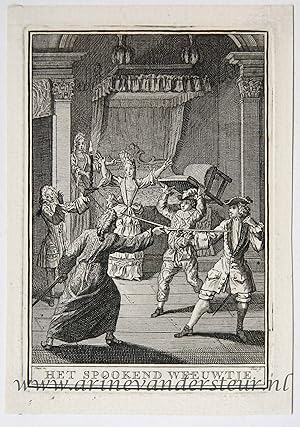
Antique title page | Het spookend weeuwtje, published 1712, 1 p.
Seller: Antiquariaat Arine van der Steur / ILAB, Den Haag, Netherlands
Seller rating 4 out of 5 stars
An elegant company in a bedroom. Two men attack each other with a sword. Another man lifts a chair over his head. Two ladies and a chamberlain look on in amazement.Titled at bottom: Het spookend weeuwtje.Signed at bottom: Picart inv. / Pool sc.Frontispiece to the comedy by Antoine Le Métel d'Ouville, published in Amsterdam in 1712.[NL] Een elegant gezelschap in een slaapvertrek. Twee mannen gaan elkaar te lijf met een degen. Een andere man tilt een stoel boven zijn hoofd. Twee dames en een kamerheer kijken verschrikt toe. Etching and engraving on paper; total: 144 x 100 mm; state II/2, traces of previous mounting on verso, otherwise in great condition.
-
![Seller image for [Antique print, etching and engraving] Allegorical composition, published 1709, 1 p. for sale by Antiquariaat Arine van der Steur / ILAB](https://pictures.abebooks.com/inventory/md/md31325810839.jpg)
[Antique print, etching and engraving] Allegorical composition, published 1709, 1 p.
Seller: Antiquariaat Arine van der Steur / ILAB, Den Haag, Netherlands
Seller rating 4 out of 5 stars
Allegorical composition with Louis XIV (? or a Marshal of France) standing before Religion, who points at a shining triangle, symbol of the Trinity; at left, a fox, and a female figure looking into a mirror and holding a snake (Prudence?); at right, a lion and a female figure leaning on a pedestal.Signed at bottom: A. Coypel jnue. B. Picart Sculp. 1709. Etching on paper with some margin; plate mark: 72 x 120 mm, total: 90 x 140 mm; despite some light rubbing in very good condition. Corners slighly folded.
-
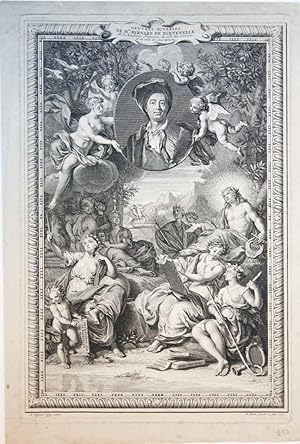
Antique title page | OEUVRES DIVERSES DE MR BERNARD DE FONTENELLE, published 1728, 1 p.
Seller: Antiquariaat Arine van der Steur / ILAB, Den Haag, Netherlands
Seller rating 4 out of 5 stars
Beautiful emblematic title print to the: 'OEUVRES DIVERSES DE MR BERNARD DE FONTENELLE' with a portrait of the poet by Rigaud, in an oval held by flying putti. On the bottom right Apollo with his lyre is looking towards the portrait, while the muses are seated in front of him. On the background Pegasus.Signed on the bottom left:'H. Rigaud Effig. pinxit.', to the right: 'B Picart invenit et fecit 1727' .Above within cartouche:'OEUVRES DIVERSES / DE M.R BERNARD DE FONTENELLE / de l'Academie Françoise, de celle des Sciences, / et de celle des inscriptions.' Inscription, Fontenelle, Illus. 1728 //.[NL] Landschap met de vrouwelijke personificaties van de zeven vrije kunsten. Boven hen vliegen putti die het portret van de schrijver Bernard de Fontenelle dragen. Op de achtergrond een putto op de rug van Pegasus. De voorstelling is gevat in een omlijsting die wordt bekroond door een cartouche waarin de titel in het Frans. Etching and engraving on paper with some margin; plate mark: 303 x 201 mm, total: 330 x 222 mm; slightly cooked paper, repaired tear above; otherwise in very good condition.
-
![Seller image for [Antique print, ornament, 1720] Ornament with deer, hunting dogs and leaf vines, published ca. 1720, 1 p. for sale by Antiquariaat Arine van der Steur / ILAB](https://pictures.abebooks.com/inventory/md/md31325814796.jpg)
[Antique print, ornament, 1720] Ornament with deer, hunting dogs and leaf vines, published ca. 1720, 1 p.
Seller: Antiquariaat Arine van der Steur / ILAB, Den Haag, Netherlands
Seller rating 4 out of 5 stars
Ornament with deer, hunting dogs and leaf vines.Print originally intended for: Figures de la Bible. Amsterdam, Bernard Picart, 1720.Print also used in: Taferelen der voornaamste geschiedenissen van het Oude en Nieuwe Testament (.) door de vermaarde kunstenaars Hoet, Houbraken, en Picart getekent (.) en met beschrijvingen uitgebreid. The Hague: Pieter de Hondt, 1728. Print may also have been used in other bibles. Etching and engraving on paper, letterpress on verso; total: 96 x 202 mm; in great condition.
-
![Seller image for [Original etching/ets by Pieter Bodart] Old man with beard / Oude man met baard. for sale by Antiquariaat Arine van der Steur / ILAB](https://pictures.abebooks.com/inventory/md/md30447160483.jpg)
[Original etching/ets by Pieter Bodart] Old man with beard / Oude man met baard.
Seller: Antiquariaat Arine van der Steur / ILAB, Den Haag, Netherlands
Seller rating 4 out of 5 stars
Bust of an old man with beard. Numbered on top right corner: '10'. Signed at bottom: 'G.Hoet del: / P.Bodart.fec'. Not in G. Hoet's 'Les principaux fondements du dessein' published in Leiden by J.A. Langerak in 1723. Etching on paper, mounted on a thick sheet of paper; plate mark: 115 x 97 mm, total: 187 x 149 mm; some dirt within plate and smudges along the margins.
-
![Seller image for [Antique print, etching and engraving] The Annunciation, published ca. 1720. for sale by Antiquariaat Arine van der Steur / ILAB](https://pictures.abebooks.com/inventory/md/md20807898636.jpg)
[Antique print, etching and engraving] The Annunciation, published ca. 1720.
Seller: Antiquariaat Arine van der Steur / ILAB, Den Haag, Netherlands
Seller rating 4 out of 5 stars
In an interior the Virgin is announced by the angel. Inscribed at the bottom in six different languages: Greek, English, German, Latin, French and Dutch.Possibly from Picart's illustrated Bible.Signed at the bottom: 'Picart delin. / Surugue sculp.' Etching and engraving on paper; plate mark: 353 x 223 mm, total: 414 x 255 mm; damaged on the bottom left, on the Greek inscription, soiled especially along the margin, stain within the plate, tear on the margin above; traces of previous mounting on the verso.
-
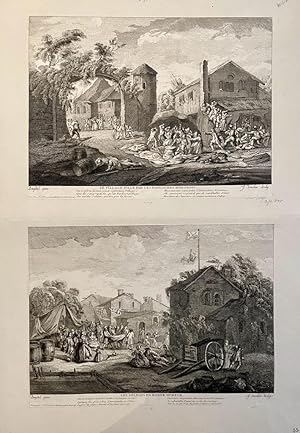
2 Antique prints, etching and engraving | Village pillé par les Pandoures Hongrois; Les soldats en bonne humeur, published 1746, 1 p.
Seller: Antiquariaat Arine van der Steur / ILAB, Den Haag, Netherlands
Seller rating 4 out of 5 stars
A rare depiction of the pillage of a village by the Trenck's Pandurs. "The Pandurs were a skirmisher unit of the Habsburg monarchy, raised by Baron Franz von der Trenck following a grant issued by Maria Theresa of Austria on 27 February 1741, permitting Trenck to raise a 1,000-strong troop. The unit was largely composed of men enlisted as volunteers from areas of the Kingdom of Slavonia and Slavonian Military Frontier, consisting of ethnic Croats and Serbs. The Pandurs saw military action in Silesia, Bohemia, Bavaria and France.[.] The Pandurs did not have specific uniformstheir clothes varied but were of Turkish style. Their oriental appearance was compounded by mandatory head shaving, leaving a rattail, as well as by the use of a horse tail bunchuk instead of a unit banner. Each Pandur carried four single-shot pistols, a fighting knife and a small knife.[.] The Pandurs earned a reputation for being brave and audacious, as well as feared and ruthless soldiers, looting and pillaging, but also characterized by disobedience, breaches of military discipline and stubbornness." (Wikipedia)The army was officially active between 1741 and 1748 and this print falls inbetween these dates: 1746.Flemish artist Karel (or Carel) Breydel painted several scenes of battles and village pillages.Plate signed and dated at bottom, with six lines of French text below: Breydel pinx. / J Vanloo Sculp.Titled: LE VILLAGE PILLE PAR LES PANDOURES HONGROIS. with six lines of text in French.The other impression is commonly found in museum's collections. Titled: LES SOLDATS EN BONNE HUMEUR, with six lines of text in French.The plates are cut within plate mark and mounted on a large sheet of paper with pencil annotations and printed numbers.[NL] Een zeldzame afbeelding van de plundering van een dorp door de Trenck's Pandurs. Ets gemaakt door Jean Baptiste Van Loo. Twee antieke prenten op 1 pagina. Een pandoer was een strijder in een militaire eenheid in het keizerlijke Oostenrijkse leger. Oorspronkelijk waren pandoeren de lijfwachten van edellieden in het Kroatië en Slavonië van de 17e en 18e eeuw. Hier zien we de Pandoeren in Hongarije. Etchings on paper, mounted on folded piece of cardboard with some inscription in pencil; prints ca. 295 x 399 mm; etchings trimmed within plate mark; in very good condition.
-
![Seller image for [Antique print, etching] Meleager and Atalanta (tapisserie of the Duc d'Orleans), published 1720, 1 p. for sale by Antiquariaat Arine van der Steur / ILAB](https://pictures.abebooks.com/inventory/md/md31325812762.jpg)
[Antique print, etching] Meleager and Atalanta (tapisserie of the Duc d'Orleans), published 1720, 1 p.
Seller: Antiquariaat Arine van der Steur / ILAB, Den Haag, Netherlands
Seller rating 4 out of 5 stars
Meleager bringing the head of the Calydonian boar to Atalanta; in ornate frame, with flowers and other animals, from a different plate. Outer plate missing. [Complete print 66962]Meleager - Atalanta - everzwijn - mythologie - Artemis Etching and engraving on paper; total: 263 x 185 mm; on the top margin two small binding holes, otherwise in great condition.
-
![Seller image for [Antique prints, ca. 1700] VERSCHEYDE T'ZAMEN-GEVLOGTE NAAM-LETTEREN OF CHIFRES ., Amsterdam Louis Renard, published ca. 1700, 11 pp. for sale by Antiquariaat Arine van der Steur / ILAB](https://pictures.abebooks.com/inventory/md/md22497829605.jpg)
[Antique prints, ca. 1700] VERSCHEYDE T'ZAMEN-GEVLOGTE NAAM-LETTEREN OF CHIFRES ., Amsterdam Louis Renard, published ca. 1700, 11 pp.
Seller: Antiquariaat Arine van der Steur / ILAB, Den Haag, Netherlands
Seller rating 4 out of 5 stars
'-- Choose binding --. Condition: '-- Choose book condition --. Title page and ten plates [9-19] of combinations of initials, in monogram.Address of the publisher at the bottom: 'Louis Renard, met Privilegie'.[NL] Combinatie van monogrammen, spiegelmonogrammen. Prachtige set. Engraving with some etching on paper; plate mark: 135 x 192 mm, total: 205 x 325 mm; frontispiece cut on the bottom plate mark, whereas the other plates have very broad margins; Bonacini 2051; Cat. Berlin 5310; cf Fuhring 13150 (title of an earlier edition).
-
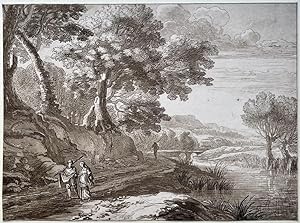
Antique printdrawing | Landscape with three travellers, published 1821, 1 p.
Seller: Antiquariaat Arine van der Steur / ILAB, Den Haag, Netherlands
Seller rating 4 out of 5 stars
Woody landscape with two travellers on a path in lower left, a third figure further down the road, a meandering river at right; a facsimile of a drawing by Herman van Swanevelt; from a series of 105 facsimiles published by Christian Josi as a continuation of Ploos van Amstel's publication; illustration to Josi's "Collection d'imitations de dessins" (London: 1821).Etching and roulette in Ploos van Amstel's technique, in brown ink.On verso: C. Brower Fecit / C:S:Ploos Excudit Amst.[NL] Italianiserend landschap met drie wandelaars. Prent naar tekening van Herman van Swanevelt gedrukt met twee platen. Prent uit serie van negen prenttekeningen met acht landschappen en een zeegezicht naar Hollandse meesters uit de 17e eeuw, zie Huffel 1921, p. 33-35. Deze serie werd door Christiaan Josi opgenomen in een uitgave met 100 werken naar Hollandse en Vlaamse meesters: Collection d'imitations de dessins d'après les principaux maîtres hollandais et flamands, Londen, C. Josi, 1821. Alle prenten in deze uitgave dragen op het verso het wapen van Cornelis Ploos van Amstel, de initiatiefnemer voor de uitgave. Printdrawing on paper; total: 163 x 221 mm; a tiny stain in the sky, in very good condition, in paper passepartout. Van Huffel 159.
-
![Seller image for [Antique print, etching] Meleager and Atalanta (tapisserie of the Duc d'Orleans), published 1720. for sale by Antiquariaat Arine van der Steur / ILAB](https://pictures.abebooks.com/inventory/md/md30793337040.jpg)
[Antique print, etching] Meleager and Atalanta (tapisserie of the Duc d'Orleans), published 1720.
Seller: Antiquariaat Arine van der Steur / ILAB, Den Haag, Netherlands
Seller rating 4 out of 5 stars
Meleager bringing the head of the Calydonian boar to Atalanta; in ornate frame, with flowers and other animals, from a different plate. Outer plate signed: 'C. le Brun pinx. / B. Picart excudit Amstelodami'. Signed also within the internal plate: 'C. le Brun pinxit B. Picart del.'Meleager - Atalanta - everzwijn - mythologie - Artemis Etching and engraving on paper; internal plate: 283 x 271 mm, total: 408 x 395 mm; despite some light yellowing in great condition. Traces of previous mounting on verso, top margin.
-
![Seller image for [Antique prints, etching, 1728] Seven etchings of lions after Rembrandt, of a set of eight, making up part F of the series 'Recueil de lions'/Zeven etsen van leeuwen naar Rembrandt, published 1728, 7 pp. for sale by Antiquariaat Arine van der Steur / ILAB](https://pictures.abebooks.com/inventory/md/md30824109288.jpg)
[Antique prints, etching, 1728] Seven etchings of lions after Rembrandt, of a set of eight, making up part F of the series 'Recueil de lions'/Zeven etsen van leeuwen naar Rembrandt, published 1728, 7 pp.
Seller: Antiquariaat Arine van der Steur / ILAB, Den Haag, Netherlands
Seller rating 4 out of 5 stars
Seven etchings of lions after Rembrandt, of a set of eight, making up part F of the series 'Recueil de lions'.The frontispiece of the series of lions shows a lion resting on the ground, carrying the title of the series: 'RECEUÏL de LIONS Dessinés d'apres nature par REMBRANDT et B. Picart qui les a gravés en 1728.' At the bottom inscribed: 'B. Picart ad Vivum del, et sculp.' Lettered at the bottom left: 'F.' Numbered at the bottom right: '1.' Etching on paper with small margins; platemark: 70 x 113 mm, total: 78 x 120 mm; traces of previous mounting on the verso.A lion standing. At the bottom inscribed: 'B. Picart ad Vivum del. et sculp.' Lettered at the bottom left: 'F.' Numbered at the bottom right: '2.' Etching on paper with small margins; platemark: 69 x 113 mm, total: 79 x 122 mm; traces of previous mounting on the verso.A lion lying on its side. At the bottom inscribed: 'B. Picart ad Vivum del. et sculp.' Lettered at the bottom left: 'F.' Numbered at the bottom right: '3.' Etching on paper with small margins; platemark: 70 x 113 mm, total: 77 x 122 mm; traces of glue and previous mounting on the verso.A lion resting on the ground. At the bottom inscribed: 'B. Picart ad Vivum del. et sculp.' Lettered at the bottom left: 'F.' Numbered at the bottom right: '4.' Etching on paper with small margins; platemark: 70 x 113 mm, total: 80 x 122 mm; traces previous mounting on the verso.A chained lion resting on the ground. At the bottom inscribed: 'Rembrand del. B. Picart sculp.' Lettered at the bottom left: 'F.' Numbered at the bottom right: '5.' Etching on paper with small margins; platemark: 71 x 107 mm, total: 82 x 119 mm; light foxing, traces of previous mounting on the verso.A lion sitting on the ground, seen from the back. At the bottom inscribed: 'Rembrand del. B. Picart sculp.' Lettered at the bottom left: 'F.' Numbered at the bottom right: '7.' Etching on paper with small margins; platemark: 70 x 113 mm, total: 79 x 122 mm; traces of previous mounting on the verso.A lion lying down feeding from a bowl, seen from the back. At the bottom inscribed: 'Rembrand del. B. Picart sculp.' Lettered at the bottom left: 'F.' Numbered at the bottom right: '8.' Etching on paper with small margins; platemark: 70 x 114 mm, total: 80 x 124 mm; light stain in the middle-left, light foxing, traces of previous mounting on the verso. Literature: Les peintres français du XVIIIe siècle : histoire des vies et catalogue, Louis Dimier, dl. 1, p. 393, cat.nr. 903-946.


![Seller image for LES // METAMORPHOSES // D'OVIDE, // EN LATIN, // TRADUITES EN FRANÇOIS, // AVEC DES REMARQUES, // ET DES // EXPLICATIONS HISTORIQUES. // PAR MR. L'ABBE BANIER,// DE L'ACADEMIE ROYALE DES INSCRIPTIONS // ET BELLES LETTRES. // Ouvrage enrichi de Figures en taille douce, // Gravées par B. PICART, & autres habiles Maitres. // TOME PREMIER [and ] [SECOND] // [vignette] // A AMSTERDAM. 2 volumes in one. First edition. for sale by Wittenborn Art Books](https://pictures.abebooks.com/inventory/md/md31259491077.jpg)


