

Order Total (1 Item Items):
Shipping Destination:

After Poisson (7 results)
Skip to main search results
Search filters
Product Type
- All Product Types
- Books (No further results match this refinement)
- Magazines & Periodicals (No further results match this refinement)
- Comics (No further results match this refinement)
- Sheet Music (No further results match this refinement)
- Art, Prints & Posters (7)
- Photographs (No further results match this refinement)
- Maps (No further results match this refinement)
- Manuscripts & Paper Collectibles (No further results match this refinement)
Condition Learn more
- New (No further results match this refinement)
- As New, Fine or Near Fine (No further results match this refinement)
- Very Good or Good (1)
- Fair or Poor (No further results match this refinement)
- As Described (6)
Binding
- All Bindings
- Hardcover (No further results match this refinement)
- Softcover (No further results match this refinement)
Collectible Attributes
- First Edition (No further results match this refinement)
- Signed (No further results match this refinement)
- Dust Jacket (No further results match this refinement)
- Seller-Supplied Images (7)
- Not Print on Demand (7)
Language (2)
Price
- Any Price
- Under US$ 25 (No further results match this refinement)
- US$ 25 to US$ 50
- Over US$ 50
Free Shipping
- Free Shipping to U.S.A. (No further results match this refinement)
Seller Location
Seller Rating
-

"Action de Graces pour le Retablissement de la Sante de Monsieur le Dauphin" - Giving thanks for the restoration of the health of the king / Ritual / Amor / Staue / statues
Language: French
Published by Paris ca. 1775., 1775
Seller: Antiquariat Steffen Völkel GmbH, Seubersdorf, Germany
Seller rating 5 out of 5 stars

Art / Print / Poster
Sehr seltener Kupferstich aus der Serie "Suite d'Estampes gravees par Madame la Marquise de Pompadour d'apres les Pierres gravées de Guay" (ca. 1775). -- Blatt-Maße: ca. 28 x 21 cm. Platte: ca. 13 x 10,5 cm. -- im Außenrand nur leicht fleckig, sonst gut erhalten. || Very rare engraving from the series "Suite d'Estampes gravees par Madame la Marquise de Pompadour d'apres les Pierres gravees de Guay" (c. 1775). -- slightly stained on the outer margin, otherwise in good condition. || Madame de Pompadour, born Jeanne Antoinette Poisson (1721 1764), was a prominent member of the French court during the 18th century. She served as King Louis XV's official mistress from 1745 to 1751, and maintained her influence as a court favorite until her death. Despite facing political opposition and struggling with poor health, Pompadour took charge of the king's schedule and acted as a valuable aide and advisor. She also secured titles of nobility for herself and her relatives, while cultivating a network of clients and supporters that notably included the Queen, Marie Leszczynska. In the 1750s, Madame de Pompadour's role in the French court evolved from that of the King's mistress to that of his trusted confidante, although she still maintained significant influence over the king, acting often as an advisor as well. She relocated to the ground floor of the Palace in 1751 and focused on patronizing the arts and overseeing new construction projects. In 1756, she played a pivotal role in the establishment of the royal porcelain factory at Sèvres and the creation of Place Louis XV (Place de la Concorde). She also convinced the King, with the help of her brother, to build the Petit Trianon. Madame de Pompadour enjoyed nurtureing her intellect and supported the publication of the first two volumes of Diderot and d'Alembert's Encyclopaedia in 1751. In 1753, Louis XV purchased the Hôtel d'Evreux (now the Elysée Palace) for Madame de Pompadour to use as a residence during her visits to Paris. She split her time between the capital and the Palace of Bellevue in Meudon until her death from tuberculosis at the age of 42 in Versailles in 1764. The King was deeply affected by her death. As a patron of the arts, Pompadour supported architecture, decorative arts, and porcelain. She was also a prominent patron of Enlightenment philosophers like Voltaire. Despite criticism from some of her contemporaries who viewed her as a malevolent political influence, modern historians generally view her more positively, highlighting her successes as a champion of French pride and as a woman who rose to power and influence despite not being born into the aristocracy. Some historians argue that Pompadour's critics were motivated by a fear of the social and gender hierarchies she challenged. // Wir, das Antiquariat Steffen Völkel, kaufen und verkaufen alte Bücher, Handschriften, Zeichnungen, Autographen, Grafiken und Fotografien. Wir sind stets am Ankauf von kompletten Bibliotheken, Sammlungen und Nachlässen interessiert. Sprache: Französisch Gewicht in Gramm: 10.
-

"Pretre Egyptien" - Egyptian priest / Ägyptischer Priester / Egypt / Ägypten
Language: French
Published by Paris ca. 1775., 1775
Seller: Antiquariat Steffen Völkel GmbH, Seubersdorf, Germany
Seller rating 5 out of 5 stars
Art / Print / Poster
Sehr seltener Kupferstich aus der Serie "Suite d'Estampes gravees par Madame la Marquise de Pompadour d'apres les Pierres gravées de Guay" (ca. 1775). -- Blatt-Maße: ca. 18 x 16 cm. Platte: ca. 35 x 10,5 cm. -- nur leicht fleckig, sonst gut erhalten. || Very rare engraving from the series "Suite d'Estampes gravees par Madame la Marquise de Pompadour d'apres les Pierres gravees de Guay" (c. 1775). -- only slightly stained, otherwise in very good condition. || Madame de Pompadour, born Jeanne Antoinette Poisson (1721 1764), was a prominent member of the French court during the 18th century. She served as King Louis XV's official mistress from 1745 to 1751, and maintained her influence as a court favorite until her death. Despite facing political opposition and struggling with poor health, Pompadour took charge of the king's schedule and acted as a valuable aide and advisor. She also secured titles of nobility for herself and her relatives, while cultivating a network of clients and supporters that notably included the Queen, Marie Leszczynska. In the 1750s, Madame de Pompadour's role in the French court evolved from that of the King's mistress to that of his trusted confidante, although she still maintained significant influence over the king, acting often as an advisor as well. She relocated to the ground floor of the Palace in 1751 and focused on patronizing the arts and overseeing new construction projects. In 1756, she played a pivotal role in the establishment of the royal porcelain factory at Sèvres and the creation of Place Louis XV (Place de la Concorde). She also convinced the King, with the help of her brother, to build the Petit Trianon. Madame de Pompadour enjoyed nurtureing her intellect and supported the publication of the first two volumes of Diderot and d'Alembert's Encyclopaedia in 1751. In 1753, Louis XV purchased the Hôtel d'Evreux (now the Elysée Palace) for Madame de Pompadour to use as a residence during her visits to Paris. She split her time between the capital and the Palace of Bellevue in Meudon until her death from tuberculosis at the age of 42 in Versailles in 1764. The King was deeply affected by her death. As a patron of the arts, Pompadour supported architecture, decorative arts, and porcelain. She was also a prominent patron of Enlightenment philosophers like Voltaire. Despite criticism from some of her contemporaries who viewed her as a malevolent political influence, modern historians generally view her more positively, highlighting her successes as a champion of French pride and as a woman who rose to power and influence despite not being born into the aristocracy. Some historians argue that Pompadour's critics were motivated by a fear of the social and gender hierarchies she challenged. // Wir, das Antiquariat Steffen Völkel, kaufen und verkaufen alte Bücher, Handschriften, Zeichnungen, Autographen, Grafiken und Fotografien. Wir sind stets am Ankauf von kompletten Bibliotheken, Sammlungen und Nachlässen interessiert. Sprache: Französisch Gewicht in Gramm: 10.
-

"Jacquot Tambour Major du Regiment du Roy" - Portrait of a drum major of the king's regiment / Militaria / military
Language: French
Published by Paris ca. 1775., 1775
Seller: Antiquariat Steffen Völkel GmbH, Seubersdorf, Germany
Seller rating 5 out of 5 stars
Art / Print / Poster
Sehr seltener Kupferstich aus der Serie "Suite d'Estampes gravees par Madame la Marquise de Pompadour d'apres les Pierres gravées de Guay" (ca. 1775). -- Blatt-Maße: ca. 18 x 15,5 cm. Platte: ca. 13 x 10,5 cm. -- gut erhalten. || Very rare engraving from the series "Suite d'Estampes gravees par Madame la Marquise de Pompadour d'apres les Pierres gravees de Guay" (c. 1775). -- in very good condition. || Madame de Pompadour, born Jeanne Antoinette Poisson (1721 1764), was a prominent member of the French court during the 18th century. She served as King Louis XV's official mistress from 1745 to 1751, and maintained her influence as a court favorite until her death. Despite facing political opposition and struggling with poor health, Pompadour took charge of the king's schedule and acted as a valuable aide and advisor. She also secured titles of nobility for herself and her relatives, while cultivating a network of clients and supporters that notably included the Queen, Marie Leszczynska. In the 1750s, Madame de Pompadour's role in the French court evolved from that of the King's mistress to that of his trusted confidante, although she still maintained significant influence over the king, acting often as an advisor as well. She relocated to the ground floor of the Palace in 1751 and focused on patronizing the arts and overseeing new construction projects. In 1756, she played a pivotal role in the establishment of the royal porcelain factory at Sèvres and the creation of Place Louis XV (Place de la Concorde). She also convinced the King, with the help of her brother, to build the Petit Trianon. Madame de Pompadour enjoyed nurtureing her intellect and supported the publication of the first two volumes of Diderot and d'Alembert's Encyclopaedia in 1751. In 1753, Louis XV purchased the Hôtel d'Evreux (now the Elysée Palace) for Madame de Pompadour to use as a residence during her visits to Paris. She split her time between the capital and the Palace of Bellevue in Meudon until her death from tuberculosis at the age of 42 in Versailles in 1764. The King was deeply affected by her death. As a patron of the arts, Pompadour supported architecture, decorative arts, and porcelain. She was also a prominent patron of Enlightenment philosophers like Voltaire. Despite criticism from some of her contemporaries who viewed her as a malevolent political influence, modern historians generally view her more positively, highlighting her successes as a champion of French pride and as a woman who rose to power and influence despite not being born into the aristocracy. Some historians argue that Pompadour's critics were motivated by a fear of the social and gender hierarchies she challenged. // Wir, das Antiquariat Steffen Völkel, kaufen und verkaufen alte Bücher, Handschriften, Zeichnungen, Autographen, Grafiken und Fotografien. Wir sind stets am Ankauf von kompletten Bibliotheken, Sammlungen und Nachlässen interessiert. Sprache: Französisch Gewicht in Gramm: 10.
-

"Victoire de Lutzelberg" - Battle of Lutterberg (1758) / Bataille de Lutzelberg / Schlacht bei Lutterberg
Language: French
Published by Paris ca. 1775., 1775
Seller: Antiquariat Steffen Völkel GmbH, Seubersdorf, Germany
Seller rating 5 out of 5 stars
Art / Print / Poster
Sehr seltener Kupferstich aus der Serie "Suite d'Estampes gravees par Madame la Marquise de Pompadour d'apres les Pierres gravées de Guay" (ca. 1775). -- Blatt-Maße: ca. 17,5 x 14,5 cm. Platte: ca. 15 x 12,5 cm. -- gut erhalten. || Very rare engraving from the series "Suite d'Estampes gravees par Madame la Marquise de Pompadour d'apres les Pierres gravees de Guay" (c. 1775). -- in very good condition. || Madame de Pompadour, born Jeanne Antoinette Poisson (1721 1764), was a prominent member of the French court during the 18th century. She served as King Louis XV's official mistress from 1745 to 1751, and maintained her influence as a court favorite until her death. Despite facing political opposition and struggling with poor health, Pompadour took charge of the king's schedule and acted as a valuable aide and advisor. She also secured titles of nobility for herself and her relatives, while cultivating a network of clients and supporters that notably included the Queen, Marie Leszczynska. In the 1750s, Madame de Pompadour's role in the French court evolved from that of the King's mistress to that of his trusted confidante, although she still maintained significant influence over the king, acting often as an advisor as well. She relocated to the ground floor of the Palace in 1751 and focused on patronizing the arts and overseeing new construction projects. In 1756, she played a pivotal role in the establishment of the royal porcelain factory at Sèvres and the creation of Place Louis XV (Place de la Concorde). She also convinced the King, with the help of her brother, to build the Petit Trianon. Madame de Pompadour enjoyed nurtureing her intellect and supported the publication of the first two volumes of Diderot and d'Alembert's Encyclopaedia in 1751. In 1753, Louis XV purchased the Hôtel d'Evreux (now the Elysée Palace) for Madame de Pompadour to use as a residence during her visits to Paris. She split her time between the capital and the Palace of Bellevue in Meudon until her death from tuberculosis at the age of 42 in Versailles in 1764. The King was deeply affected by her death. As a patron of the arts, Pompadour supported architecture, decorative arts, and porcelain. She was also a prominent patron of Enlightenment philosophers like Voltaire. Despite criticism from some of her contemporaries who viewed her as a malevolent political influence, modern historians generally view her more positively, highlighting her successes as a champion of French pride and as a woman who rose to power and influence despite not being born into the aristocracy. Some historians argue that Pompadour's critics were motivated by a fear of the social and gender hierarchies she challenged. // Wir, das Antiquariat Steffen Völkel, kaufen und verkaufen alte Bücher, Handschriften, Zeichnungen, Autographen, Grafiken und Fotografien. Wir sind stets am Ankauf von kompletten Bibliotheken, Sammlungen und Nachlässen interessiert. Sprache: Französisch Gewicht in Gramm: 10.
-
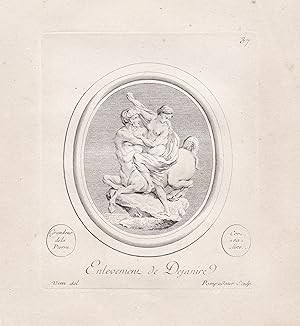
"Enlevement de Dejanire" - Abduction of Deianira / Entführung von Deianeira durch den Zentauren Nessus / mythology / Mythologie
Language: French
Published by Paris ca. 1775., 1775
Seller: Antiquariat Steffen Völkel GmbH, Seubersdorf, Germany
Seller rating 5 out of 5 stars
Art / Print / Poster
Sehr seltener Kupferstich aus der Serie "Suite d'Estampes gravees par Madame la Marquise de Pompadour d'apres les Pierres gravées de Guay" (ca. 1775). -- Blatt-Maße: ca. 18 x 15,5 cm. Platte: ca. 13 x 10,5 cm. -- gut erhalten. || Very rare engraving from the series "Suite d'Estampes gravees par Madame la Marquise de Pompadour d'apres les Pierres gravees de Guay" (c. 1775). -- in very good condition. || Madame de Pompadour, born Jeanne Antoinette Poisson (1721 1764), was a prominent member of the French court during the 18th century. She served as King Louis XV's official mistress from 1745 to 1751, and maintained her influence as a court favorite until her death. Despite facing political opposition and struggling with poor health, Pompadour took charge of the king's schedule and acted as a valuable aide and advisor. She also secured titles of nobility for herself and her relatives, while cultivating a network of clients and supporters that notably included the Queen, Marie Leszczynska. In the 1750s, Madame de Pompadour's role in the French court evolved from that of the King's mistress to that of his trusted confidante, although she still maintained significant influence over the king, acting often as an advisor as well. She relocated to the ground floor of the Palace in 1751 and focused on patronizing the arts and overseeing new construction projects. In 1756, she played a pivotal role in the establishment of the royal porcelain factory at Sèvres and the creation of Place Louis XV (Place de la Concorde). She also convinced the King, with the help of her brother, to build the Petit Trianon. Madame de Pompadour enjoyed nurtureing her intellect and supported the publication of the first two volumes of Diderot and d'Alembert's Encyclopaedia in 1751. In 1753, Louis XV purchased the Hôtel d'Evreux (now the Elysée Palace) for Madame de Pompadour to use as a residence during her visits to Paris. She split her time between the capital and the Palace of Bellevue in Meudon until her death from tuberculosis at the age of 42 in Versailles in 1764. The King was deeply affected by her death. As a patron of the arts, Pompadour supported architecture, decorative arts, and porcelain. She was also a prominent patron of Enlightenment philosophers like Voltaire. Despite criticism from some of her contemporaries who viewed her as a malevolent political influence, modern historians generally view her more positively, highlighting her successes as a champion of French pride and as a woman who rose to power and influence despite not being born into the aristocracy. Some historians argue that Pompadour's critics were motivated by a fear of the social and gender hierarchies she challenged. // Wir, das Antiquariat Steffen Völkel, kaufen und verkaufen alte Bücher, Handschriften, Zeichnungen, Autographen, Grafiken und Fotografien. Wir sind stets am Ankauf von kompletten Bibliotheken, Sammlungen und Nachlässen interessiert. Sprache: Französisch Gewicht in Gramm: 10.
-
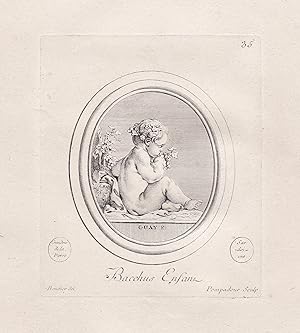
"Bacchus enfant" - Bacchus as a child / Dionysus / mythology / Mythologie
Language: French
Published by Paris ca. 1775., 1775
Seller: Antiquariat Steffen Völkel GmbH, Seubersdorf, Germany
Seller rating 5 out of 5 stars
Art / Print / Poster
Sehr seltener Kupferstich aus der Serie "Suite d'Estampes gravees par Madame la Marquise de Pompadour d'apres les Pierres gravées de Guay" (ca. 1775). -- Blatt-Maße: ca. 18 x 15,5 cm. Platte: ca. 13 x 10,5 cm. -- gut erhalten. || Very rare engraving from the series "Suite d'Estampes gravees par Madame la Marquise de Pompadour d'apres les Pierres gravees de Guay" (c. 1775). -- in very good condition. || Madame de Pompadour, born Jeanne Antoinette Poisson (1721 1764), was a prominent member of the French court during the 18th century. She served as King Louis XV's official mistress from 1745 to 1751, and maintained her influence as a court favorite until her death. Despite facing political opposition and struggling with poor health, Pompadour took charge of the king's schedule and acted as a valuable aide and advisor. She also secured titles of nobility for herself and her relatives, while cultivating a network of clients and supporters that notably included the Queen, Marie Leszczynska. In the 1750s, Madame de Pompadour's role in the French court evolved from that of the King's mistress to that of his trusted confidante, although she still maintained significant influence over the king, acting often as an advisor as well. She relocated to the ground floor of the Palace in 1751 and focused on patronizing the arts and overseeing new construction projects. In 1756, she played a pivotal role in the establishment of the royal porcelain factory at Sèvres and the creation of Place Louis XV (Place de la Concorde). She also convinced the King, with the help of her brother, to build the Petit Trianon. Madame de Pompadour enjoyed nurtureing her intellect and supported the publication of the first two volumes of Diderot and d'Alembert's Encyclopaedia in 1751. In 1753, Louis XV purchased the Hôtel d'Evreux (now the Elysée Palace) for Madame de Pompadour to use as a residence during her visits to Paris. She split her time between the capital and the Palace of Bellevue in Meudon until her death from tuberculosis at the age of 42 in Versailles in 1764. The King was deeply affected by her death. As a patron of the arts, Pompadour supported architecture, decorative arts, and porcelain. She was also a prominent patron of Enlightenment philosophers like Voltaire. Despite criticism from some of her contemporaries who viewed her as a malevolent political influence, modern historians generally view her more positively, highlighting her successes as a champion of French pride and as a woman who rose to power and influence despite not being born into the aristocracy. Some historians argue that Pompadour's critics were motivated by a fear of the social and gender hierarchies she challenged. // Wir, das Antiquariat Steffen Völkel, kaufen und verkaufen alte Bücher, Handschriften, Zeichnungen, Autographen, Grafiken und Fotografien. Wir sind stets am Ankauf von kompletten Bibliotheken, Sammlungen und Nachlässen interessiert. Sprache: Französisch Gewicht in Gramm: 10.
-

La Ressource de Jeanne Lormeau-Pleurez, pleurez, petits enfants!.
Published by [Paris: French Publisher, circa 1869]., 1869
Seller: Wittenborn Art Books, San Francisco, CA, U.S.A.
Seller rating 5 out of 5 stars
Art / Print / Poster
Condition: Good. Hand colored engraving. 170 x 115 mm. (sheet). Very Good, text on verso.Provenance: From the collection of the Late Frederick G. Ruffner, Jr., founder of Gale Research, Detroit.
